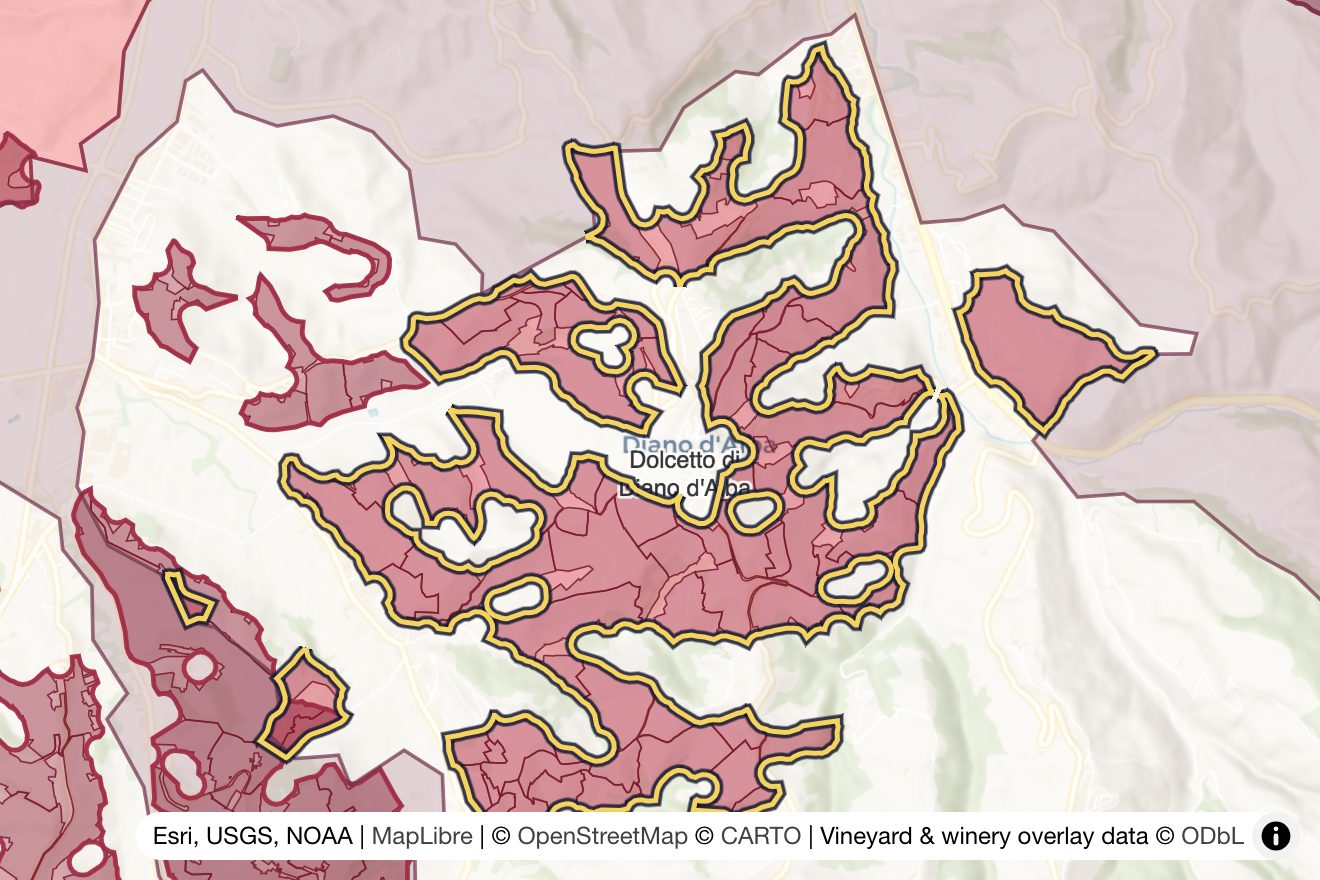
The commune's viticultural identity rests primarily not on Nebbiolo but on Dolcetto, the precocious black grape that thrives on sites considered unsuitable for Barolo's noble variety. In 1974, Diano d'Alba distinguished itself as one of the first denominations in Italy to undertake comprehensive geological study and terroir mapping of its vineyard sites: a pioneering effort that predated similar initiatives in many of Barolo's core communes. This early commitment to terroir classification resulted in the establishment of 75 Menzioni Geografiche Aggiuntive (MGAs) within the Diano d'Alba DOCG, a Dolcetto-based denomination that represents the commune's true calling card. Today, Diano d'Alba exemplifies the complex administrative geography of the Langhe, where communal boundaries, varietal suitability, and DOCG delimitations intersect to create a patchwork of overlapping wine zones.
For those seeking to understand Barolo in its entirety, Diano d'Alba warrants attention not as a source of the denomination's greatest wines, but as a case study in marginal terroir, administrative expansion, and the economic realities that have historically shaped viticulture in the Langhe hills. The commune produced only 24.3 hectares of Nebbiolo planted for Barolo production as of recent surveys: a figure that underscores its minimal contribution to the denomination's approximately 2,000-hectare total. Yet this very marginality offers insight into the boundaries of where Nebbiolo can successfully ripen and where Dolcetto becomes not merely an economic expedient but a varietal imperative.
Terroir and Geography: The Limits of Nebbiolo Suitability
Diano d'Alba's position on the northeastern edge of the Barolo zone places it at both geographic and climatic margins for Nebbiolo cultivation. The commune's vineyards extend beyond what historical producers considered the optimal Barolo growing area, occupying terrain where elevation, exposure, and soil composition converge to create conditions that favor earlier-ripening varieties. This geological and topographical reality explains why all but a western slice of Diano d'Alba was excluded from the Barolo zone, relegated instead to the Nebbiolo d'Alba DOC: a designation for wines from areas surrounding Alba that lack the intensity, structure, and aging potential of true Barolo.
The soils within Diano d'Alba's Barolo-eligible vineyards share characteristics with other northeastern Barolo sites, particularly those in the adjoining communes of Verduno, Roddi, and Grinzane Cavour, all of which were incorporated into the denomination's expanded boundaries in the early 20th century. These areas generally feature calcareous marls from the Tortonian epoch, the same geological formation that dominates La Morra and the commune of Barolo to the west. These relatively compact, more fertile soils (when compared to the Helvetian sandstone formations of Serralunga d'Alba and Monforte d'Alba) typically yield wines with softer tannins, more pronounced fruit character, and earlier accessibility.
However, the specific mesoclimates and elevations within Diano d'Alba present challenges for Nebbiolo that do not exist in more favorably situated Barolo communes. The northeastern orientation of many vineyard sites means they receive less optimal sun exposure during the critical late-season ripening period when Nebbiolo completes its famously protracted journey to phenolic maturity. Where south and southwest-facing slopes in La Morra and Barolo benefit from extended afternoon sun that facilitates the full development of Nebbiolo's complex phenolic compounds, Diano d'Alba's topography often necessitates compromises in site selection.
This is where Dolcetto reveals its economic and viticultural logic. As a variety that ripens up to four weeks before Nebbiolo, Dolcetto permits growers to exploit higher elevations and less favorably exposed sites that would struggle to ripen Nebbiolo reliably in all but the warmest vintages. In the precious Barolo and Barbaresco zones, Dolcetto is typically relegated to sites deemed inadequate for Nebbiolo, too high, too shaded, or insufficiently drained. In Diano d'Alba, this relationship inverts: Dolcetto becomes the primary crop, with Nebbiolo for Barolo confined to the commune's most privileged exposures.
The elevation range in Diano d'Alba varies considerably, with vineyards planted from approximately 250 to 500 meters above sea level. The higher-altitude sites, while offering cooling influences that preserve acidity, extend the growing season beyond what Nebbiolo can comfortably accommodate in marginal years. The commune's climate, while broadly similar to the rest of the Langhe, exhibits slightly cooler nighttime temperatures and reduced accumulated heat units compared to Serralunga d'Alba or Monforte d'Alba, where Nebbiolo achieves its most powerful and structured expressions.
The practical result of these terroir limitations is that Diano d'Alba Barolo, when it appears at all, tends toward the lighter, more immediately accessible style associated with cooler, earlier-drinking interpretations of the denomination. These are not wines built for decades of cellaring, nor do they exhibit the massive tannin structures and concentrated aromatics that define benchmark Barolo from the central communes. Rather, they occupy a qualitative position closer to superior examples of Nebbiolo d'Alba, wines that express varietal character and regional typicity without aspiring to the longevity and complexity expected from prime Barolo vineyard sites.
Historical Context: A Late and Contentious Addition
The incorporation of parts of Diano d'Alba into the Barolo DOCG represents one of the most contentious episodes in the denomination's administrative history. When the Italian Ministry of Agriculture undertook its initial delimitation work in 1896, Diano d'Alba was not included in the proposed Barolo zone. The Agricultural Commission of Alba, in its 1909 revision, added Grinzane, part of Verduno, and a section of Novello to the core townships of Barolo, La Morra, Castiglione Falletto, Serralunga d'Alba, and Monforte d'Alba. This became the official definition in 1934, establishing what producers in Barolo and Castiglione Falletto considered the authentic boundaries of the zone: a demarcation they vigorously defended as representing the true terroir of great Nebbiolo.
The 1966 DOC decree, which formalized Italy's first wave of controlled appellations, expanded Barolo's boundaries to include parts of Diano d'Alba, Roddi, and Cherasco. This expansion was immediately controversial. Traditional producers in the historic core viewed it as a dilution of Barolo's identity, an administrative error driven by political considerations rather than viticultural merit. The communes of Barolo and Castiglione Falletto, in particular, protested the additions, arguing that these peripheral areas lacked the soil composition, mesoclimate, and historical track record necessary to produce authentic Barolo.
The numbers support these concerns. Roddi has a mere 24.3 hectares planted to Nebbiolo for Barolo production; Cherasco has only 2.76 hectares. Diano d'Alba's 24.3 hectares similarly represent a negligible fraction of the denomination's total vineyard area. These figures stand in stark contrast to La Morra's approximately 550 hectares, Serralunga d'Alba's 360 hectares, or Monforte d'Alba's 300 hectares dedicated to Barolo production.
Defenders of the expansion point to the quality achievements of a new generation of producers who have demonstrated that conscientious viticulture and modern winemaking can extract genuine quality from these marginal sites. However, even the most sympathetic assessments acknowledge that Diano d'Alba Barolo occupies a qualitative tier below wines from the denomination's established geographic core. The historical controversy surrounding the commune's inclusion reflects broader tensions within Italian wine law between geographic expansion (often motivated by economic concerns and local political pressure) and quality-focused delimitation based on demonstrated terroir superiority.
Dolcetto di Diano d'Alba DOCG: The Commune's True Identity
While Diano d'Alba's role in Barolo production remains minimal, the commune has established itself as one of Piedmont's premier sources of Dolcetto through the Diano d'Alba DOCG (officially Dolcetto di Diano d'Alba DOCG). This denomination, distinct from the broader Dolcetto d'Alba DOC that covers 25 communes surrounding Alba, represents a quality tier specifically reserved for Dolcetto from Diano d'Alba's classified vineyards.
The 1974 geological study and terroir mapping that established Diano d'Alba's 75 MGAs was groundbreaking for its time, predating similar classification efforts in much of the Langhe by decades. These MGAs must meet the same requirements as Superiore wines, which demand higher minimum alcohol levels and extended aging. For Diano d'Alba DOCG, Normale wines require 2-3 months of aging, while Superiore bottlings must age a minimum of 10 months before release. These regulations place Diano d'Alba Dolcetto among the most strictly governed expressions of the variety in Piedmont.
The terroir mapping identified geological subzones and specific vineyard sites with distinct characteristics, acknowledging that even within a single commune, variations in soil composition, elevation, and exposure create meaningful differences in wine style. The 75 MGAs represent an unusually granular classification system, particularly for a Dolcetto-based denomination: a recognition that this variety, often dismissed as a simple quaffing wine, can express genuine terroir character when grown on appropriate sites and treated with ambition.
Dolcetto's viticultural characteristics make it ideally suited to Diano d'Alba's terrain. The variety's early ripening habit (typically a full month before Nebbiolo) allows it to complete its cycle before autumn rains and cooling temperatures threaten grape health and sugar accumulation. This precocity permits cultivation on higher-elevation sites and north-facing slopes where Nebbiolo would struggle. In the economic calculus of Langhe viticulture, Dolcetto serves a crucial role: it provides income while Nebbiolo-based wines undergo their mandated extended aging periods. Unlike Barbera, which increasingly commands respect and cellar time in its own right, Dolcetto remains overwhelmingly a wine for early consumption, typically released within months of harvest.
The best expressions of Diano d'Alba Dolcetto display the variety's characteristic deep purple color, vibrant acidity, and flavors of dark plums, black cherries, and almonds, often with a distinctive bitter twist on the finish. The Superiore wines, with their extended aging and stricter production standards, achieve greater depth and complexity while maintaining Dolcetto's essential freshness and drinkability. These wines rarely improve beyond five years of age, but they offer immediate pleasure and represent genuine expressions of place, wines that could not be produced with the same character on different soils or in different mesoclimates.
For visitors and students of Piedmontese wine, Diano d'Alba's Dolcetto represents an accessible entry point into MGA classification and terroir variation. The 75 designated sites provide opportunities to taste and compare wines from different elevations, aspects, and soil compositions, educational experiences typically reserved for Nebbiolo in Barolo and Barbaresco, but here available at more approachable price points and without the cellaring time required for Nebbiolo-based wines to reveal their character.
Wine Style and Characteristics: Barolo at the Margins
The limited Barolo production from Diano d'Alba tends toward the lighter, more aromatic style associated with Tortonian marl soils and cooler growing conditions. These wines typically display pronounced floral aromatics (rose petals, violets, and dried herbs) alongside red fruit notes of cherry, raspberry, and cranberry. The tannin structure, while present, lacks the massive, gripping intensity found in Serralunga d'Alba or the more powerful expressions from Monforte d'Alba. Acidity remains high, as expected from Nebbiolo, but the overall impression is one of elegance and accessibility rather than power and concentration.
In optimal vintages, warm, dry years like 2015, 2016, or 2019, Diano d'Alba Barolo can achieve impressive ripeness and balance, expressing classic Nebbiolo character with sufficient structure for medium-term aging of 10-15 years. These wines find their place alongside lighter expressions from La Morra or Verduno, offering early pleasure while maintaining the denomination's essential identity. In cooler or more challenging vintages, however, the wines can struggle with incomplete ripeness, displaying vegetal notes, harsh tannins, and insufficient concentration to justify the Barolo designation.
The comparison to Nebbiolo d'Alba is instructive. The Nebbiolo d'Alba DOC encompasses areas surrounding Alba deemed unsuitable for Barolo or Barbaresco production, including the southern sections of Monforte d'Alba and Novello, the northeastern tip of La Morra, all but a western slice of Diano d'Alba, and the northern parts of Verduno, Grinzano Cavour, and Roddi. Most Nebbiolo d'Alba comes from the Roero hills north of the Tanaro River, where sandier soils yield softer, less intense wines that mature more quickly than Barolo. The best Nebbiolo d'Alba offers genuine varietal character at lower price points, with aging requirements of just 26 months (versus 38 for Barolo) reflecting its earlier-drinking style.
Diano d'Alba Barolo exists in the uncomfortable middle ground between true Barolo from privileged sites and honest Nebbiolo d'Alba that makes no pretense to grandeur. The wines carry Barolo's premium pricing and elevated expectations but often deliver qualitative experiences closer to superior Nebbiolo d'Alba. This positioning creates challenges in the marketplace, where consumers reasonably expect that any wine labeled Barolo will demonstrate the structure, complexity, and longevity that justify the denomination's prestige and cost.
Stylistically, Diano d'Alba Barolo pairs most naturally with lighter Piedmontese cuisine: vitello tonnato, tajarin with butter and sage, lighter preparations of game birds, and younger cheeses. These wines lack the tannic heft to stand up to the braised meats and aged cheeses that traditional Barolo from Serralunga d'Alba handles with ease. Served slightly cooler than powerful Barolo, around 16-17°C rather than 18-19°C, Diano d'Alba expressions can showcase their aromatic complexity and prevent any tannic astringency from dominating the palate.
Notable Producers: Quality from Marginal Terrain
Given the limited Barolo production from Diano d'Alba, few producers have built reputations specifically on wines from this commune. The 24.3 hectares of Nebbiolo planted for Barolo production are distributed among multiple growers, many of whom farm small parcels and sell grapes to négociants or cooperative wineries. Unlike La Morra or Serralunga d'Alba, where single-commune or single-vineyard Barolo bottlings are common and commercially significant, Diano d'Alba Barolo typically appears as a minor component in multi-commune blends or as curiosities in the portfolios of producers with more significant holdings elsewhere.
The commune has achieved greater recognition through its Dolcetto production, where serious growers have demonstrated that Diano d'Alba can produce some of Piedmont's most structured and ageworthy expressions of the variety. Producers focusing on Superiore and MGA-designated Dolcetto have elevated the commune's reputation, even as its contribution to Barolo remains marginal. These estates employ the same viticultural rigor and cellar practices (temperature-controlled fermentation, careful oak integration, minimal intervention) that characterize modern Piedmontese winemaking across all varieties and denominations.
For producers working in Diano d'Alba, the economic calculus typically prioritizes Dolcetto, which can be harvested, vinified, and sold within months, providing crucial cash flow. Nebbiolo for Barolo, with its 38-month minimum aging requirement (18 months in oak) and the additional bottle aging necessary before wines reach market readiness, represents a significant financial commitment. Only estates with sufficient capital and diversified portfolios can afford to hold Barolo in cellar for the extended periods required. This economic reality partially explains why Diano d'Alba has not developed the producer culture and quality obsession that characterizes Barolo's historic communes.
The new generation of producers referenced in the historical context (those who demonstrate that quality can be achieved from Diano d'Alba's Barolo vineyards) work primarily through meticulous site selection, aggressive yield management, and careful harvest timing. By restricting production to the commune's most favorable exposures, maintaining vine age to ensure deep rooting and natural yield limitation, and picking at optimal phenolic ripeness (sometimes requiring late October or early November harvest in cooler years), these producers extract the maximum potential from marginal terrain. The results, while respectable, rarely achieve the complexity and longevity that define benchmark Barolo from more privileged sites.
Visiting Diano d'Alba: Practical Considerations
Diano d'Alba lies approximately 8 kilometers northeast of Alba, easily accessible via the SP3 provincial road. The commune occupies rolling hillside terrain characteristic of the Langhe, with vineyards interspersed among hazelnut groves: a reminder that viticulture represents just one component of the region's agricultural economy. Unlike Barolo or La Morra, where wine tourism infrastructure has developed extensively with numerous tasting rooms, restaurants, and luxury accommodations, Diano d'Alba retains a quieter, more agricultural character.
For wine tourists, Diano d'Alba functions primarily as a detour or secondary destination rather than a focal point. The commune lacks the architectural landmarks and panoramic vineyard vistas that draw visitors to Serralunga d'Alba's castle or La Morra's belvedere. Winery visits typically require advance appointments, and English-speaking staff may be less common than in the main Barolo communes where international tourism drives significant business. However, this relative obscurity can offer advantages: less crowded tasting experiences, more personal interactions with producers, and the opportunity to discover Dolcetto's quality potential beyond its reputation as a simple table wine.
The ideal time to visit Diano d'Alba follows the general Langhe rhythm: spring (April-May) offers flowering vineyards and mild weather; autumn (September-October) provides harvest energy and the truffle season's culinary excitement; winter (January-March) allows for quiet contemplation and access to newly released wines. Summer visits, while pleasant, coincide with tourist peaks in nearby Alba and the main Barolo communes, when producer availability decreases and the region's restaurants and hotels operate at capacity.
Conclusion: Marginality as Perspective
Diano d'Alba's position within the Barolo denomination illuminates the tensions between historical delimitation and administrative expansion, between terroir-based quality hierarchies and economic pressures for inclusion. The commune produces a negligible quantity of Barolo from sites that represent the denomination's geographic and qualitative margins, wines that carry the prestigious designation but rarely achieve the complexity and longevity expected from the name. This marginality, however, offers perspective on what makes Barolo's core communes exceptional: the specific combination of soil, mesoclimate, and elevation that permits Nebbiolo to ripen fully and consistently, developing the phenolic complexity and structural intensity that justify extended aging and premium pricing.
For students of Piedmontese wine, understanding Diano d'Alba's relationship to Barolo deepens appreciation for how fine-grained the distinctions between great and merely good vineyard sites can be. The commune's true achievement lies not in its minimal Barolo production but in its pioneering terroir classification work for Dolcetto and its demonstration that serious viticulture and winemaking can elevate even precocious, early-drinking varieties into expressions of genuine place. The 75 MGAs within the Diano d'Alba DOCG represent an ambition and precision typically reserved for noble varieties: an acknowledgment that terroir matters regardless of grape variety or market prestige.
In the broader context of Barolo, Diano d'Alba serves as a reminder that boundaries matter, that not all Nebbiolo vineyards merit inclusion in Italy's most prestigious denominations, and that peripheral areas, however conscientiously farmed, rarely equal the qualitative achievements possible on truly privileged sites. This is not a romantic conclusion, but it is an honest one, and honesty about terroir and its limitations remains the foundation of any meaningful wine classification system.