Introduction
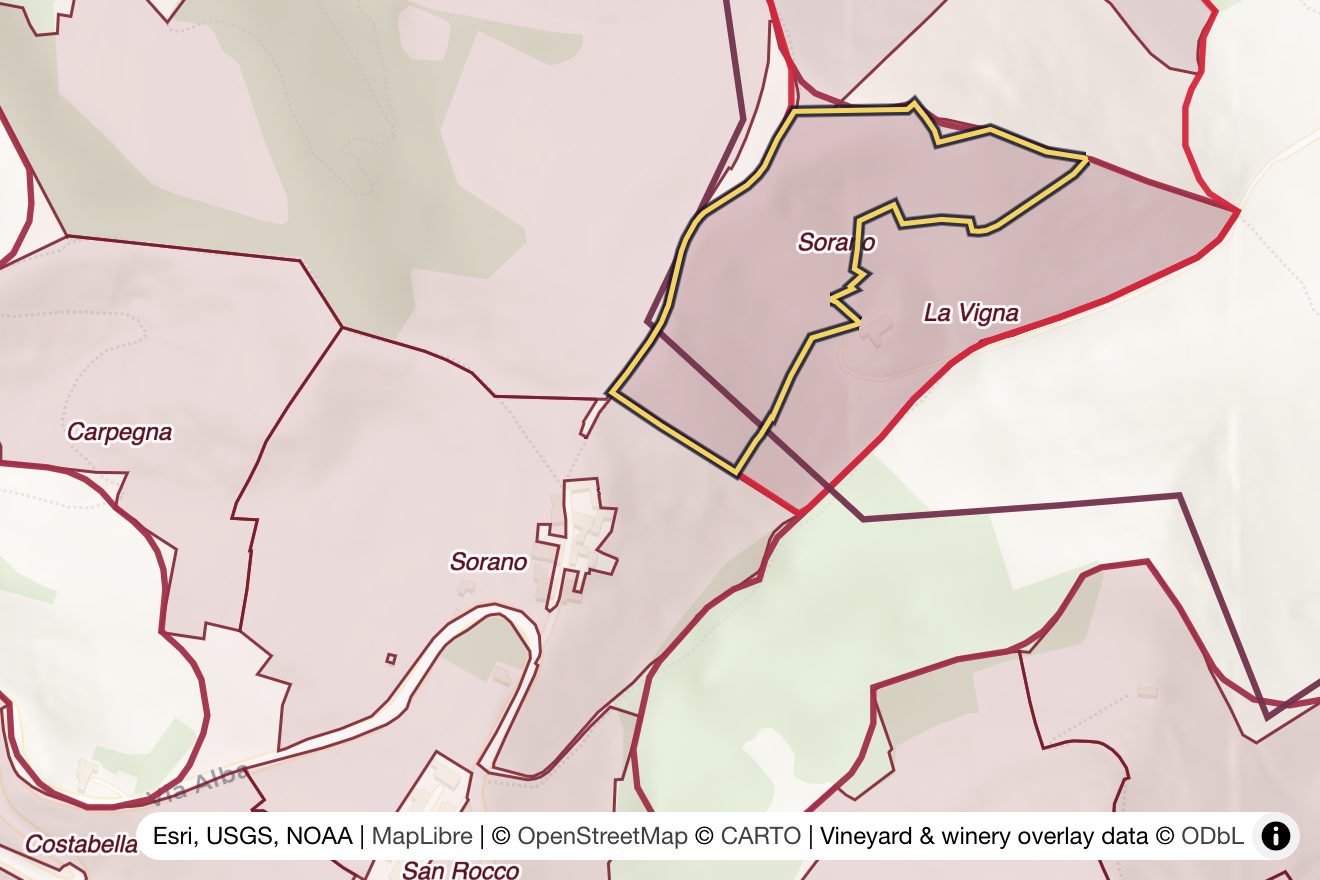
The introduction of the MGA system in 2010 represented a watershed moment for Barolo, formalizing what had been centuries of informal recognition of specific vineyard sites. While the system stopped short of creating a Burgundian-style hierarchical classification, it established an official registry of recognized crus throughout the denomination. Sorano, as a designated MGA straddling Serralunga d'Alba and Diano d'Alba, thus occupies a legally defined position within this framework, though it remains among the lesser-known sites compared to the celebrated vineyards of La Morra, Serralunga d'Alba, or Castiglione Falletto.
Geographic and Administrative Context
The situation of Diano d'Alba within the Barolo zone merits careful attention, as it fundamentally shapes the character and market perception of its wines. As documented in the official Barolo regulations, "all but a western slice of Diano d'Alba" has been excluded from the Barolo DOCG zone.
This geographic positioning places Sorano in proximity to the communes of Verduno and Grinzano Cavour, which similarly have portions both within and outside the Barolo zone. The Roero hills, across the River Tanaro from the Langhe, have sandier soils (soils that "yield wines that are softer, less intense, and faster maturing than a Barolo or a Barbaresco." The areas of Diano d'Alba qualifying for Barolo designation, however, would possess different soil characteristics more aligned with the denomination's requirements for structure and aging potential.
Terroir Considerations
While specific documentation of Sorano's precise soil composition and microclimate remains limited in readily available sources, we can establish certain parameters based on its location and the general geological structure of the Barolo zone. The denomination is characterized primarily by two major soil types corresponding to different geological epochs. The older Tortonian formations, with their higher clay content mixed with sand and limestone marls, tend to produce "softer, fruitier, aromatic wines." The younger Helvetian epoch soils, with their higher proportion of compressed sandstone and lower fertility, yield "more intense, structured wines that mature more slowly."
The positioning of Diano d'Alba's Barolo-classified areas suggests these vineyards likely share geological characteristics with neighboring communes rather than the sandier Roero formations that dominate the excluded portions of Diano. The physical attributes of soil) rather than chemical composition (have been demonstrated to exert the primary influence on wine quality in prestigious regions. As Professor Gérard Seguin's foundational research established, high-quality wine soils across diverse geological types share common physical characteristics: "moderate fertility and well-regulated, moderately sufficient water" supply.
The manner in which vine roots navigate the complex vertical layering of soil strata proves crucial to both water access and nutrient uptake throughout the growing season. In the Barolo zone specifically, these physical soil characteristics interact with the region's continental climate) characterized by hot summers, cold winters, and the moderating influence of morning fog during the autumn ripening period (to create conditions suitable for the late-ripening Nebbiolo grape.
Elevation and aspect, both critical components of site quality in marginal climates, would significantly influence Sorano's expression. The Langhe hills, where Barolo is produced, feature elevations typically ranging from 200 to 450 meters, with southern and southwestern exposures generally preferred for optimal ripening of Nebbiolo. The specific elevation and orientation of Sorano would profoundly affect both diurnal temperature variation and sun exposure, parameters that directly influence phenolic ripeness and aromatic development.
Wine Character and Style
Barolo from Sorano, which straddles Serralunga d'Alba and Diano d'Alba, would be expected to reflect certain fundamental characteristics of the denomination while potentially displaying distinctive site-specific qualities. All fine Barolo shares certain defining traits: "colour that is never deep (for Nebbiolo, like Pinot Noir, never produces opaque wines), ruby tending relatively rapidly to garnet or brick; and complex and expansive aromas of cherries and plums, evolving with time into dried cherries, rose petals, tar, liquorice."
The wine style from Diano d'Alba's Barolo sites has historically occupied a somewhat intermediate position within the denomination's spectrum. The commune's location and geology would likely produce wines that balance approachability with structure) neither as immediately accessible as some La Morra crus nor as powerfully structured as the wines from Serralunga d'Alba's Helvetian soils. This positioning could prove advantageous in contemporary markets increasingly valuing elegance and drinkability over sheer power.
The influence of terroir on wine expression is particularly pronounced in marginal climates like those of the Langhe, where vintage variation and site-specific characteristics manifest more dramatically than in warmer regions. This climatic reality means that Sorano's specific mesoclimate (its exposure, altitude, and air drainage patterns) would significantly impact both ripening consistency and aromatic profile across vintages.
Production and Market Position
The MGA system's implementation has had "the paradoxical result of focusing attention on and reinforcing confidence in single producers" rather than creating a vineyard hierarchy independent of winemaker reputation. For lesser-known MGAs like Sorano, this reality means that producer identity carries particular weight. Without the established reputation of a Brunate, Cannubi, or Bussia, wines from Sorano must prove themselves through consistent quality and distinctive character rather than relying on site recognition alone.
The current dynamics of Barolo production reveal significant pressure on vineyard land, with Langhe Nebbiolo experiencing remarkable commercial success "as a kind of economy Barolo." This phenomenon has reduced the proportion of fruit that historically might have entered Barolo production, as growers find strong markets for wines carrying the more accessible Langhe denomination. For MGAs in less celebrated communes, this trend presents both challenges and opportunities: reduced volume may enhance exclusivity, while the need to command appropriate price premiums for Barolo DOCG becomes more pressing.
Producers working in Diano d'Alba's Barolo-classified areas face the additional challenge of consumer confusion regarding the commune's split status. Educational efforts must clarify that wines labeled as Barolo from Diano d'Alba MGAs like Sorano come from areas that fully meet the denomination's strict requirements, despite the majority of the commune falling outside the zone.
Historical Context and Evolution
The delineation of Barolo DOCG boundaries has evolved through careful study of which areas consistently produce wines with the structure, aromatics, and aging potential that define the denomination. The exclusion of most Diano d'Alba from Barolo status reflects this rigorous approach to delimitation, prioritizing wine quality criteria over administrative or political convenience.
Historical documentation of specific vineyard sites in the Langhe stretches back centuries, with written traditions from Lorenzo Fantini in the late 19th century through modern scholars like Renato Ratti and Alessandro Masnaghetti establishing which sites commanded premium prices and critical recognition. The oral traditions of the zone, "made concretely significant by the higher prices paid by négociants for the grapes and wines of certain vineyards," created an informal classification long before the MGA system's formalization.
While Sorano does not appear among the most frequently cited historical crus, those "privileged positions" that have "long enjoyed greater prestige", its inclusion in the official MGA registry acknowledges its capacity to produce distinctive Barolo worthy of single-vineyard designation. The development of site-specific bottlings has accelerated dramatically since the 1980s, as producers increasingly emphasized terroir expression over the blended house Barolos that dominated earlier eras.
Conclusion
Sorano MGA represents the complex interplay of terroir, regulation, and market dynamics that characterizes contemporary Barolo. Straddling Serralunga d'Alba and Diano d'Alba, it produces wines that must balance the denomination's quality requirements with the challenge of building recognition in an increasingly crowded field of single-vineyard bottlings. For those willing to explore beyond Barolo's most celebrated names, MGAs like Sorano offer the potential to discover distinctive expressions of Nebbiolo at potentially more accessible price points, though always filtered through the skill and vision of the producers who farm these sites. As the Barolo denomination continues to refine its identity in global markets, the trajectory of lesser-known MGAs will reveal much about whether site or producer ultimately determines reputation in one of Italy's most tradition-bound wine regions.