Introduction
The introduction of the MGA system represented a significant development for Barolo, providing an official registry of single vineyards throughout the zone. While these designations do not constitute a formal classification of quality, they officially recognize these sites as distinct "crus" and allow producers to indicate vineyard origin on their labels.
Geographic and Administrative Context
Diano d'Alba's relationship with the Barolo zone reflects the complex administrative and viticultural boundaries that characterize this historic wine region. The commune's partial inclusion in Barolo DOCG (with most of its territory relegated to Nebbiolo d'Alba production) speaks to the strict delimitation standards that have governed Barolo since its formalization. The areas excluded from Barolo designation, which encompass much of Diano d'Alba along with portions of other communes including southern Monforte d'Alba and Novello, the northeastern tip of La Morra, and northern sections of Verduno, Grinzano Cavour, and Roddi, produce Nebbiolo d'Alba DOC wines that are typically softer, less intense, and faster-maturing than Barolo.
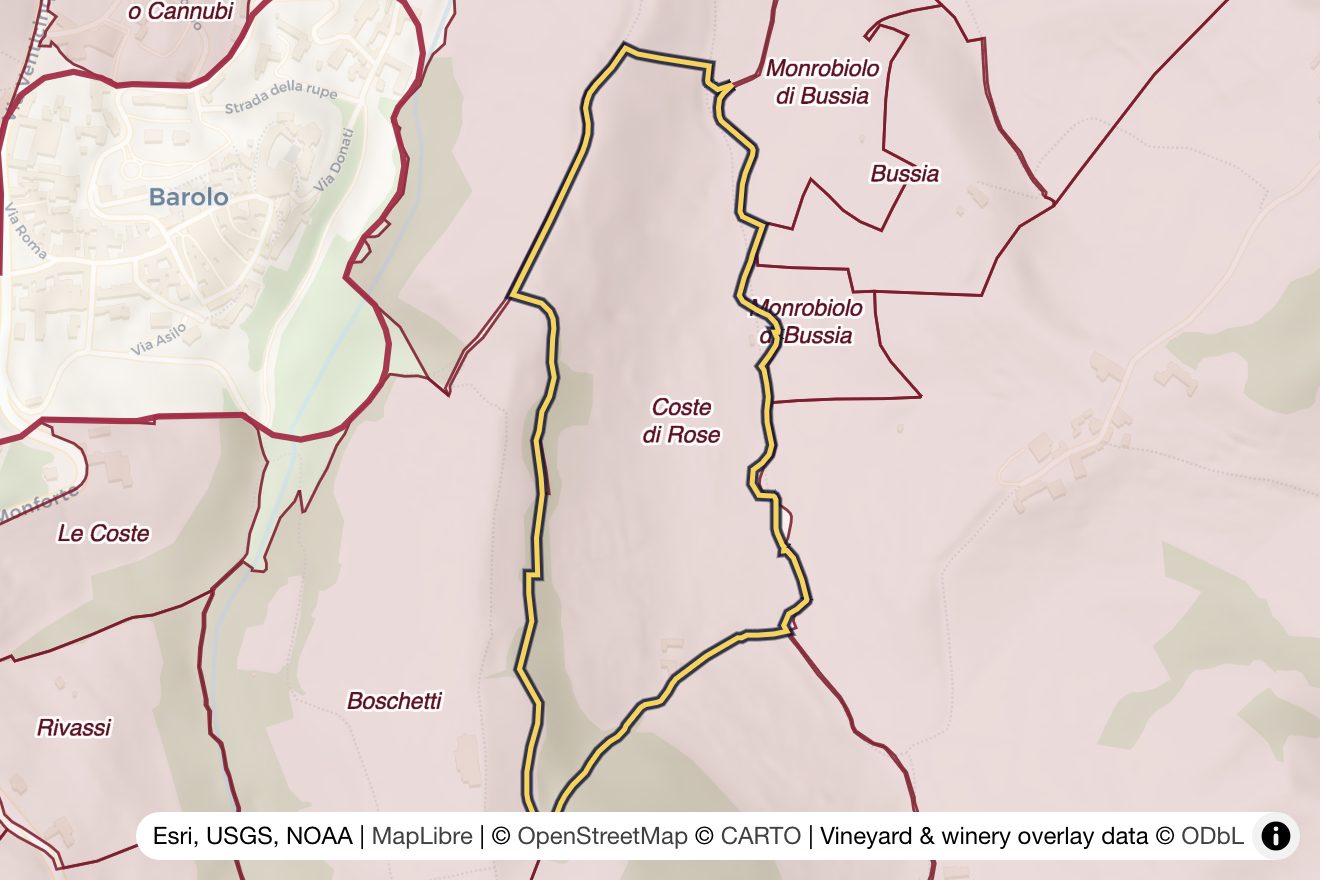
The western slice of Diano d'Alba that does qualify for Barolo production represents terroir deemed suitable for the more rigorous demands of this prestigious denomination. Coste di Rose, as a registered MGA within this approved zone, benefits from this official recognition .
The MGA System and Single-Vineyard Recognition
The proliferation of single-vineyard bottlings beginning in the 1980s created both opportunity and confusion in Barolo. In the absence of an official classification system, individual producers became the primary guarantors of quality, with reputations built on specific holdings and winemaking philosophies. The MGA system, while not resolving all questions of hierarchy and quality, provided structure to this fragmented landscape.
Historical recognition of Barolo's finest sites (documented in sources ranging from Lorenzo Fantini's late 19th-century writings to modern authorities including Luigi Veronelli, Renato Ratti, and Alessandro Masnaghetti) has traditionally focused on a relatively narrow list of crus. These include Rocche dell'Annunziata, Brunate, and Cerequio in La Morra; Cannubi and Sarmazza in Barolo commune; Rocche di Castiglione, Villero, and Monprivato in Castiglione Falletto; Bussia, Ginestra, and previously Santo Stefano di Perno in Monforte d'Alba; and Francia, Lazzarito, Ceretta, Arione, and Vignarionda in Serralunga d'Alba.
Terroir Considerations
Coste di Rose's soils are sandy, dominated by the Arenarie di Diano sandstone formation, and the terroir principles that govern quality wine production provide a framework for understanding any Barolo MGA. Soil characteristics can vary dramatically even within a single vineyard, both vertically through different strata and horizontally across the site. These variations influence water availability, nutrient access, and ultimately vine behavior and wine quality.
Research in Bordeaux and other quality wine regions has demonstrated that diverse soil types can produce excellent wines when they share certain fundamental characteristics: moderate fertility and well-regulated, moderately sufficient water supply. The specific geological and pedological features of individual Barolo MGAs (whether in Diano d'Alba or elsewhere) must be evaluated within this broader understanding of how soil, climate, and viticulture interact to influence vine physiology and grape ripening.
The aspect and elevation of vineyard sites within the Langhe hills create meaningful variation in microclimate, sun exposure, and temperature patterns. These factors, combined with soil composition and drainage, establish the parameters within which Nebbiolo expresses itself. The name "Coste di Rose" itself (suggesting slopes or hillsides) indicates the site's topographical character, with slopes facing east to southeast.
Current Production Context
The contemporary landscape of Barolo production reflects significant economic pressures that have reshaped vineyard composition throughout the zone. The extraordinary commercial success of Langhe Nebbiolo (marketed effectively as an accessible, earlier-drinking alternative to Barolo) has led many producers to dedicate vineyard land to this denomination rather than pursuing Barolo classification. This phenomenon affects communes throughout the Barolo zone, including Diano d'Alba, where the division between Barolo-eligible and Nebbiolo d'Alba territory already creates complexity in production decisions.
The economic incentives favoring Nebbiolo extend beyond the Langhe, with neighboring denominations such as Monferrato recently modifying regulations to permit Nebbiolo on labels, despite fierce protests from Barolo producers concerned about maintaining the variety's prestige and price levels.
For MGAs in relatively less prominent communes like Diano d'Alba, these market dynamics create both challenges and opportunities. While they may lack the immediate name recognition of celebrated sites in La Morra or Serralunga d'Alba, they offer producers the possibility of creating distinctive wines at price points that can be more accessible while still maintaining the quality standards and aging potential expected from Barolo.
Recognition and Documentation
Alessandro Masnaghetti's comprehensive cartographic and analytical work on Barolo's MGAs, documented in Barolo MGA: The Barolo Great Vineyards Encyclopedia, represents the most thorough modern effort to map and characterize the zone's individual sites. While Masnaghetti has attempted his own unofficial classification system, the MGAs themselves remain officially unranked, leaving questions of relative quality and prestige to be determined by critical consensus, market reception, and time.
For lesser-known MGAs, this absence of official hierarchy means that reputation must be built through consistent quality in the bottle and the dedicated work of producers committed to expressing the particular character of their sites. The multiplicity of single-vineyard bottlings that has characterized Barolo since the 1980s has paradoxically reinforced the importance of individual producers rather than vineyard sites alone (a reality that continues to shape how wines from places like Coste di Rose are evaluated and understood.
Conclusion
Coste di Rose represents a thread in the complex tapestry of Barolo's MGA system) a officially recognized site in the commune of Barolo. While detailed information about this specific vineyard's characteristics remains limited in accessible sources, its existence as a registered MGA indicates official recognition of its suitability for producing wine under the Barolo designation.
The broader context of the economic pressures shaping Nebbiolo production throughout Piedmont, and the ongoing project of understanding and communicating the terroir of individual sites all inform how we approach lesser-documented MGAs. For wine enthusiasts and professionals seeking to understand the full scope of Barolo production beyond its most famous names, sites like Coste di Rose merit attention proportional to the quality demonstrated in the bottle: the ultimate arbiter of any vineyard's merit.