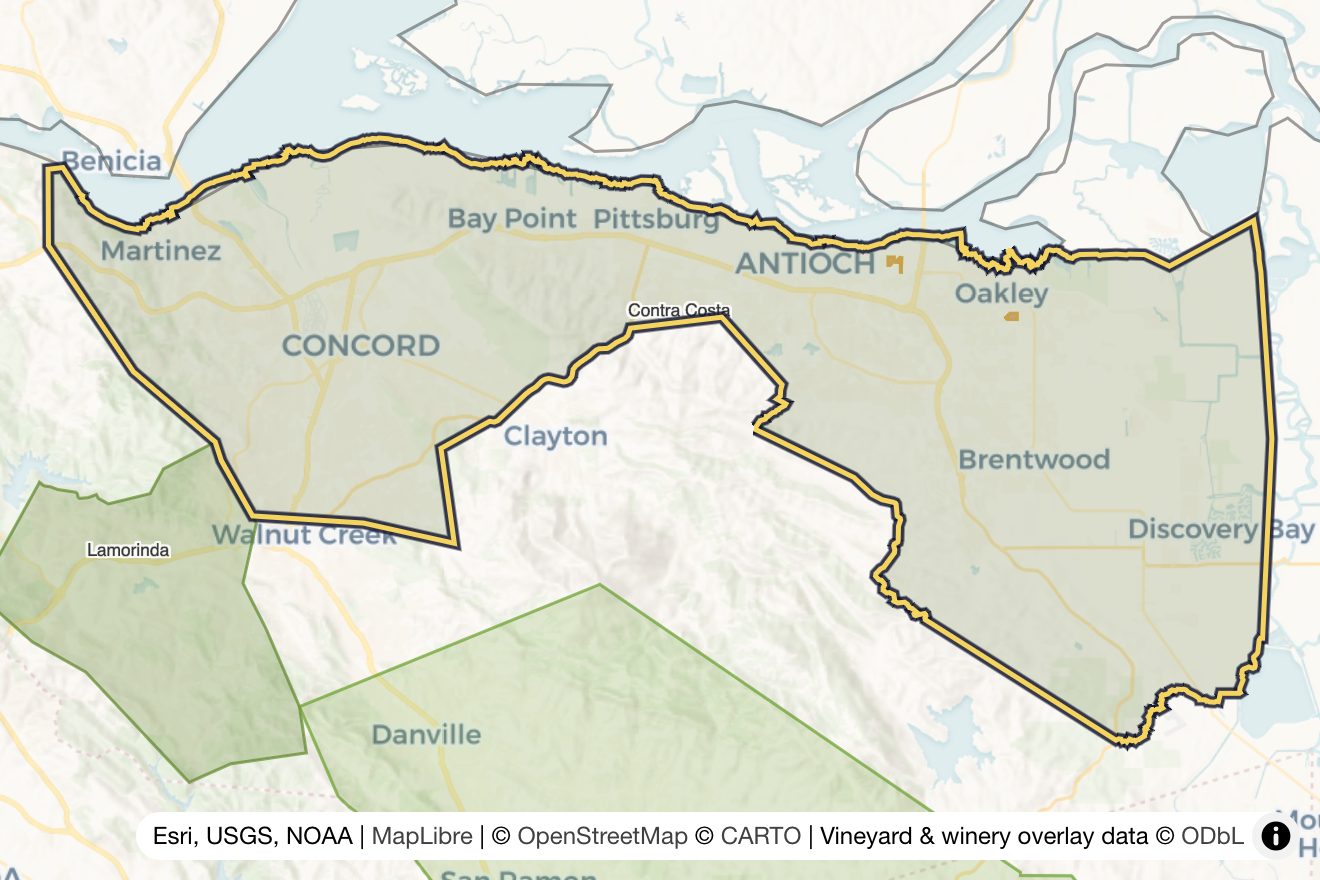
Overview
Contra Costa County lies east of San Francisco Bay, where the Sacramento-San Joaquin Delta meets the East Bay. Its significance in California wine rests on a small surviving band of old vineyards around Oakley and Antioch: own-rooted plantings of Mourvèdre, Zinfandel and Carignane in deep sand, some dating to the 1890s, that constitute one of the state's most important reserves of pre-Prohibition vine material. The county has no AVA of its own beyond the broad Central Coast and San Francisco Bay designations, and its acreage has contracted steadily under suburban development.
History
Portuguese and Italian farming families planted the Oakley sands in the late nineteenth century, choosing varieties suited to dry-farming in a hot district: Mourvèdre, then known locally as Mataro, Zinfandel and Carignane, along with smaller amounts of Palomino, Muscat and Alicante Bouschet. The deep, phylloxera-resistant sand allowed own-rooted vines, and blocks planted before 1900 remain in production. The district supplied bulk and home winemakers for most of the twentieth century until Rhône-focused producers rediscovered it in the 1980s and 1990s, when Cline Cellars, founded at Oakley, and buyers such as Bonny Doon brought the fruit into the fine wine market. Old-vine specialists have since made the surviving sites, Evangelho, Del Barba and Salvador among them, recognized vineyard names.
Terroir & Climate
The Oakley district sits on aeolian sand deposits, tens of feet deep in places, over the eastern edge of the Delta. The sand's poverty limits vigor and its structure blocks phylloxera, permitting ungrafted vines of great age. The climate is hot by Bay Area standards but moderated daily by strong marine and Delta winds that funnel through the Carquinez Strait; warm days, breezy afternoons and sandy dry-farmed soils produce moderate yields of concentrated, high-acid fruit.
Grape Varieties & Wine Styles
Mourvèdre is the district's flag: old-vine Oakley Mourvèdre gives mid-weight, savory reds of red fruit, earth and meat, prized for balance rather than power. Zinfandel from the sands runs bright and spicy, Carignane deep and fresh-edged; the three appear varietally and in traditional field-blend style. Small lots of white and fortified material from the historic mix persist. Because the county lacks its own AVA, labels typically carry Contra Costa County as the origin, with the vineyard name doing the finer work.
Notable Producers
Cline Cellars built its early reputation on the Oakley plantings before relocating operations to Carneros. The fruit now anchors bottlings from old-vine specialists including Bedrock Wine Co., Turley, Neyers and a number of small Rhône-minded producers; the Evangelho vineyard, farmed for decades by the Evangelho family and now under specialist stewardship, is the best known single site.
What to Know
Contra Costa is a county designation, not an AVA, and its importance is out of proportion to its size: a few hundred acres of ancient, own-rooted, dry-farmed vines in sand. The district is a living archive of nineteenth-century California field planting, and its principal threat is real estate rather than vine disease. Vineyard-designated bottlings from the Oakley sands are the reliable route to its character.