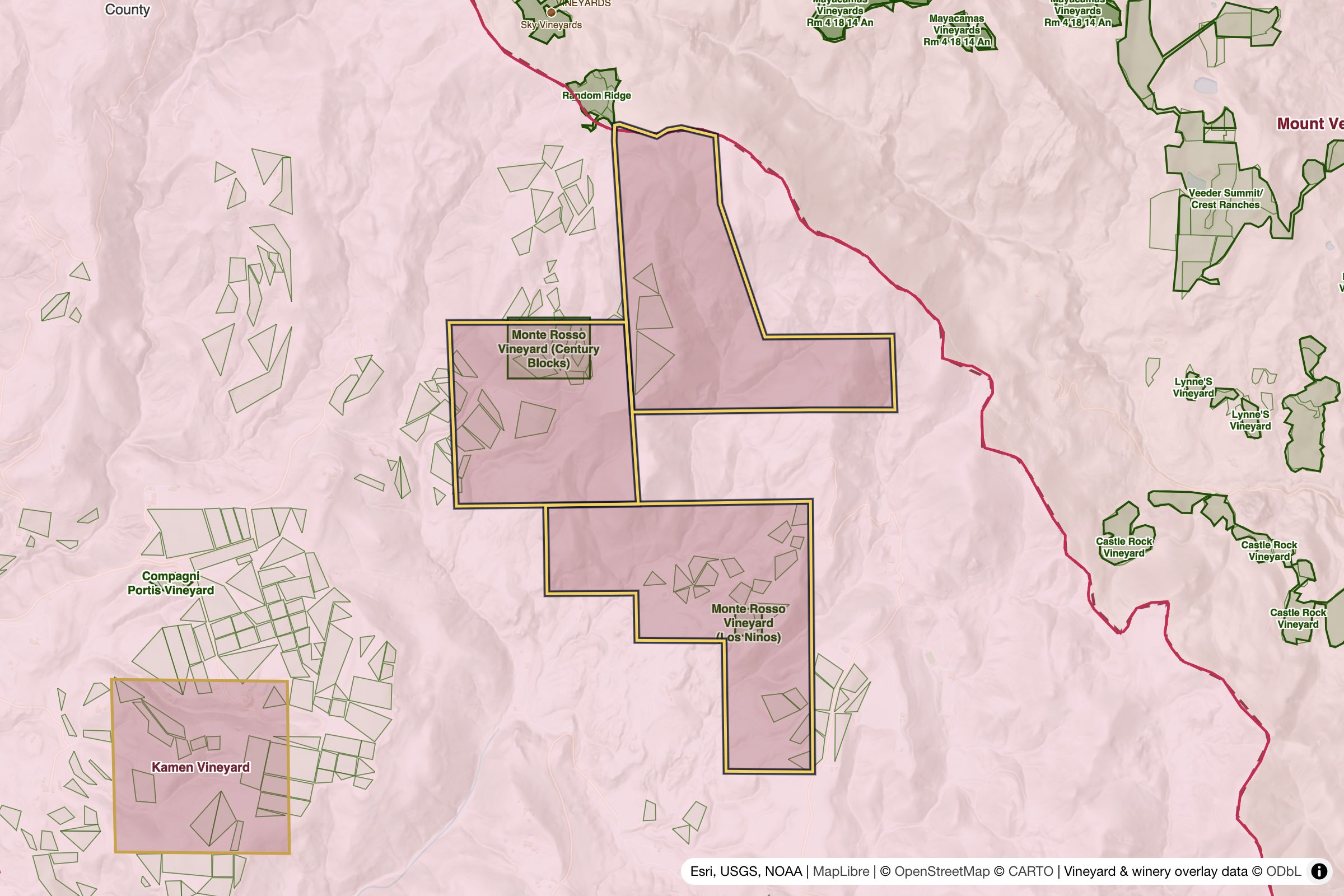
Monte Rosso
Emmanuel Goldstein planted vines high in the Mayacamas above Sonoma Valley in 1886, on a ranch then called Mount Pisgah. Louis M. Martini bought it in 1938 and renamed it for the thing you cannot miss: the red mountain.
History
Goldstein's 1886 planting included the Zinfandel and Semillon that still produce today, and his 1886 stone winery was named Mount Peak. Martini made the ranch the backbone of his mountain program, planting the Los Ninos Cabernet block in 1940 and selling mountain Zinfandels from this ranch in the years after Prohibition. E. and J. Gallo has owned and farmed the property since 2002, continuing the Louis M. Martini program and launching estate bottlings under the Monte Rosso name.
The Site
The ranch spans about 575 acres on the upper mountain, with roughly 250 acres of vines patchworked between 700 and 1,300 feet wherever terrain allows. The soil is Red Hill loam, a red volcanic clay loam, fast-draining and iron-rich; elevation keeps nights cold and acidity high, producing the site's noted paradox of dark mountain power with bright, almost juicy finishes.
Vines and Blocks
Zinfandel, Cabernet Sauvignon and Semillon lead a mixed mountain planting. The 1886 Century Blocks on the upper terraces hold the ancient head-trained, dry-farmed Zinfandel and Semillon; their rows run east to west, an old choice made to shade the trunks through hot afternoons, still plainly visible from the air. Los Ninos, a 3.7 acre block on a southwest bench with a sightline to San Pablo Bay, was planted to Cabernet in 1940 and is regarded as the oldest producing Cabernet block in California.
The Wines
Louis M. Martini remains the flagship label, joined by vineyard-designated bottlings from Bedrock, Robert Biale, Carlisle, Turley and Ridge among others. Monte Rosso on a label signals a specific promise: old vines, red rock, altitude and acid.