History
Sanford was a Berkeley geographer and former navy navigator, Benedict a botanist who had run the University of California's Santa Cruz Island reserve. What drew them was the shape of the land: the Santa Ynez Valley runs east to west rather than north to south, so nothing blocks the cold marine air coming off a Pacific some ten miles away. Benedict judged the ocean-based shale the best soil he had surveyed anywhere. Vines went in on their own roots from 1971, with Pinot Noir following within a year or two, and the first three barrels were made in 1975. The partnership ended in 1980 when Sanford sold out to found his own label; Benedict farmed on with investors until 1990, when the British collectors Robert and Janice Atkin bought the property and Sanford returned as its vineyard manager. The Terlato family bought it in 2007, reuniting vineyard and Sanford label after twenty-seven years. Sanford himself went on to found Alma Rosa, which he still lives at as its ambassador.
The Site
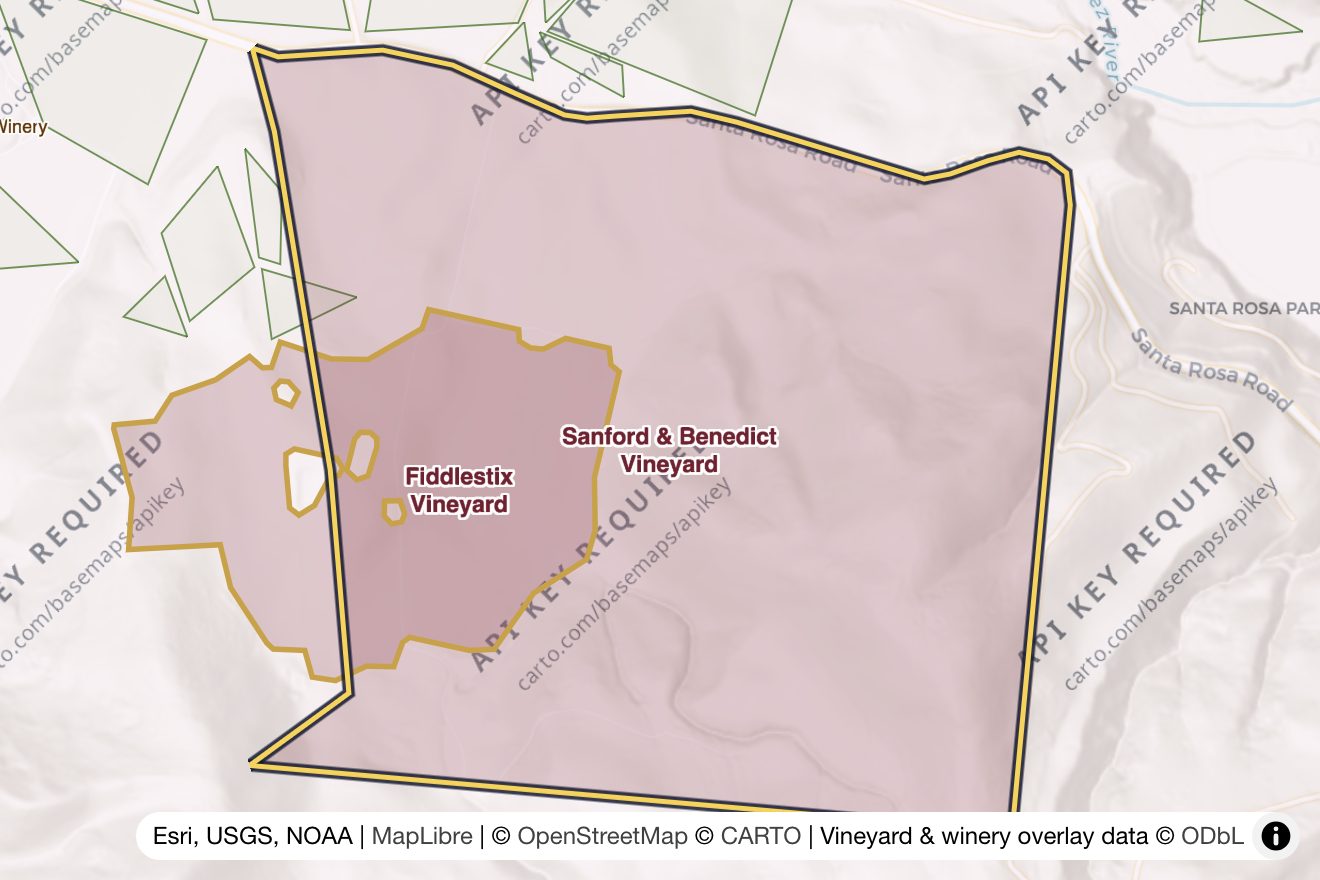
The vineyard runs along Santa Rosa Road on a north-facing bench above the Santa Ynez River at around 400 feet, with individual blocks between roughly 375 and 525. Accounts of its size differ by what is being counted: 51 to 53 acres of surviving original planting, against about 134 acres planted in total once the 1990s and later blocks are included. The soils are consistently described as a calcium-rich clay loam heavy with fractured shale and chert, with Santa Lucia and Botella series named in places. It forms one half of the Terlato family's estate, alongside La Rinconada.
Vines and Blocks
The 1971 plantings are own-rooted and ungrafted, which is rare anywhere in California and is the vineyard's single most valuable asset. Their origin is disputed: some accounts trace the material to Karl Wente's propagations out of Arroyo Seco, others call it the Mount Eden selection. Eleven Pinot Noir clones now spread across more than twenty blocks, with 667, 828 and 943 named among the later plantings, and Chardonnay alongside. Individual block names surface only in producers' own notes, Block 4d below the original barn among them, and no complete block map is published.
The Wines
The designate roster is the longest in the appellation and spans generations of California Pinot Noir. Sanford Winery speaks for the estate; Au Bon Climat, Chanin, Racines, Arnot-Roberts, Testarossa, Presqu'ile, Tyler, Sandhi, Dragonette and Liquid Farm all bottle it, and The Hilt buys old-vine fruit for blending. The Historic Vineyard Society lists the site among California's protected historic plantings.