History
The ground belongs to Rancho Tepusquet, granted to Tomas Olivera in 1837 and bought by Juan Pacifico Ontiveros in 1855; the adobe still standing on the property went up in 1857. Stephen and Bob Miller, whose family had farmed in California since 1871, bought the land in 1969 and concluded after studying the soils and the cold that it would grow wine grapes better than it grew cattle. The first vines went in ungrafted from UC Davis in 1973, and the ranch doubled for years as a certified budwood nursery. In 1989 the family put up a plain winery building on the property to house Au Bon Climat and Qupe, the two labels that carried the vineyard's name furthest; Jim Clendenen worked there until his death in 2021 and Au Bon Climat continues under his children, while Qupe passed to Vintage Wine Estates in 2018 and to Andrew Murray in 2024. The Millers started making their own wine from the 2005 vintage, went commercial with a Syrah in 2007, and opened a tasting room on the ranch in 2023 for the vineyard's fiftieth year.
The Site
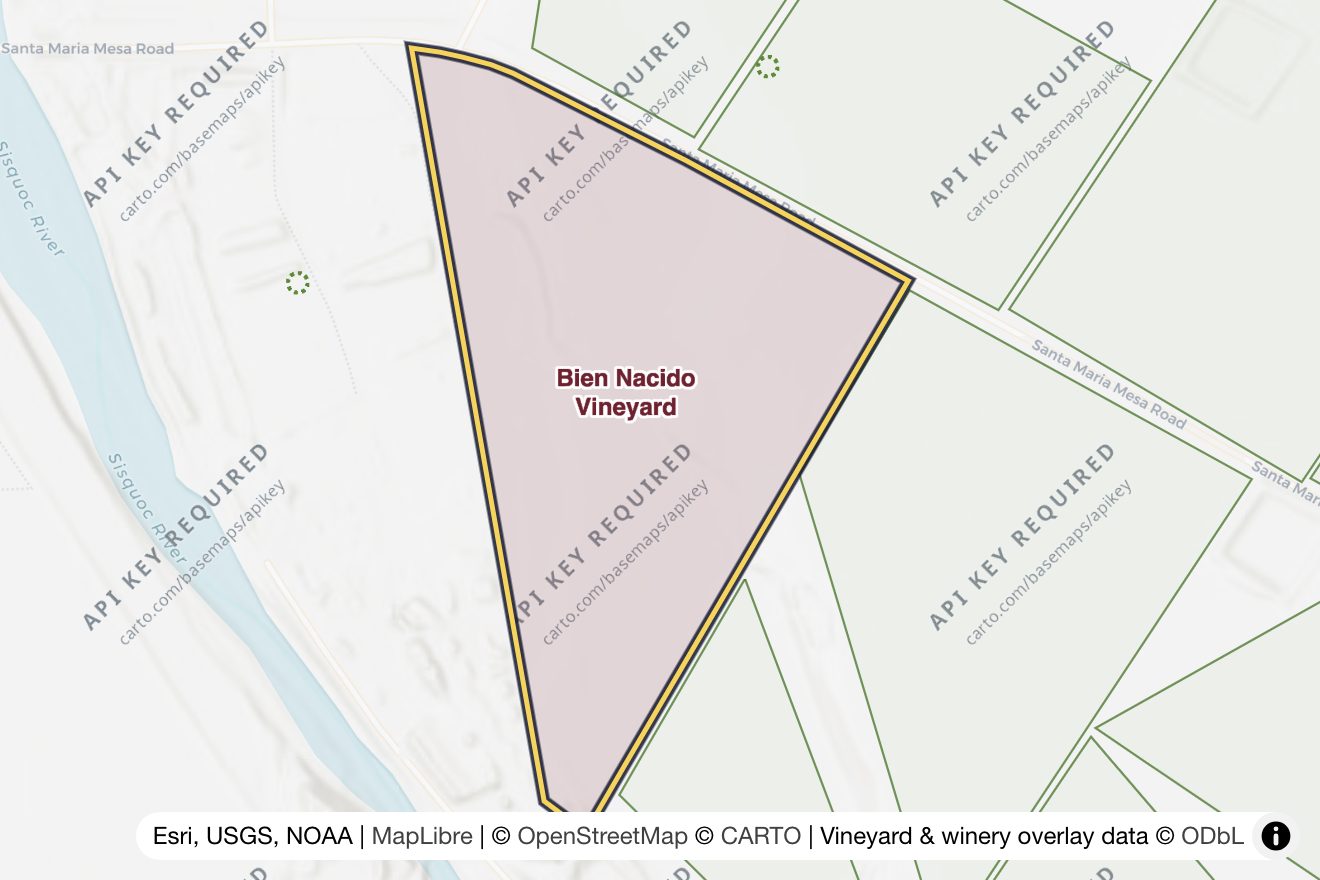
The vineyard lies on the bench at the eastern end of the Santa Maria Valley, where the foothills rise out of the coastal plain. The mountains here run east to west rather than north to south, one of the few places in California where they do, so nothing stands between the vines and the Pacific: fog fills the rows most mornings and does not lift until midday, the wind follows through the afternoon, and the result is Region I heat and one of the longest growing seasons in the state. Rainfall runs twelve to fourteen inches. Published acreage ranges from well under 650 (after hundreds of acres were pulled in recent years) to nearly 900 depending on the source and the year, a spread that reflects a footprint which genuinely shrinks as old blocks are pulled. The soils change block by block: Elder loam and shaly loam under much of the Chardonnay, Los Osos clay loam beneath the Syrah, chamise clay and shaly loam on the hillside plantings, and shale with limestone outcropping in the oldest Chardonnay.
Vines and Blocks
Chardonnay and Pinot Noir lead, alongside Syrah, Pinot Blanc, Merlot and a run of experimental varieties begun in 1992. The block letters are the vineyard's working vocabulary and several carry reputations of their own. W Block is the original 1973 Wente Chardonnay, own-rooted, on the windiest ground on the ranch. Q Block is the most coveted of the Pinot Noir, Pommard planted in 1973. X Block went in as Riesling that same year and was grafted over to Estrella Syrah in 1986, which makes it the oldest Syrah here. Z Block, planted in the early 1990s, is the Syrah critics single out. G and T hold 1973 Pinot Noir in Pommard 4 and clone 22; Block I is 1973 Chardonnay interplanted again in 2005; K Block feeds Au Bon Climat's block bottling; blocks 3 and 8 went in during 1996; blocks 1, 7 and 9 are farmed organically on the hill; and The Captain is a monopole named for the founders' father. N Block, the own-rooted Martini Pinot Noir of 1973 that Tyler, Longoria and Flying Goat all bottled, was pulled out in 2019 after disease took it, and its removal is why the ranch's oldest surviving Pinot Noir now sits elsewhere.
The Wines
The Millers rent by the block or by the row rather than by the ton, which lets each winery farm its own rows to its own standard, and they decide who may put the vineyard's name on a label at all. Roughly forty wineries buy here now, down from more than sixty at the peak. Au Bon Climat, Qupe, Foxen, Ojai, Longoria, Tyler, Gary Farrell, Presqu'ile, Twomey, Bedrock and Piedrasassi have all bottled designates, several of them block by block, and Bien Nacido Estate now speaks for the property itself.