Introduction
The introduction of the MGA system provided official recognition to Barolo's single vineyards, addressing what had been a paradoxical situation where "the multiplicity of single-vineyard bottlings from the 1980s, in the absence of an official classification, has had the paradoxical result of focusing attention on and reinforcing confidence in single producers." While the MGAs are identified as 'crus,' they remain unclassified, leaving sites like Piantà to establish their reputation through the wines themselves rather than through historical hierarchies or official designation.
Terroir and Geographic Context
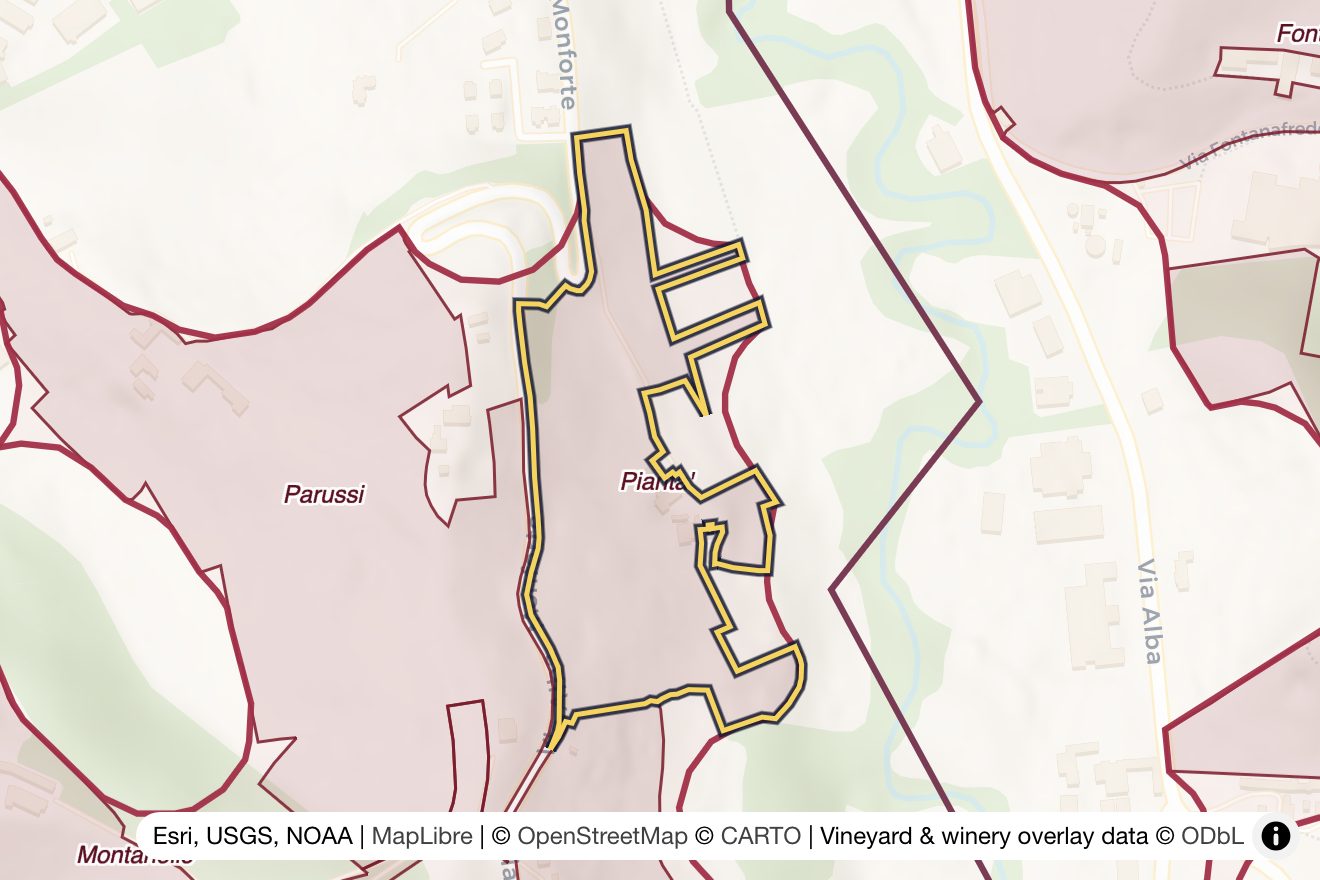
Piantà lies within Castiglione Falletto, one of the five core Barolo communes. Castiglione Falletto, along with Barolo, La Morra, Serralunga d'Alba, and Monforte d'Alba, forms "the core of Barolo," a delimitation that traces back to an unofficial boundary drawn in 1909 and to the ministerial decree of 31 August 1933.
The character of Castiglione Falletto's terroir derives from its geological foundation and topographical features. The soils in this eastern portion of the Barolo zone differ markedly from those in the western communes of La Morra and Barolo, contributing to the distinct personality of Castiglione Falletto wines. Modern terroir research, building on the foundational work of Dr. Gérard Seguin at the University of Bordeaux, has demonstrated that "soil's physical characteristics" play a crucial role in wine quality, particularly through their influence on "well-regulated, moderately sufficient" water availability to the vine.
The complex interplay of soil composition, drainage, and topography in Castiglione Falletto creates conditions that typically produce wines of substantial structure and longevity. As research has shown, "the attributes of soil can change rapidly within a vineyard, both vertically and horizontally," meaning that even within a single MGA, significant variation may exist. The manner in which "roots navigate this complex layering of soil strata dictates the amount of water and nutrients the plant can access all year long," directly influencing the concentration and character of the resulting wines.
The marginal climate of the Langhe amplifies the influence of terroir on wine character. As noted in viticultural research, "the effect of soil on wine quality is reduced in warmer climates, which is why the influence of terroir is so much more marked in marginal climates." This principle underscores why precise vineyard location matters so profoundly in Barolo, where climatic conditions allow subtle differences in exposition, elevation, and soil to express themselves distinctly in the finished wines.
Wine Characteristics
While specific documentation of Piantà's wines remains limited compared to Serralunga's more celebrated sites, the wines from this MGA share the fundamental characteristics of Castiglione Falletto Barolo. The Nebbiolo grape, which forms the exclusive foundation of Barolo, expresses itself with particular power and structure in Serralunga's vineyards, producing wines marked by "the tannins and acidity that mark the Nebbiolo grape."
Castiglione Falletto Barolos are typically characterized by their firm tannic framework, substantial concentration, and exceptional aging potential. These wines often require extended cellaring to integrate their structural components and reveal the complex aromatic evolution that Nebbiolo offers with age: "perfumes of cherry, violets, and, with age, iron, tar, and orange peel." The wines demand patience from their admirers, as "young Barbaresco is by no means an inevitably pleasurable glass of wine", a statement that applies with even greater force to the more structured Barolos of Serralunga.
The modern minimum alcoholic strength for Barolo stands at 13%, with wines "easily reaching 13.5%" or higher, reflecting the physiological ripeness necessary to tame Nebbiolo's formidable tannins. This balance between power and finesse represents the ongoing challenge and achievement of Serralunga's winemakers, who work to capture both the inherent strength of their terroir and the elegance that distinguishes Barolo from mere extraction.
Contemporary Context
Piantà exists within a rapidly evolving landscape for Barolo production. The success of Langhe Nebbiolo as "a kind of economy Barolo" has transformed the economics of Nebbiolo production, with "most of the production not geared towards Barolo but Langhe Nebbiolo, which has taken the market by storm." This commercial reality affects even established MGAs, as producers balance the demands of crafting age-worthy Barolo with market pressures for more accessible wines.
The tradition of single-vineyard bottlings in Barolo, while now well-established, remains relatively recent in historical terms. The proliferation of MGA-designated wines since the system's introduction has created both opportunity and challenge: opportunity for lesser-known sites like Piantà to build recognition through quality, and challenge in distinguishing themselves within an increasingly crowded field of single-vineyard offerings.
The work of producers committed to expressing Piantà's distinctive character contributes to the broader evolution of Barolo, where "a number of smaller producers have begun converting to organic and biodynamic viticulture and are using traditional winemaking techniques to produce highly original, long-lived wines." This commitment to terroir expression and quality over volume represents the path forward for MGAs seeking to establish their reputation.
Significance and Future
Piantà occupies a position common to many of Barolo's officially recognized but less celebrated sites: it possesses the fundamental geological and climatic prerequisites for quality but lacks the historical documentation and market recognition of the zone's most famous crus. This status need not be permanent. The "written tradition (from Lorenzo Fantini in the late 19th century to modern writers such as Luigi Veronelli, Renato Ratti and, more recently, Alessandro Masnaghetti) and in the oral tradition of the zone" continues to evolve, shaped by the wines that emerge from each site and the dedication of producers working them.
The absence of official classification within the MGA system means that reputation building remains organic, determined by wine quality and the "opinions made concretely significant by the higher prices paid by négociants for the grapes and wines of certain vineyards." For Piantà, this represents both challenge and opportunity: the chance to be discovered and appreciated by those seeking to explore beyond Barolo's established hierarchy of sites.
In the context of Serralunga d'Alba's established excellence, Piantà contributes to the commune's diverse terroir expression, offering another perspective on how Nebbiolo interprets this distinctive corner of the Barolo zone. As understanding of Barolo's vineyard mosaic deepens and producers continue refining their approach to individual sites, MGAs like Piantà may reveal nuances and qualities that distinguish them within Serralunga's powerful portfolio of wines.