Introduction
The introduction of the MGA system formalized the recognition of specific vineyard sites throughout the Barolo zone, creating an official registry of single vineyards without imposing a qualitative classification. Within this framework, Ornato holds legal status as a recognized cru, though it lacks the extensive historical documentation and critical consensus that surrounds Serralunga's most celebrated sites. This position is not necessarily a reflection of quality potential, but rather of historical visibility and market recognition) factors that have often been shaped as much by the presence of influential producers as by intrinsic terroir characteristics.
The Serralunga Context
Understanding Ornato requires first understanding Serralunga d'Alba itself, a commune that represents a distinct expression within the Barolo landscape. Serralunga occupies the eastern portion of the Barolo production zone, where the soils are predominantly derived from the Serravallian geological formation (younger, more compact, and more iron-rich than the Tortonian marls that dominate the western communes of La Morra and Barolo.
This geological foundation has profound implications for the wines produced here. The Serravallian soils, characterized by their Lequio Formation composition, tend to produce wines of considerable structure, marked tannins, and pronounced minerality. Where the Tortonian soils of the western communes often yield more perfumed, earlier-maturing wines with softer tannic profiles, Serralunga's geological inheritance typically results in Barolos that demand patience) wines that can appear austere and tightly wound in youth but possess the structural integrity to evolve over decades.
The commune's topography also plays a crucial role. Serralunga's vineyards generally occupy steep slopes with varied exposures, and the interplay between elevation, aspect, and soil depth creates a complex mosaic of mesoclimates. These factors (the manner in which vine roots navigate the layered soil strata, accessing water and nutrients; the angle at which sunlight strikes the canopy throughout the growing season; the drainage patterns that determine water stress) all contribute to the distinct personality that Serralunga wines express.
Ornato's Place in the Landscape
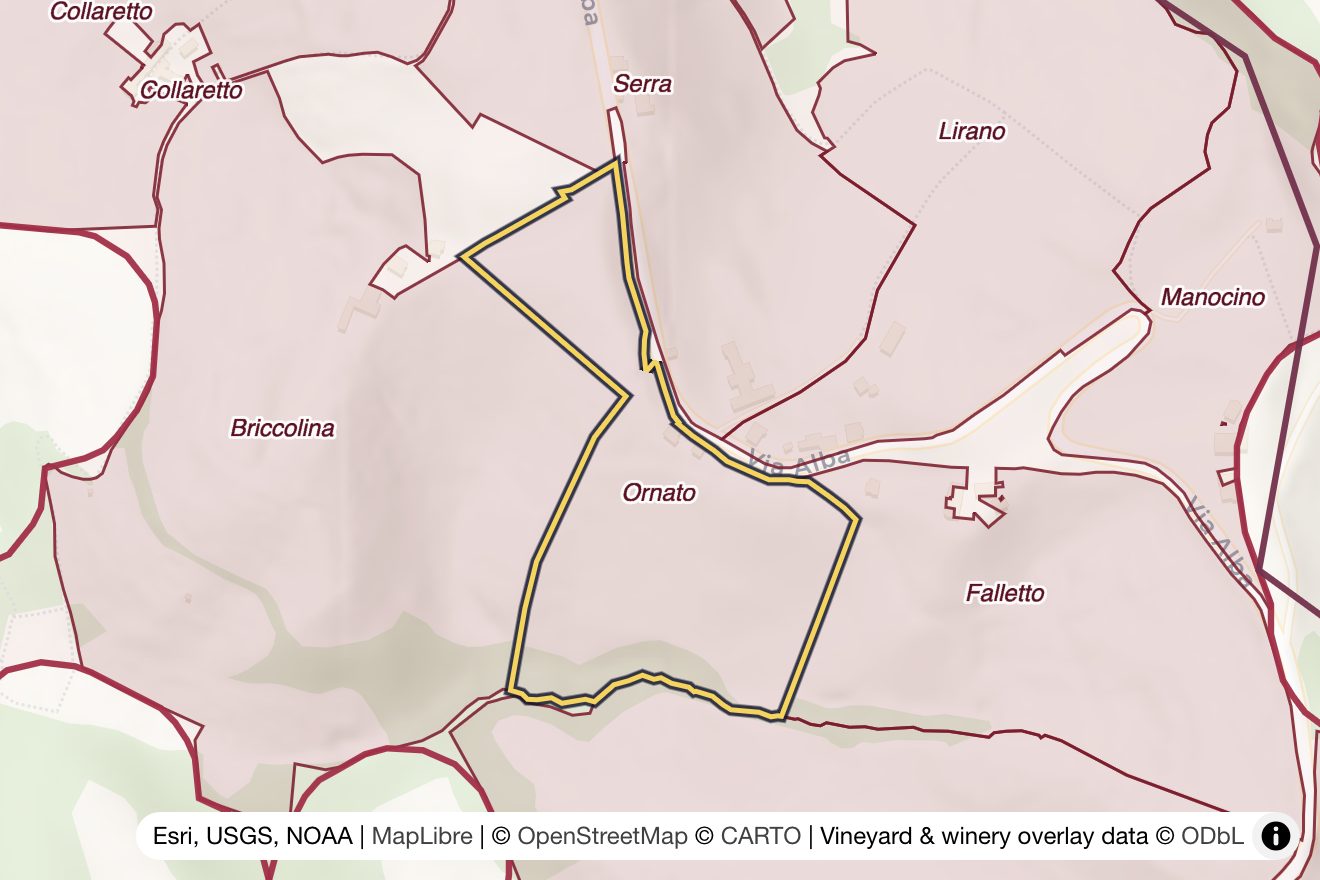
Within Serralunga's viticultural map, Ornato exists as one of numerous MGAs that collectively represent the commune's productive capacity. The site's relative absence from the historical canon (the writings of Lorenzo Fantini in the late 19th century, the work of Renato Ratti and Luigi Veronelli in the modern era, though Alessandro Masnaghetti's MGA maps do cover the site) suggests that Ornato has not historically commanded the premium prices or critical attention directed toward the commune's most prestigious positions.
This historical positioning reflects a broader reality of the Barolo zone: while certain vineyards have enjoyed centuries of recognition, supported by consistent quality, favorable terroir, and the advocacy of important producers, many sites of legitimate quality have remained in relative obscurity. The explosion of single-vineyard bottlings from the 1980s onward, paradoxically, both illuminated the diversity of Barolo's vineyard landscape and reinforced the hierarchies established by producer reputation rather than purely by site characteristics.
The absence of extensive documentation regarding Ornato's specific terroir attributes (its precise soil profile, elevation range, aspect, and microclimate particularities) reflects the reality that not all MGAs have been subject to the same level of viticultural and geological analysis. Unlike the thoroughly studied and debated sites that appear consistently in critical discussions of Barolo, Ornato represents the broader category of officially recognized vineyards whose quality and character remain more closely held knowledge among the producers who work them.
General Characteristics and Potential
While specific information about Ornato's individual expression remains limited in the broader wine literature, we can reasonably infer certain characteristics based on its location within Serralunga d'Alba. Wines from this commune generally display a particular aromatic profile (often showing darker fruit tones compared to the more floral, red-fruit-driven wines of La Morra, with notes that can include black cherry, plum, licorice, tar, and iron. The tannic structure tends toward firmness and persistence, and the wines typically require extended aging to integrate their components and reveal their complexity.
The question of how Ornato specifically expresses these Serralunga characteristics) whether it produces wines of particular elegance within the commune's generally powerful framework, or whether it emphasizes structure and minerality, or occupies some other position in the spectrum (remains a matter for those with direct experience of wines from the site. The quality potential of any vineyard ultimately depends not only on its inherent terroir characteristics but also on the viticultural and winemaking choices applied to it, from rootstock selection and vine density to canopy management, harvest timing, and cellar practices.
The Producer Question
One of the significant factors in establishing a vineyard's reputation is the presence of quality-focused producers willing to vinify and bottle its fruit separately, thereby bringing attention to the site's specific characteristics. Ornato is best known through Pio Cesare's single-vineyard Barolo Ornato, first made in 1985, which is widely distributed internationally.
This dynamic highlights a fundamental aspect of wine geography: recognition often follows producer investment and marketing as much as it reflects inherent quality. The most celebrated crus frequently owe their status to decades or centuries of advocacy by influential estates whose wines have been tasted, written about, and traded internationally. Sites without such advocacy may possess comparable terroir potential while remaining largely unknown outside their immediate locality.
Contemporary Context
Within the current Barolo landscape, where the MGA system has created both clarity and complexity, Ornato represents one of many officially recognized sites that contribute to the denominazione's diversity. For consumers and professionals seeking to understand Barolo's geography, the challenge lies in distinguishing between the historically validated top sites, the emerging properties being championed by quality-conscious producers, and the broader population of legitimate but less-celebrated vineyards.
The value of exploring wines from less-heralded MGAs like Ornato lies partly in the potential to discover quality at more accessible price points, and partly in gaining a more complete understanding of a commune's viticultural range. Not every site can or should occupy the pinnacle of critical and commercial recognition, yet each contributes to the complex tapestry of expressions that make Barolo one of the world's most compelling wine regions.
For those interested in Serralunga d'Alba's particular expression of Nebbiolo) its combination of power and minerality, its demand for patience, its capacity for long evolution (seeking out wines from various MGAs within the commune, including those like Ornato that lack extensive historical documentation, can provide valuable perspective on how terroir variation operates even within a single township.
Conclusion
Ornato stands as an officially recognized component of Serralunga d'Alba's viticultural landscape, holding MGA status within the Barolo denominazione while remaining outside the circle of historically celebrated and extensively documented crus that define the commune's reputation. This position reflects the complex interplay of factors) historical accident, producer investment, critical attention, and market dynamics, that shape wine geography beyond the intrinsic qualities of site and soil.
The site's relative obscurity in wine literature and critical discussion should not be mistaken for a definitive statement about quality potential, but rather understood as reflecting the reality that recognition and reputation in wine often accumulate slowly and unevenly. As the Barolo zone continues to evolve, with new generations of producers bringing fresh perspectives to both celebrated and overlooked sites, the hierarchy of vineyards remains, as it has always been, subject to reassessment and revision.