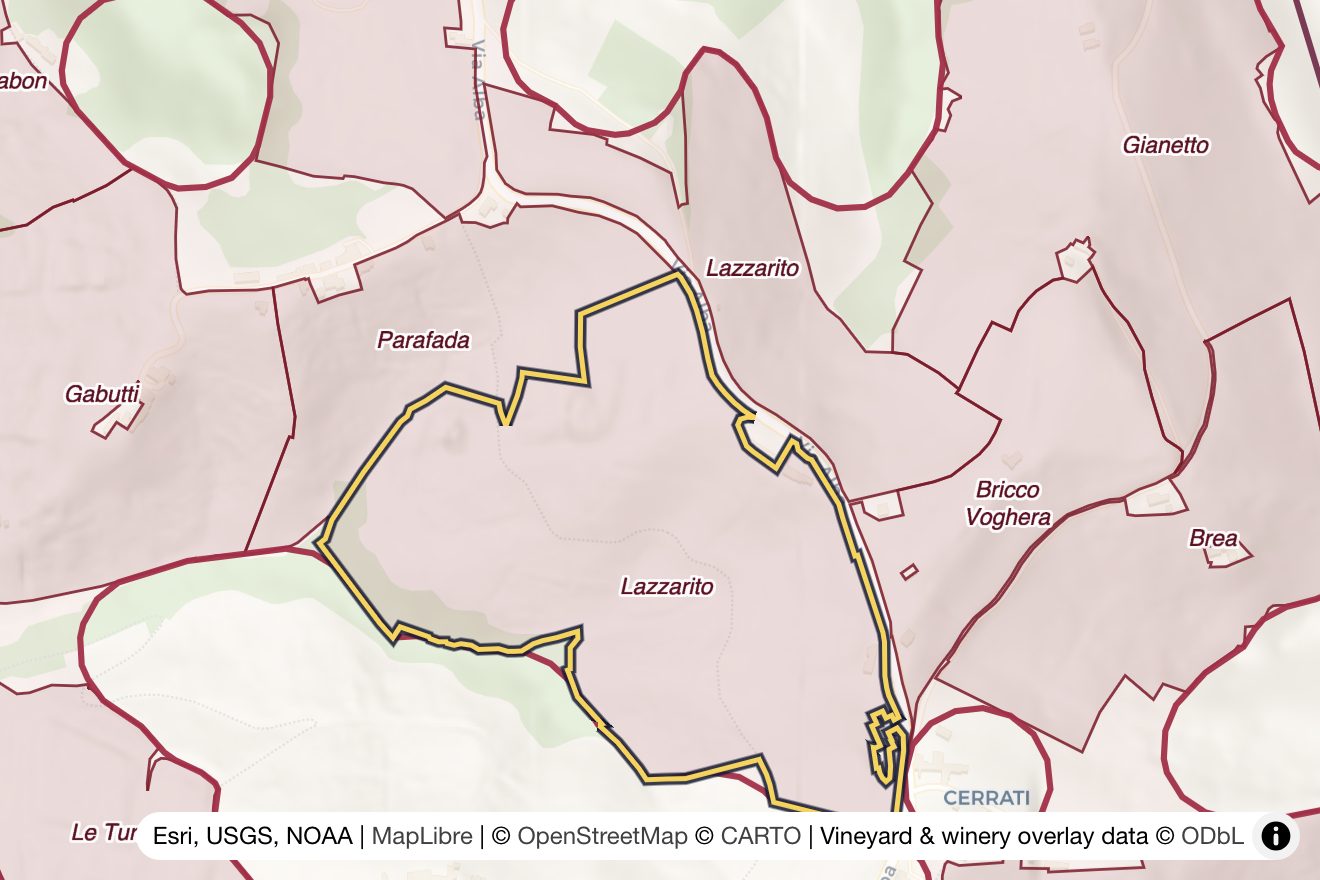
Introduction
The introduction of the MGA system formalized what generations of Piedmontese vignerons and négociants had long understood through practical experience: that certain privileged positions within the Barolo zone consistently yield wines of superior quality and distinctive character. Lazzarito's inclusion in this official registry, and more significantly, its recurring presence in both the written tradition) from Luigi Veronelli and Renato Ratti to contemporary cartographer Alessandro Masnaghetti (and the oral tradition of the zone, confirms its historical and contemporary significance. This recognition was made concrete through the higher prices that négociants traditionally paid for grapes and wines from the site, a market-driven validation that preceded any formal acknowledgment.
The Serralunga Context
To understand Lazzarito, one must first appreciate Serralunga d'Alba's distinctive position within the Barolo landscape. Serralunga represents one of the five historic core townships of Barolo, alongside La Morra, Barolo, Castiglione Falletto, and Monforte d'Alba. These communes have formed the heart of the denomination since the early delimitations of the zone, which the Agricultural Commission of Alba later extended in 1909.
Serralunga d'Alba occupies the eastern reaches of the Barolo zone, and its wines have long been characterized by a particular expression of Nebbiolo that emphasizes structure, tannic power, and longevity. The commune's association with royal patronage traces back to the 19th century, when Emanuele, Count of Mirafiori) son of King Vittorio Emanuele II by his mistress Rosa Vercellana (developed the extensive vineyards around the hunting lodge of Fontanafredda. This royal connection contributed to Barolo's designation as "the wine of kings, the king of wines," and established Serralunga as a source of Barolo worthy of aristocratic cellars.
Terroir and Physical Characteristics
While specific soil analysis data for Lazzarito may vary across its extent, the site shares the fundamental geological characteristics that define Serralunga's terroir. The physical attributes of soil) particularly those governing water supply to the vine and influencing temperatures in and above the soil (play the predominant role in determining wine quality and character. As research has consistently demonstrated, these physical characteristics prove more influential than chemical composition in their impact on grape quality and wine individuality.
The terroir of any great vineyard site represents the complex interaction between soil, climate, topography, and viticultural management. In Barolo's marginal climate, where the influence of terroir expresses itself with particular clarity, these factors combine to create conditions for moderate vine vigor and well-regulated, moderately sufficient water stress) conditions identified by pioneering researchers such as Dr. Gérard Seguin of the University of Bordeaux as common denominators among soils capable of producing high-quality wines.
The specific mesoclimate and exposition of Lazzarito contribute to its distinctive expression of Nebbiolo. Aspect, elevation, and drainage patterns all influence the site's ability to bring Nebbiolo (a notoriously late-ripening variety) to optimal phenolic maturity while maintaining the acidity essential for structure and longevity. Contemporary viticulturists working in classified sites must select appropriate plant material (rootstock and vine variety) and adapt their management choices (including vineyard floor management, training systems, and canopy management) to optimize wine quality in each particular environment, a practice that might be described as "managing terroir."
Wine Profile and Character
Lazzarito produces wines that embody the classic Serralunga expression of Nebbiolo: powerful, structured, and built for extended aging. These are Barolos that demand patience, revealing their complexity only after years in bottle. The tannins, derived from Nebbiolo's thick skins and high phenolic content, are abundant but refined when the site is farmed and vinified with appropriate care.
The wines typically display the masculine architecture associated with Serralunga, showing more evident structure and grip than the more immediately seductive Barolos from La Morra or the village of Barolo itself. This structural intensity does not preclude elegance; rather, it provides the framework for extraordinary longevity and the development of tertiary complexity. With proper cellaring, Lazzarito Barolos evolve through stages of development, their youthful austerity gradually yielding to profound expressions of tar, roses, dried herbs, leather, tobacco, and subtle earth tones.
The site's consistent recognition among Barolo's finest crus suggests wines of notable concentration and depth, with the capacity to express vintage variation while maintaining a recognizable site character. In optimal vintages, Lazzarito should demonstrate the balance between power and finesse that defines truly great Barolo (wines that combine Serralunga's characteristic strength with sufficient aromatic complexity and textural refinement to transcend mere concentration.
The MGA System and Lazzarito's Place
The proliferation of single-vineyard bottlings from the 1980s onward, occurring in the absence of an official classification, had the paradoxical result of focusing attention on individual producers rather than specific sites. This producer-centric approach contrasted with more established European wine regions where vineyard classification provided an organizing principle for quality assessment. The introduction of the Menzione Geografica Aggiuntiva system represented an attempt to address this situation, creating an official registry of recognized vineyard sites throughout the Barolo zone.
The MGAs are not classified hierarchically) there exists no official first growth or grand cru equivalent within the system. However, they are identified as "crus," providing legal definition to what had previously existed only in traditional knowledge and market prices. Alessandro Masnaghetti has attempted an unofficial classification, and while no absolute unanimity exists regarding which sites constitute Barolo's apex, certain vineyards appear with remarkable consistency on critical shortlists.
Lazzarito's inclusion among this elite group (named alongside legendary sites such as Rocche dell'Annunziata, Brunate, Cerequio, Cannubi, Rocche di Castiglione, Villero, Monprivato, Bussia, and Ginestra) places it firmly within the upper echelon of Barolo production. Within Serralunga specifically, it shares this distinction with Francia, Ceretta, Arione, and Vignarionda, representing the commune's most celebrated terroirs.
Historical Significance and Evolution
The written and oral traditions of Barolo have long recognized certain privileged positions within the zone, even before modern classification systems attempted to formalize these hierarchies. From Lorenzo Fantini's late 19th-century observations through the modern scholarship of Luigi Veronelli, Renato Ratti, and Alessandro Masnaghetti, Lazzarito has maintained its reputation among discerning producers and consumers.
The site's recognition predates the contemporary emphasis on single-vineyard bottlings, having been valued by the négociant houses that historically dominated Barolo commerce. These houses, dealing in large quantities and blending wines from different provenances into harmonious house Barolos, nonetheless paid premium prices for grapes from recognized sites (a practical acknowledgment of quality that transcended marketing considerations.
The evolution of Barolo from a négociant-dominated industry to one emphasizing estate bottling and single-vineyard designations has, if anything, enhanced Lazzarito's profile. As consumers and critics increasingly focus on terroir expression rather than blended house styles, sites with distinctive character and proven quality have gained prominence. The MGA system's formal recognition arrived as validation of what the market had already established: that Lazzarito represents one of Serralunga's) and by extension, Barolo's (most significant vineyard sites.
Conclusion
Lazzarito exemplifies the principle that, within the complex mosaic of Barolo's terroir, certain sites possess inherent qualities that, when combined with skilled viticulture and thoughtful winemaking, consistently produce wines of superior quality and distinctive character. Its position among Serralunga's elite MGAs reflects both historical recognition and contemporary validation, bridging the traditional knowledge of generations of Piedmontese vignerons with modern understanding of how soil, climate, and exposition interact to shape wine quality.
For collectors and enthusiasts seeking Barolo that embodies Serralunga's powerful, structured style while offering the complexity and longevity that define great Nebbiolo, Lazzarito merits serious attention. These are wines that reward patience and proper cellaring, revealing their full character only after years of development. In an era when Barolo faces pressures toward earlier approachability and stylistic homogenization, sites like Lazzarito remain testaments to the appellation's capacity to produce wines of profound depth and extraordinary aging potential) wines that justify Barolo's historical reputation as one of the world's greatest expressions of terroir.