Introduction
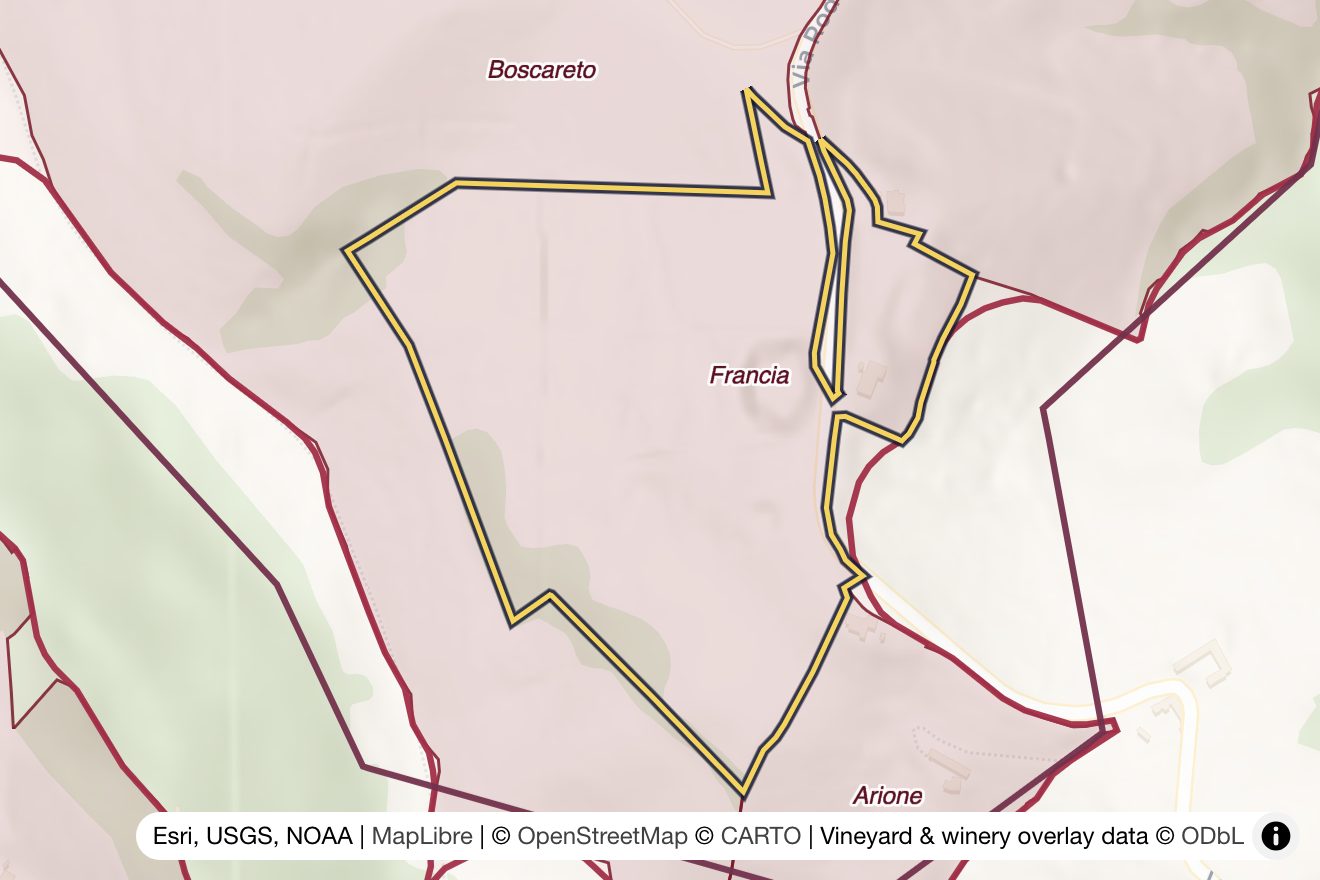
As one of the officially recognized Menzioni Geografiche Aggiuntive (MGAs) established in 2010, Francia holds formal acknowledgment within Barolo's 181 designated sites. Yet unlike many MGAs that are divided among multiple producers, Francia's monopole status places it in rare company within the denomination, standing alongside other single-owner sites like Bruno Giacosa's Falletto. This exclusivity means that Francia's reputation rests entirely on the wines produced by Giacomo Conterno, without the comparative interpretations that emerge from sites worked by multiple growers.
Terroir and Location
Serralunga d'Alba occupies distinct geological and climatic territory within Barolo. The township's vineyards are characterized by soils from the Helvetian (Serravallian) epoch, which differ notably from the younger Tortonian soils dominant in La Morra and Barolo. These Serravallian formations tend to produce wines of greater structure, firmer tannins, and pronounced longevity (the hallmarks of Serralunga's reputation as the source of Barolo's most age-worthy expressions.
Francia participates in these fundamental Serralunga characteristics, though its specific position and exposition within the township create its distinctive personality. The physical attributes of Serralunga's soils) particularly those governing water supply to the vine and temperature regulation, play crucial roles in determining the character of wines from this area. The moderate water stress that well-structured Serralunga sites can impose on vines contributes to concentration and complexity without compromising the complete ripening essential to great Nebbiolo.
The elevation and aspect of Serralunga's finest sites ensure adequate sun exposure during the growing season, critical for this late-ripening variety. The regulations governing Barolo production require vineyard planting between 170 and 540 meters, prohibiting valley floor sites and northern exposures that would compromise ripening. Francia's recognition among the commune's elite crus indicates optimal positioning within these parameters, providing the extended hang time that allows Nebbiolo to develop its complex aromatics while maintaining the acidity that gives these wines their capacity for extended cellaring.
Wine Characteristics
Francia produces wines that embody the essence of Serralunga: powerful, structured Barolos built for the long term, yet possessing the complexity and aromatic refinement that prevent them from being merely monolithic. The Serralunga character typically manifests in wines with darker fruit profiles compared to the more ethereal, floral expressions of La Morra, alongside pronounced mineral notes and firm, persistent tannins that require years to fully integrate.
The tannin structure in wines from Francia and its neighboring Serralunga crus (Lazzarito, Ceretta, Arione, and Vignarionda) tends toward density and grip, supported by the elevated acidity that is Nebbiolo's birthright. These are not wines that flatter in youth; they demand patience, often requiring a decade or more to begin revealing their complexity, and can continue evolving for decades beyond that. The physical soil characteristics particular to Serralunga, especially those regulating vine water stress, contribute to the concentration and structural intensity that define these wines.
Classic descriptors for top Serralunga sites include tar, licorice, dark cherry, iron, tobacco, and dried roses (the savory, earthy dimensions of Nebbiolo given full voice. Francia, through Giacomo Conterno's interpretation, expresses these qualities within a framework of traditional winemaking that emphasizes vineyard expression over technological intervention. The wines display the "classic" Barolo profile: firmly structured with elevated tannins and acidity, complex flavors of tart red fruit, tar, and roses, requiring significant bottle age to harmonize their components.
The aging potential of Francia is exceptional, as befits both its terroir and the traditional approach employed in its vinification. Wines from elite Serralunga sites regularly show best between 15 and 40 years of age, with the greatest examples continuing to develop for even longer. This longevity is not merely a function of structural components but of the fundamental balance and complexity that allows the wines to evolve gracefully rather than simply endure.
Giacomo Conterno: The Monopole Producer
Francia's identity is inseparable from Giacomo Conterno, one of Barolo's most revered producers and a standard-bearer for traditional winemaking. The estate's approach emphasizes extended maceration, aging in large Slavonian oak casks (botti), and minimal intervention) techniques that allow terroir characteristics to express themselves fully without the overlaying influence of new oak or other modern cellar practices.
The monopole nature of Francia means that all expressions of this site emerge from a single viticultural and winemaking philosophy. While this limits our ability to compare different interpretations of the site (a comparison that can illuminate terroir characteristics across multiple producers) it also ensures a consistency of vision and an uncompromising focus on quality. Giacomo Conterno's Francia is not modulated for earlier accessibility or stylistic diversity; it is made as the producer believes this site should be expressed, following principles honed over generations.
This single-producer reality also means that Francia's reputation has been earned entirely through the wines themselves, without the amplification that can come from multiple producers championing a site. Its inclusion among the finest crus of Serralunga, alongside sites worked by various growers, testifies to the exceptional quality of this fruit and the esteem in which these wines are held by critics and collectors.
Recognition and Significance
Francia's consistent appearance on shortlists of Barolo's finest crus places it within an elite group. While there is "no absolute unanimity" about which sites constitute Barolo's very top tier, the repeated mention of Francia alongside acknowledged grands crus like Rocche dell'Annunziata, Cannubi, Monprivato, and Bussia indicates a broad consensus about its quality. Among Serralunga's recognized elite sites. Francia, Lazzarito, Ceretta, Arione, and Vignarionda (Francia holds particular prestige, perhaps enhanced by its monopole status and the reputation of its producer.
The introduction of the MGA system in 2010 formalized what the market had long recognized: that specific sites within Barolo produce wines of distinctive character and, in some cases, exceptional quality. Francia's designation as an official MGA affirms its historical significance, though the MGA system itself does not classify sites hierarchically. Various commentators, notably Alessandro Masnaghetti, have attempted unofficial classifications that would rank MGAs by quality, and Francia appears prominently in such discussions.
The paradox of Barolo's single-vineyard landscape) that the proliferation of cru bottlings has reinforced attention on individual producers rather than sites themselves (applies somewhat less forcefully to Francia. While Giacomo Conterno's reputation certainly elevates perception of the vineyard, Francia's consistent recognition suggests that knowledgeable observers attribute genuine site-specific quality to this monopole, not merely reflected glory from the producer's skill.
Conclusion
Francia represents a distinctive point on Barolo's quality spectrum: a recognized grand cru from Serralunga d'Alba, expressing the structural power and aging capacity characteristic of that township's finest sites, interpreted through the uncompromising traditional approach of a single legendary producer. Its monopole status makes it both easier and harder to understand) easier because one need only know Giacomo Conterno's wines to know Francia; harder because we lack the comparative perspectives that multiple producers working a site can provide.
For collectors and enthusiasts, Francia offers the opportunity to follow a single site's expression across vintages, observing how this particular terroir responds to varying climatic conditions within the consistent framework of traditional winemaking. These are wines that require patience and reward it generously, embodying the aristocratic character that earned Barolo its royal associations. Francia may not have the name recognition of Cannubi or Brunate, but among those who know Barolo deeply, its reputation stands secure among the denomination's most distinguished sites.