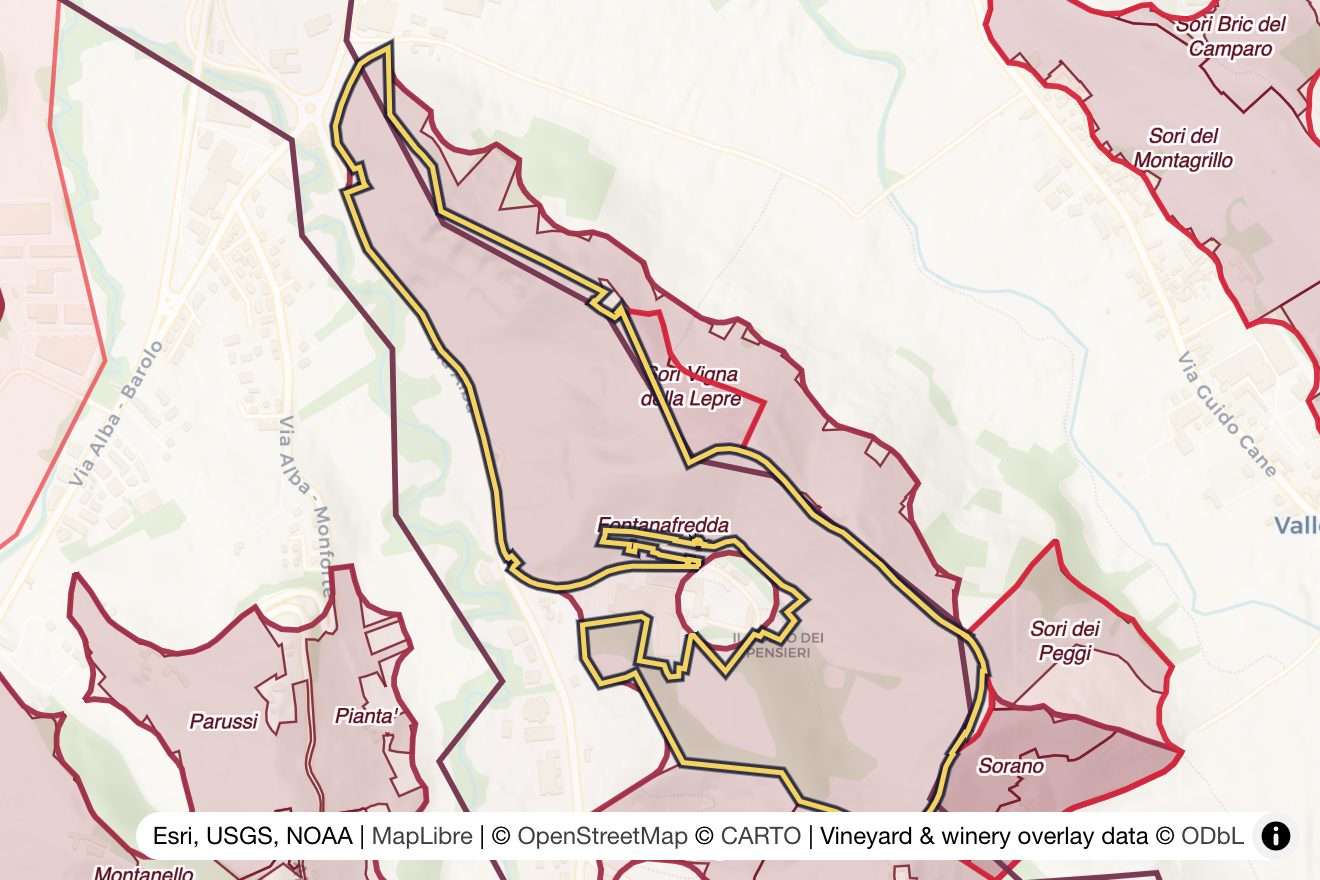
Introduction
The site's historical significance centers on its development by Emanuele, Count of Mirafiori, the son of King Vittorio Emanuele II and his mistress Rosa Vercellana. The Count developed the vineyards around the royal hunting lodge of Fontanafredda in Serralunga d'Alba during the late 19th century, a period of crucial importance for Barolo's evolution from rustic country wine to refined, age-worthy "vino nobile." This royal association contributed directly to Barolo earning its famous sobriquet: "the wine of kings, the king of wines."
Historical Context and the Royal Connection
The development of Fontanafredda occurred during Barolo's formative decades, when the region's viticultural identity was being shaped by aristocratic patronage and emerging oenological expertise. While the Marchesa Giulia Colbert Falletti di Barolo is often credited with pioneering modern Barolo production (allegedly inspiring King Carlo Alberto di Savoia to purchase and develop the estates of the castles of Verduno and Roddi) the Fontanafredda estate represented the next generation's commitment to Nebbiolo viticulture.
The timing was significant. By the mid-to-late 19th century, when Count Emanuele developed Fontanafredda's vineyards, the basic template for modern Barolo was established, though techniques would continue evolving through the 20th century. The estate's scale and royal backing allowed for substantial vineyard development and infrastructure investment, establishing Fontanafredda as a major force in the region's wine business. For historical reasons, the Langhe and Piedmont more generally maintained a structure of small family-owned farms, and Fontanafredda became one of the region's larger producers, historically purchasing grapes from smaller growers throughout the zone.
The MGA System and Fontanafredda's Place
The introduction of the Menzione Geografica Aggiuntiva system represented a significant development for Barolo, creating an official list of registered single vineyards throughout the zone. These MGAs are identified as "crus" but are not classified hierarchically (a crucial distinction. The system emerged partly in response to the proliferation of single-vineyard bottlings beginning in the 1980s, which, in the absence of official classification, had the paradoxical result of focusing attention on individual producers rather than vineyard sites themselves.
Within Serralunga d'Alba, certain MGAs have achieved recognition among critics and enthusiasts as belonging to the commune's top tier. When shortlists of Barolo's finest crus are compiled, Serralunga typically contributes Francia, Lazzarito, Ceretta, Arione, and Vignarionda) sites that regularly demonstrate exceptional quality and command premium prices. Fontanafredda does not typically appear on these shortlists of Serralunga's elite sites, occupying instead a position of historical importance and solid quality rather than superlative terroir expression.
This distinction is worth understanding. An MGA designation confirms that Fontanafredda is an officially recognized, delimited vineyard site with established boundaries and a history of wine production. It does not, however, guarantee that wines from this MGA will reach the heights of Serralunga's most celebrated sites. The MGA system provides transparency and traceability, allowing consumers to understand geographic origin with precision, but quality ultimately depends on the intersection of site, producer skill, and viticultural/winemaking choices.
Serralunga d'Alba: Communal Character
To understand Fontanafredda as an MGA, one must first understand Serralunga d'Alba's position within the broader Barolo landscape. Serralunga forms part of Barolo's historic core, officially recognized since the Agricultural Commission of Alba's 1909 delimitation work, which extended the boundaries first set by the Ministry of Agriculture in 1896. The core of Barolo has always comprised five townships: Barolo, La Morra, Castiglione Falletto, Serralunga d'Alba, and Monforte d'Alba, supplemented by outlying areas in other townships.
Serralunga d'Alba generally produces Barolos known for their structure, power, and aging potential (characteristics driven by the commune's particular geological and climatic conditions. While specific terroir details for the Fontanafredda MGA are not extensively documented in the same manner as the commune's most celebrated sites, the wine would be expected to reflect Serralunga's broader characteristics: substantial tannic structure, pronounced acidity, and the capacity for extended bottle aging that allows Nebbiolo's complex aromatic evolution to unfold over decades.
The Estate and Contemporary Production
The Fontanafredda estate's scale and historical significance as a producer have, in some ways, overshadowed the Fontanafredda MGA as a vineyard site. The estate historically represented one of the larger operations in a region characterized by small family holdings. The average property size in the Langhe has remained remarkably small) less than three hectares in comparable Piedmontese denominations (though this average has more than doubled since 2000 as some growers exited the industry.
The contemporary wine business in Barolo has shifted significantly from the historical model. Where small growers once sold their grapes to larger producers like Fontanafredda, much higher prices for Nebbiolo wines have enabled many small estates to bottle and market their own wines. This transformation has increased competition and raised quality standards, though it has also complicated the market with a proliferation of labels and bottlings.
The Barolo market remains heavily export-oriented, with the large majority of production going to international markets, particularly the United States, Germany, the United Kingdom, and Scandinavia. This export focus has helped drive prices upward, as fine wine merchants, collectors, and buyers have increasingly sought out Barolo and Barbaresco as alternatives to rapidly appreciating Bordeaux and Burgundy.
Understanding Terroir in Context
While specific soil analyses, elevation data, and microclimate details for the Fontanafredda MGA are not extensively documented in available literature) although, like Francia and Lazzarito, it has its own entry in Alessandro Masnaghetti's Barolo MGA vineyard encyclopedia, (we can understand the site within broader frameworks of terroir assessment.
Research into terroir has moved beyond purely descriptive approaches to geology, geomorphology, soil microbiology, or climate in isolation. The most meaningful terroir studies, following the pioneering work of Dr. Gérard Seguin at the University of Bordeaux, take multidisciplinary approaches that include soil, climate, and their impacts on vine physiology and grape ripening. Seguin demonstrated that diverse soil types can produce high-quality wines when they share certain characteristics: moderate fertility and well-regulated, moderately sufficient water availability.
The attributes of soil can change rapidly within a vineyard, both vertically through different strata and horizontally across the site. Differences in topography, soil depth, and composition create variation in water access and vine vigor even within officially delimited MGAs. This internal variation means that vineyard management) including rootstock selection, training systems, and canopy management (plays a crucial role in optimizing quality from any site, a concept sometimes described as "managing terroir."
Critical Perspective
Fontanafredda occupies an interesting dual identity in Barolo's landscape: historically significant but not critically acclaimed as an elite terroir. This distinction reflects an important reality in wine regions worldwide) not every historically important estate or recognized vineyard site produces wines at the absolute pinnacle of quality. The royal connection and the estate's role in Barolo's commercial development and international reputation remain important, but these historical contributions do not automatically translate to exceptional terroir.
For consumers and professionals, this distinction matters when evaluating wines bearing the Fontanafredda MGA designation. These wines merit assessment on their own terms (how well they express Serralunga's characteristic structure and aging potential, the quality of viticulture and winemaking, and their value proposition) rather than through the lens of the estate's historical prestige or assumptions about MGA designation guaranteeing top-tier quality.
The MGA system's lack of hierarchical classification is both a strength and a limitation. It provides transparency about geographic origin without making qualitative judgments, leaving the market to determine which sites consistently demonstrate superiority. This market-driven approach has advantages (it rewards producers who maximize their sites' potential rather than resting on classificatory laurels) but it also requires more knowledge and critical judgment from consumers.
Conclusion
Fontanafredda represents a fascinating case study in how history, commerce, and terroir intersect in a region as complex as Barolo. Its royal connections and the scale of the historic estate contributed significantly to Barolo's prestige and international recognition. As an MGA, Fontanafredda holds official recognition as a distinct vineyard site within Serralunga d'Alba, though it does not rank among the commune's most celebrated crus in critical estimation.
This more modest positioning does not diminish Fontanafredda's legitimate place in Barolo's tapestry. Rather, it reflects the reality that within any great wine region, sites exist along a quality spectrum, and historical importance does not always correlate with optimal terroir. For those seeking to understand Barolo's full range, from its greatest sites to its solid, historically significant ones. Fontanafredda offers both a connection to the region's romantic past and an opportunity to explore Serralunga's characteristic style without the premium pricing commanded by Francia, Lazzarito, or Vigna Rionda.