Introduction
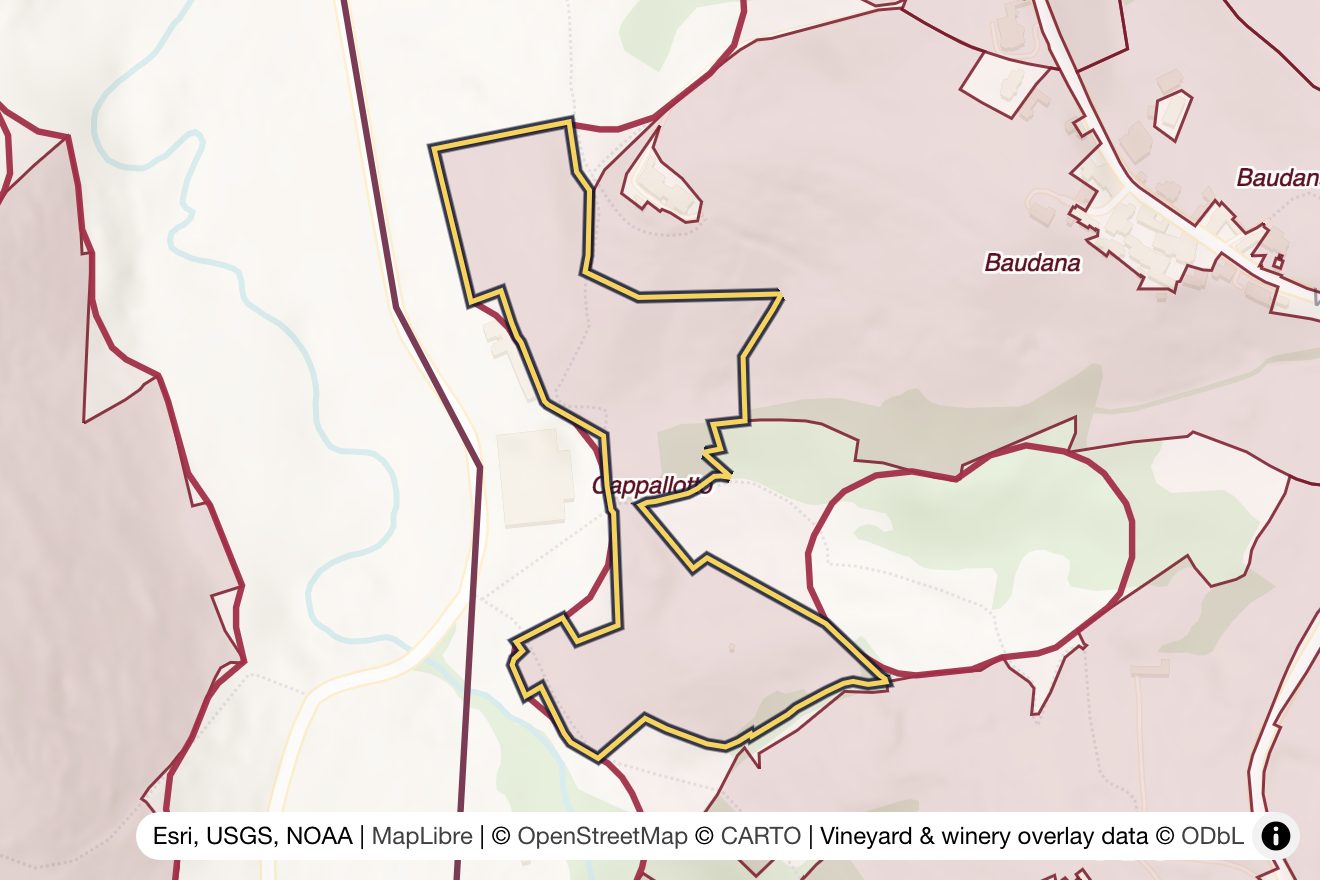
Cappallotto is a Menzione Geografica Aggiuntiva (MGA) situated in the commune of Serralunga d'Alba, one of the five historic core townships of the Barolo denomination. Among Serralunga's officially registered single vineyards, Cappallotto occupies a notably less prominent position in the critical literature compared to the commune's most celebrated sites. When contemporary wine writers and historians compile shortlists of Serralunga's finest crus. Francia, Lazzarito, Ceretta, Arione, and Vignarionda consistently appear (Cappallotto remains conspicuously absent from these elite enumerations.
This relative obscurity does not necessarily indicate inferior quality, but rather reflects the hierarchical reality of Barolo's complex vineyard landscape. The introduction of the MGA system created an official list of registered single vineyards throughout the Barolo zone without classifying them by quality, leaving the market, critics, and historical reputation to establish de facto hierarchies. In this environment, certain privileged positions have long enjoyed greater prestige through both written tradition) from Lorenzo Fantini in the late 19th century to modern authorities such as Renato Ratti and Alessandro Masnaghetti (and the oral tradition of the zone, opinions made concrete by the higher prices paid for grapes and wines from recognized sites.
Serralunga d'Alba: Commune Character
To understand Cappallotto requires first understanding Serralunga d'Alba itself, a commune that produces some of Barolo's most structured and age-worthy expressions. Serralunga occupies the eastern portion of the Barolo production zone, where the geological character differs markedly from the Tortonian formations that dominate the western communes of La Morra and Barolo. The soils of Serralunga derive primarily from the older, harder Serravallian (Helvetian) formations, which impart distinctive characteristics to the wines produced here.
These geological differences translate directly into sensory ones. Serralunga Barolos typically display firmer tannic structures, more pronounced mineral expression, and greater longevity compared to their western counterparts. The wines often require extended cellaring to reveal their full complexity, rewarding patience with extraordinary depth and persistence. While the most acclaimed sites within Serralunga have established reputations spanning generations, lesser-documented MGAs like Cappallotto participate in this broader communal character while lacking the same historical documentation and critical attention.
The Context of MGA Classification
The multiplication of single-vineyard bottlings from the 1980s onward, occurring in the absence of an official classification system, had the paradoxical result of focusing attention on individual producers rather than specific sites. This producer-centric approach partially obscured the importance of terroir, even as the proliferation of cru-designated wines theoretically celebrated vineyard origin. The MGA system, introduced to address this situation, provided official recognition and geographical delimitation for single vineyards throughout Barolo without attempting to rank them qualitatively.
Alessandro Masnaghetti, in his comprehensive cartographic and analytical work "Barolo MGA: The Barolo Great Vineyards Encyclopedia" (2015), has attempted an unofficial classification, bringing systematic rigor to the evaluation of Barolo's numerous MGAs. However, even in such exhaustive treatments, certain sites receive extensive analysis while others merit only brief mention or cartographic documentation. This distribution of attention reflects both the available historical evidence and the contemporary quality demonstrated by wines from each site.
Terroir Considerations
While specific pedological and microclimatic data for Cappallotto remains limited in the available literature, general principles of terroir assessment provide a framework for understanding how site-specific factors influence wine quality in this region. Contemporary terroir research, building on the foundational work of Dr. Gérard Seguin at the University of Bordeaux, emphasizes that physical soil characteristics predominate over chemical composition in determining vine behavior and wine quality. Seguin demonstrated that diverse soil types can produce exceptional wines when they share certain critical features: moderate fertility and well-regulated, moderately sufficient water supply.
In Serralunga specifically, the Serravallian sandstone and marl formations create soils that typically offer good drainage while retaining sufficient water during the growing season) a balance crucial for optimal grape ripening in Nebbiolo. The manner in which roots navigate the complex layering of soil strata dictates the amount of water and nutrients the plant can access throughout the year, influencing both vigor and fruit quality. Variation in soil attributes can change rapidly within a vineyard, both vertically and horizontally, meaning that even within a single MGA, different parcels may display distinct behaviors.
The effect of soil on wine quality becomes more pronounced in marginal climates, which is why terroir expression reaches such heights in regions like Barolo, where Nebbiolo ripens at the edge of its viable range. This climatic marginality amplifies site-specific differences, making precise vineyard selection critically important for quality outcomes.
Wine Character and Market Position
Given Cappallotto's limited presence in the critical discourse surrounding Serralunga's top sites, the MGA likely produces wines that, while displaying the characteristic structure and minerality of the commune, have not achieved the recognition necessary to command premium pricing or extensive critical commentary. This may reflect several factors: limited production volume, lack of bottlings from prestigious estates, relatively recent planting, or simply qualitative characteristics that, while sound, do not reach the exceptional levels demonstrated by Francia, Lazzarito, and their peers.
In the contemporary Barolo market, where single-vineyard designations proliferate and consumers navigate an increasingly complex landscape of MGAs, recognition and reputation play outsized roles in determining both critical attention and commercial success. Wines from lesser-known sites may offer compelling value propositions, delivering authentic Barolo character without the premium attached to celebrated names. However, without specific producer bottlings to evaluate, such assessments remain necessarily general.
Producers and Documentation
The absence of Cappallotto from standard references on Serralunga's top sites suggests limited production from the MGA, or production primarily destined for communal or multi-vineyard blends rather than single-site bottlings. In the producer-centric environment that characterizes modern Barolo, single vineyards gain prominence through the sustained efforts of quality-focused estates that bottle and market them as distinct expressions. Without such advocacy, even well-situated sites may remain relatively obscure.
This documentation gap also reflects the broader challenge of comprehensively assessing Barolo's numerous MGAs. With dozens of officially recognized sites across the denomination's five core communes and various outlying areas, critical and scholarly attention naturally concentrates on those vineyards with established historical reputations and contemporary quality benchmarks established by recognized producers.
Conclusion
Cappallotto represents a category of Barolo MGA that, while officially recognized and presumably capable of producing wines of authentic regional character, has not achieved the historical prominence or contemporary critical recognition of Serralunga's most celebrated sites. In a denomination where certain vineyards command prices reflecting generations of accumulated reputation, and where critical attention focuses intensively on a relatively small number of privileged positions, such secondary sites constitute the majority of the viticultural landscape.
For the wine professional or enthusiast, this reality suggests both challenges and opportunities. The challenge lies in assessing sites without the guidance provided by extensive critical literature or historical documentation. The opportunity emerges from the possibility that well-made wines from less celebrated sites may offer distinctive expressions of their terroir at more accessible price points. In Cappallotto's case, any serious evaluation would require direct experience with specific producer bottlings: an assessment that lies beyond the scope of current documentation but would constitute valuable primary research for those seeking to map Barolo's complex hierarchy of sites with greater completeness.