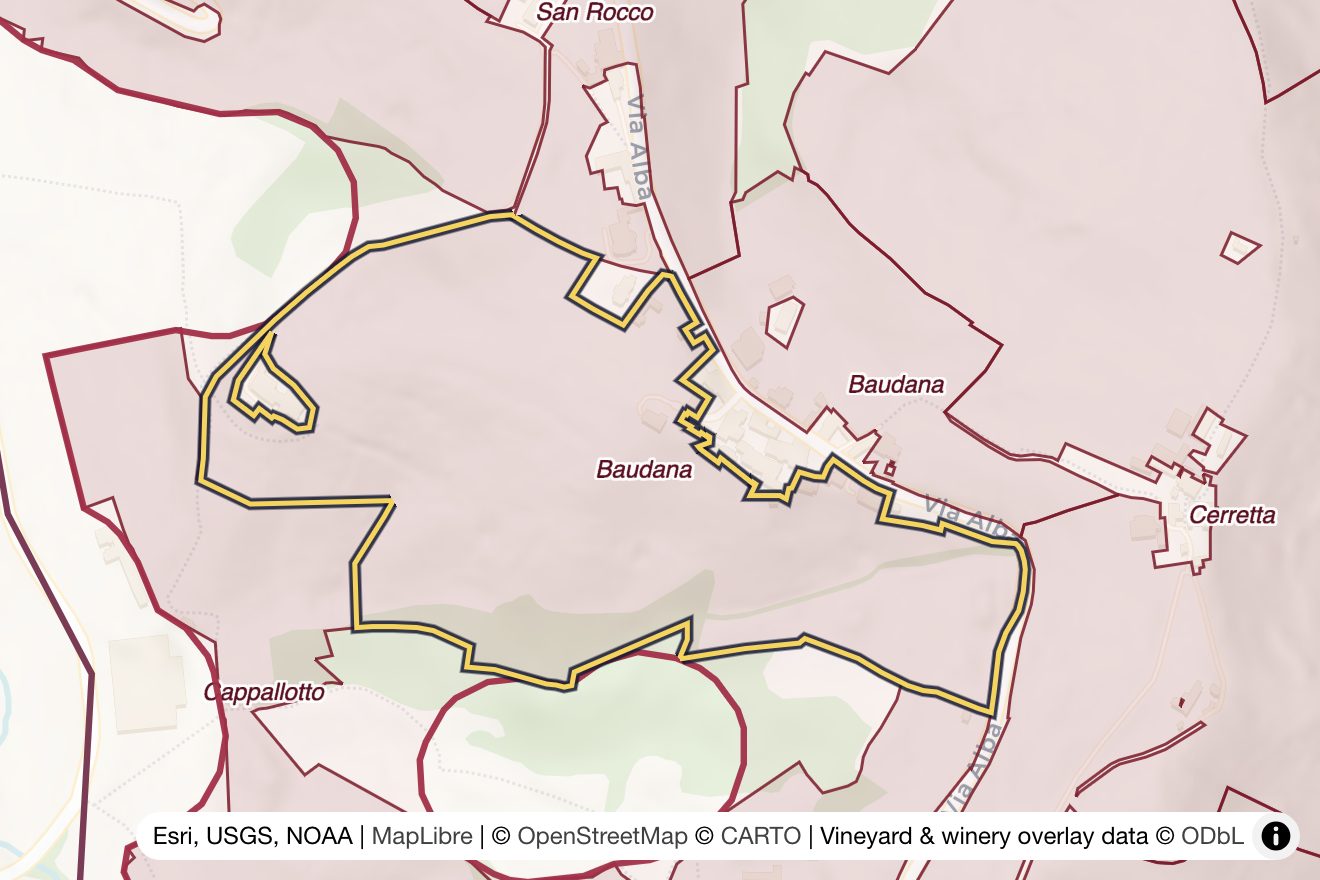
Introduction
The introduction of the MGA system has formalized the recognition of individual vineyard sites throughout the Barolo zone, creating an official registry that identifies these parcels as 'crus' even in the absence of an official quality classification. This system has particular significance for sites like Baudana, which may not enjoy the historical renown of their neighboring vineyards but nonetheless express distinct characteristics shaped by Serralunga's unique terroir.
The Serralunga d'Alba Context
To understand Baudana, one must first understand Serralunga d'Alba's position within the greater Barolo landscape. Serralunga d'Alba forms part of the eastern sector of the Barolo production zone, distinguished from the western communes of La Morra and Barolo by significant geological and stylistic differences. The commune has historical resonance beyond viticulture) it was here that Emanuele, Count of Mirafiori and son of King Vittorio Emanuele II, developed the vineyards around the royal hunting lodge of Fontanafredda, cementing Barolo's association with Italian nobility and its epithet as "the wine of kings, the king of wines."
Serralunga's reputation rests on producing Barolos of particular structure, power, and longevity. The wines from this commune are traditionally characterized by pronounced tannic architecture, requiring extended aging to reveal their full complexity. This stylistic profile distinguishes Serralunga's output from the often more immediately approachable and perfumed wines of La Morra, or the balanced elegance typical of Castiglione Falletto.
Terroir Considerations
While specific geological and microclimatic data for Baudana itself may be limited in the historical literature, the site operates within the broader terroir framework that defines Serralunga d'Alba. The soils of Serralunga generally belong to the Serravallian geological formation, characterized by compact, iron-rich marlstone and sandstone that impart distinctive qualities to Nebbiolo cultivated here.
The fundamental principles governing terroir and wine quality (particularly relevant to understanding any Serralunga MGA) center on soil physical characteristics and their regulation of water supply to the vine. Scientific consensus, following the foundational work of Dr. Gérard Seguin at the University of Bordeaux, emphasizes that soil physical properties, particularly those governing water availability, represent the primary influence on grape and wine quality beyond climate itself. The finest wines emerge from vineyards with exceptional drainage that provide steady but moderate, even limiting, water supply to the vines. Combined with appropriately restrictive mineral nutrition, this restrains vegetative growth, especially before veraison, and promotes smaller berries with favorable skin-to-juice ratios.
Serralunga's vineyard sites benefit from well-drained positions on hillside exposures, with the commune's topography creating a variety of mesoclimates across different MGAs. These physical soil attributes (texture, structure, depth, and drainage capacity) interact with the rootstock and vine variety, allowing skilled viticulturists to adapt their management strategies to optimize quality within each particular environment, a practice that might be described as "managing terroir."
Wine Characteristics
Barolos from Serralunga d'Alba, and by extension from sites like Baudana, typically express the commune's characteristic power and structural intensity. These are wines that showcase Nebbiolo's formidable tannic backbone, often requiring significant bottle age to integrate and soften. The tannins in Serralunga Barolos tend toward a firm, gripping quality that provides the architectural framework for extended aging (these are wines built for the cellar rather than immediate consumption.
In terms of aromatic and flavor profiles, Serralunga Barolos generally emphasize darker fruit tones, earth, and mineral notes, with the iron-rich soils potentially contributing to the distinctive ferrous character that can emerge with age. The classic descriptors for mature Nebbiolo) tar, roses, licorice, leather, and dried herbs, apply here, though the relative intensity and expression of these elements vary by specific site and vintage conditions.
Young Barolo from Serralunga, including from lesser-known MGAs, is by no means an inevitably pleasurable experience. The combination of substantial tannins and Nebbiolo's naturally high acidity creates wines that can appear austere and unyielding in their youth. This characteristic underscores the importance of aging, with many Serralunga Barolos requiring a decade or more to approach their optimal drinking windows.
The DOCG regulations for Barolo mandate a minimum alcoholic strength of 13%, though modern viticulture and warmer growing seasons often result in wines reaching 14% or higher. The mandatory aging requirements (38 months total, with at least 18 months in oak for standard Barolo, and 62 months total for Riserva designations) reflect the wine's need for time to develop complexity and approachability.
Production and Market Position
The phenomenon of single-vineyard bottlings emerged prominently in Barolo during the 1980s, marking a shift away from the traditional négociant model of blending wines from different provenances into house Barolos. This evolution had the paradoxical effect of focusing attention on individual producers rather than solely on vineyard sites, particularly for MGAs without centuries of established reputation. For a site like Baudana, the quality and recognition of the wines depend significantly on the skill and philosophy of the producers working the vineyard.
The MGA system has created both opportunities and challenges. While official designation provides legitimacy and allows producers to communicate site specificity on labels, it has also resulted in a proliferation of single-vineyard bottlings that can confuse consumers. The market has responded by gravitating toward established names (both producer names and the most historically prestigious cru designations) leaving lesser-known MGAs to build their reputations gradually through consistent quality.
The success of Langhe Nebbiolo as an "economy Barolo" has also impacted the broader market dynamics. This more accessible denomination, requiring less aging and commanding lower prices, has proven so successful that producers in other areas have modified regulations to permit Nebbiolo on their labels. For MGAs outside the top tier, this creates additional competitive pressure, as producers must justify the premium commanded by the Barolo DOCG designation and extended aging requirements.
Conclusion
Baudana represents the broader story of Barolo's designated vineyard sites (a formally recognized MGA that contributes to the denomination's diversity without occupying the spotlight reserved for the most historically celebrated crus. In Serralunga d'Alba, a commune known for powerful, structured, and age-worthy expressions of Nebbiolo, Baudana participates in a terroir tradition that emphasizes tannic intensity and the need for patience.
For wine enthusiasts exploring Barolo, MGAs like Baudana offer an opportunity to understand the denomination beyond its most famous names. These sites can provide compelling expressions of place at potentially more accessible price points, though success depends heavily on the skill of the producer and the vintage conditions. As with all Serralunga Barolos, wines from Baudana demand time) both the extended aging mandated by regulation and the additional bottle age that allows Nebbiolo's formidable structure to evolve into complexity and harmony.
The ongoing evolution of Barolo, driven by climate change, advancing viticultural knowledge, and shifting consumer preferences, will continue to reshape the hierarchy of vineyard sites. For now, Baudana remains part of the broader constellation of Serralunga MGAs, each contributing its distinct voice to one of Italy's most prestigious and traditional wine denominations.