Introduction
The establishment of the MGA system in the early 2010s addressed decades of confusion created by the proliferation of vineyard names on labels without official recognition or boundaries. While not a classification system per se) all MGAs are simply identified as "crus" without ranking (the formalization nonetheless separates officially recognized sites from the numerous informal vineyard designations that had accumulated over generations. Badarina's inclusion in this official roster confirms its status as a legitimate, historically-recognized vineyard site, even if it has not achieved the renown of Serralunga's most celebrated positions.
Serralunga d'Alba: Communal Context
To understand Badarina, one must first understand Serralunga d'Alba's distinctive character within Barolo. This commune represents the extreme expression of what might be called the "masculine" pole of Barolo) wines of formidable structure, imposing tannins, and legendary aging potential. If La Morra on the western side of the valley produces the more perfumed, earlier-maturing expressions of Nebbiolo, Serralunga delivers wines that demand patience and reward cellaring.
The commune's reputation rests on geological foundations quite different from those of its western neighbors. Serralunga's vineyards are predominantly planted on the Lequio formation, characterized by more compact, less calcareous soils than the Sant'Agata Fossili marls that dominate La Morra and much of Barolo village. These Serravallian-epoch soils, dating from roughly 12 to 15 million years ago, contribute to wines of greater austerity, more pronounced tannin, and slower evolution in bottle.
Beyond geology, Serralunga's topography plays a crucial role. The commune occupies some of Barolo's highest elevations, with many vineyards positioned on steep, exposed slopes that benefit from excellent drainage and significant diurnal temperature variation. This combination of factors (geological, topographical, and climatic) produces wines that typically show darker fruit character, more obvious structural backbone, and less overt aromatic flamboyance in their youth compared to wines from the Tortonian formations to the west.
The Challenge of Documentation
Unlike Serralunga's most famous sites, Badarina has not been extensively documented in the canonical literature on Barolo. It is covered in Alessandro Masnaghetti's comprehensive MGA maps and references, though it sits outside the "first tier" of Serralunga's best-known crus. This absence from the "first tier" of recognized crus does not invalidate the site (many perfectly legitimate MGAs produce excellent wine without achieving the fame of their neighbors) but it does mean that wine enthusiasts should approach Badarina with an understanding that it represents a less celebrated position within an illustrious commune.
The relative scarcity of critical commentary and historical documentation suggests that Badarina, though bottled as a named cru by Bruna Grimaldi and a few others, has not drawn the sustained attention of major estates over multiple generations (the kind of attention that elevates sites like Lazzarito or Francia to canonical status. This pattern is common in Barolo, where a small number of crus have historically commanded premium prices and attracted the most investment in vineyard management and winemaking resources, while numerous other legitimate sites have operated in their shadows.
Terroir Considerations
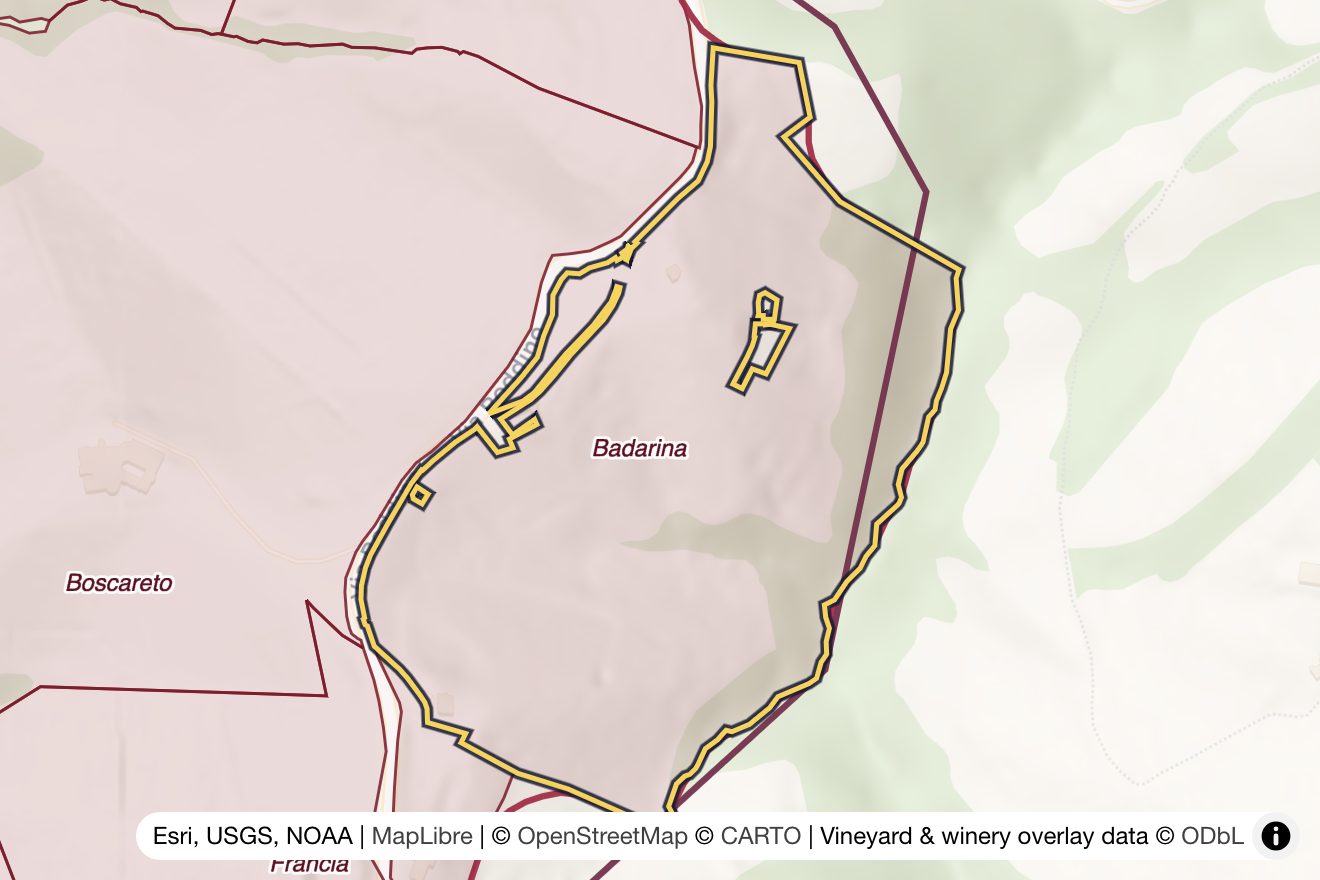
Badarina lies at the southern end of the Serralunga ridge, one of the commune's higher sites at roughly 350 to 450 m, on steep slopes facing broadly southeast, and general principles of Serralunga terroir also apply while acknowledging the significant variation that exists within any commune. Serralunga's vineyards span considerable elevation ranges and multiple exposures, creating a patchwork of mesoclimates and soil variations that can produce notably different expressions even within the same general area.
What can be stated with confidence is that any vineyard in Serralunga benefits from the commune's fundamental geological substrate and its position within the Barolo zone's climate. The Lequio formation soils typical of Serralunga offer moderate fertility and good drainage) both factors identified by Bordeaux researcher Gérard Seguin as more crucial to wine quality than specific soil chemistry. These physical soil attributes, combined with appropriate rootstock selection and canopy management, allow vignerons to regulate water availability and vegetative growth in ways that optimize grape ripening and phenolic development.
The microclimate of any specific Serralunga vineyard depends heavily on its precise exposition and elevation. South and southwest exposures maximize solar radiation and heat accumulation, potentially leading to riper tannins and more concentrated fruit. East-facing slopes receive gentler morning sun, while west-facing positions capture afternoon heat. Higher elevations introduce greater diurnal temperature variation, which can help preserve acidity and aromatic complexity during the ripening period. Without detailed information about Badarina's specific positioning, these remain general considerations rather than definitive characterizations.
Wine Character and Identity
Wines from lesser-documented Serralunga sites like Badarina would be expected to display the commune's general stylistic signature (structured, tannic, potentially austere in youth, with the darker fruit spectrum (black cherry, blackberry, plum) rather than the more ethereal red fruit and floral notes associated with Tortonian sites in La Morra. The tannin profile should show Serralunga's characteristic grip and granular texture, requiring either extended aging or modern extraction techniques to achieve approachability.
However, Badarina's specific expression within this general Serralunga framework remains incompletely documented. This assessment requires nuance: many factors beyond raw terroir potential influence a vineyard's reputation, including the ambitions and resources of the landowners, the age of the vines, viticultural practices, and simple historical accident.
The MGA System and Market Reality
The formalization of Badarina as an MGA represents both validation and clarification. It confirms the site's legitimate historical identity and provides legal protection for its name. Under current regulations, the word "vigna" (vineyard) can only appear on labels if accompanied by the official MGA designation, preventing the proliferation of invented or informal vineyard names that characterized earlier eras.
Yet official recognition does not automatically confer market prestige. In practice, the MGA system has reinforced existing hierarchies as much as it has challenged them. Collectors and knowledgeable consumers continue to seek wines from historically celebrated sites, while lesser-known MGAs like Badarina must prove their worth through consistent quality and distinctive character. This dynamic reflects a fundamental reality of terroir-based wine regions: official classifications and registrations can identify and protect sites, but only sustained evidence of exceptional wine quality can establish lasting reputations.
Conclusion
Badarina occupies an instructive position in Barolo's complex landscape) officially recognized yet historically undercelebrated, legitimately part of an illustrious commune yet absent from the canonical lists of legendary crus. For wine enthusiasts, such sites present both challenges and opportunities. The challenge lies in the scarcity of critical guidance and benchmark bottlings; the opportunity exists in potentially discovering distinctive expressions at prices below those commanded by famous neighbors.
Approaching a wine from Badarina requires contextual awareness: expect Serralunga's characteristic structure and power, but understand that this particular site has not demonstrated the consistent excellence or distinctive personality that defines the commune's most celebrated positions. Whether this reflects intrinsic terroir limitations, insufficient historical focus and investment, or simply the vagaries of reputation-building in a crowded field remains an open question, one that committed producers and patient consumers may yet answer through dedicated work in the vineyard and cellar.