Introduction
The MGA system, introduced to bring order to the proliferation of single-vineyard bottlings that emerged from the 1980s onward, paradoxically both clarified and complicated Barolo's geographical nomenclature. While it provided official recognition to numerous sites, it did so without distinguishing between the historical elite and the broader population of registered vineyards. Case Nere thus exists within this official framework as a recognized cru, subject to Barolo's stringent production standards) maximum yields of 56 hectoliters per hectare and mandatory aging of 38 months with at least 18 months in oak (yet without the accumulated prestige or critical documentation that defines the zone's most celebrated sites.
Terroir
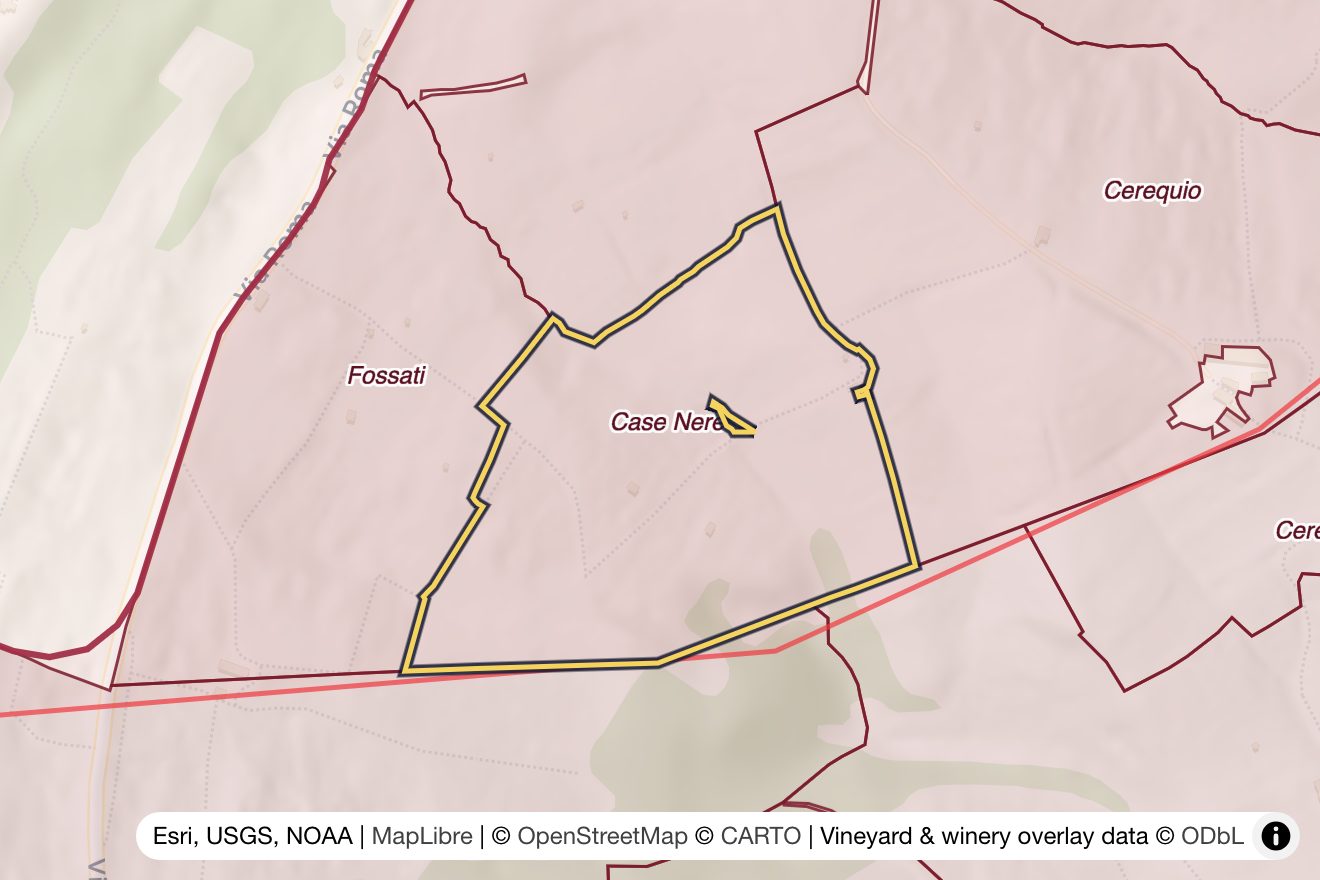
Case Nere lies in La Morra, west of the Alba-Barolo road; for contrast, consider Monforte d'Alba. The commune sits firmly on the eastern side of the Alba-Barolo road, which serves as more than a mere transportation route) it functions as a geological dividing line that fundamentally shapes the character of Barolo itself. This eastern sector, encompassing Monforte d'Alba alongside Castiglione Falletto and Serralunga d'Alba, is characterized by soils from the Helvetian epoch, distinguished by their higher proportion of compressed sandstone compared to the calcareous marls that dominate the western communes of La Morra and Barolo.
These Helvetian soils are notably less fertile than their Tortonian counterparts to the west, a characteristic that profoundly influences vine behavior and wine structure. The sandstone-rich composition provides excellent drainage while limiting vigor, compelling vines to struggle in ways that, paradoxically, favor the production of concentrated, structured wines. The physical attributes of these soils (their density, water-holding capacity, and mineral composition) create what researchers following the foundational work of Professor Gérard Seguin of the University of Bordeaux have identified as ideal conditions for quality: moderate fertility with well-regulated, moderately sufficient water supply.
The implications for Nebbiolo are significant. While the Tortonian marls of western Barolo can produce wines described as softer, fruitier, and more immediately aromatic, the Helvetian formations of Monforte tend toward wines of greater structure, firmer tannins, and enhanced aging potential. This is not to suggest that Monforte's wines lack aromatics or elegance (the finest examples demonstrate remarkable complexity) but rather that their architectural framework differs fundamentally from their western counterparts.
Monforte d'Alba's topography adds further nuance. The commune's vineyards occupy complex, often steep terrain where elevation, aspect, and exposure create significant meso-climatic variation even within small areas. These factors (slope angle affecting drainage and sun exposure, elevation influencing temperature and diurnal variation, aspect determining the intensity and duration of solar radiation) interact with soil composition to create what viticulturists term "terroir units," distinct zones where environmental conditions shape vine physiology and grape development in measurable ways.
Wine Characteristics
Wines from Monforte d'Alba's Helvetian soils typically express Nebbiolo's more austere, structural personality. The variety's inherent characteristics (pronounced tannins, elevated acidity, and complex aromatic evolution) find particular emphasis in this geological context. The sandstone influence tends to produce wines of notable grip and persistence, with tannin structures that require extended aging to fully integrate and soften.
The aromatic profile of Monforte Barolo generally emphasizes darker fruit tones (black cherry, plum, blackberry) rather than the red fruit brightness often associated with Tortonian sites. These fruit characteristics interweave with Nebbiolo's classic secondary and tertiary descriptors: tar, leather, tobacco, dried flowers, and that elusive note of white truffles that marks the variety's most profound expressions. The wines' acidity, a defining feature of Nebbiolo regardless of origin, provides both immediate freshness and the structural backbone necessary for decades of evolution.
Case Nere, a La Morra site, falls outside this Monforte profile, and it lacks the long reputation of historically acclaimed crus like Bussia or Ginestra. This is not a qualitative judgment so much as a recognition that certain sites, through some combination of geological fortune, optimal exposure, and historical selection, consistently produce wines of exceptional distinction. The finest Monforte sites yield Barolos of formidable power and longevity, wines that demand patience but reward it with extraordinary complexity.
Production and Recognition
Producers bottling Barolo from Case Nere include Enzo Boglietti and Roberto Voerzio, whose Fossati Case Nere Riserva blends fruit from the two neighbouring sites. This relative obscurity distinguishes it from the best-known Barolo sites, which have been recognized in both written tradition (from Lorenzo Fantini in the late 19th century through modern authorities like Renato Ratti and Alessandro Masnaghetti) and in the economic reality of higher prices paid for their grapes and wines.
This situation reflects a broader reality within Barolo: the introduction of the MGA system formalized geographical boundaries without addressing the fundamental question of hierarchical classification. While certain vineyards enjoy consensus recognition among most serious observers, the official system treats all registered MGAs as equivalent "crus," leaving quality distinctions to the market, critics, and accumulated reputation. Case Nere exists within this framework as a recognized but not celebrated site, potentially valuable for producers seeking to bottle site-specific wines at various quality and price tiers below their most prestigious offerings.
Conclusion
Case Nere occupies a position common to many of Barolo's lesser-known MGAs: officially recognized, subject to the denomination's exacting standards, and expressive of La Morra's terroir, yet without the accumulated prestige or documented excellence that defines the zone's aristocratic sites. For consumers, this suggests wines that sit within Barolo's quality framework, while perhaps lacking the additional complexity or site-specific distinction that justifies the premium prices commanded by historically recognized crus. In a denomination where site matters profoundly but where over 170 MGAs compete for attention, Case Nere remains, for now, among the majority rather than the celebrated few.