Introduction
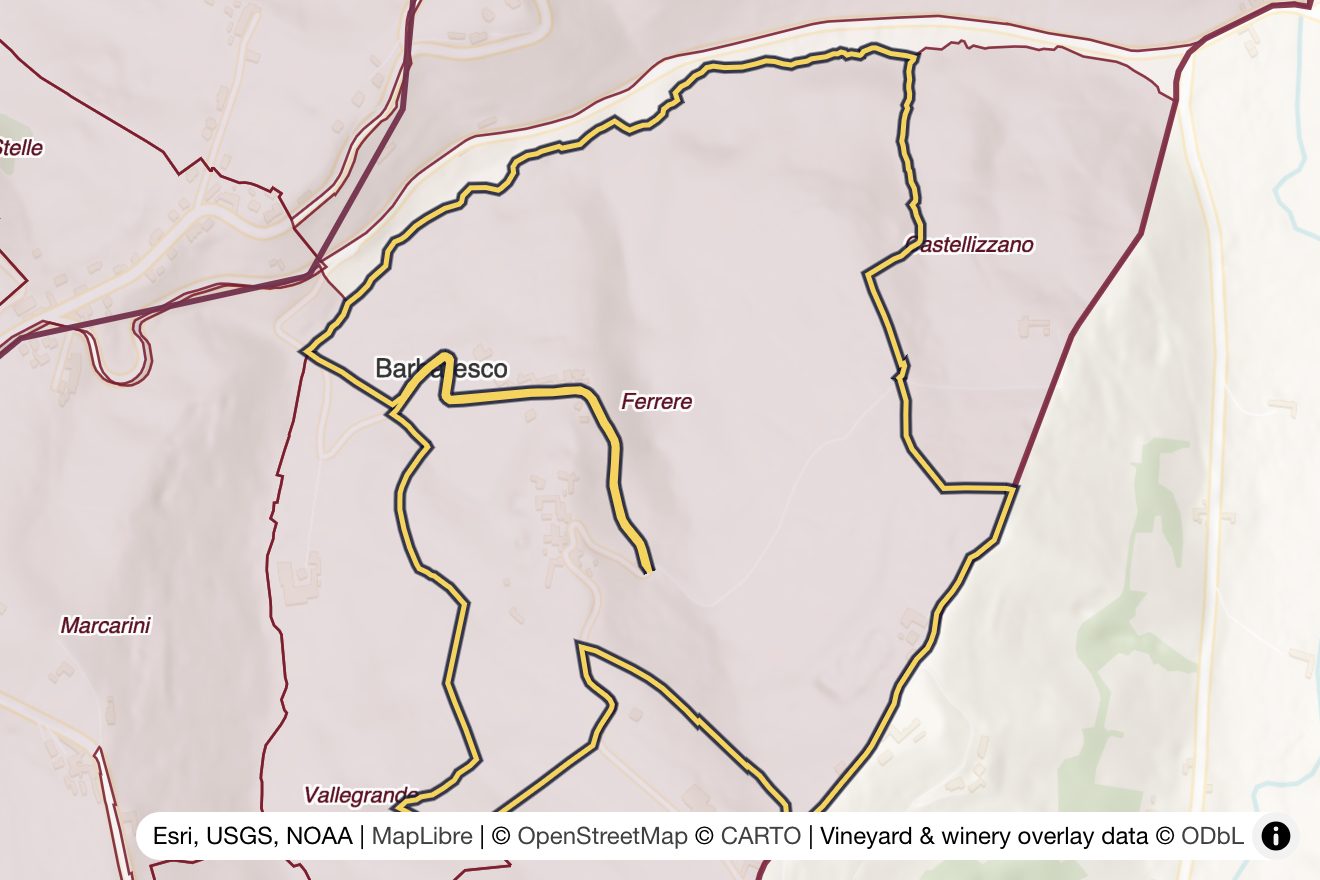
The 2007 MGA classification was notable for its integrity, as the official list "sensibly retained almost all the historically known vineyards, rarely absorbing them in more famous vineyard names for commercial reasons." This approach preserved the authentic historical geography of Barbaresco's winemaking landscape, ensuring that sites like Ferrere maintained their individual identity rather than being subsumed into larger, more commercially recognized names.
Context Within Barbaresco
Barbaresco itself occupies a compact viticultural zone northeast and east of Alba, covering approximately 733 hectares as of 2019, roughly one-third the size of neighboring Barolo. The denomination spans three principal townships: Barbaresco, Treiso, and Neive, with a small portion extending into Alba. This relatively intimate scale has fostered deep knowledge of individual vineyard sites, even as the historical documentation of these crus developed later than in Barolo.
The evolution of single-vineyard recognition in Barbaresco follows a relatively recent trajectory. While Prunotto released the first single-vineyard Barbaresco (Montestefano) in 1961, systematic documentation of the zone's finest positions emerged primarily in the 1960s and 1970s through the work of Luigi Veronelli and Renato Ratti. Lorenzo Fantini's late 19th-century monograph on Piedmontese viticulture indicated surprisingly few "choice positions" in Barbaresco compared to Barolo, with none whatsoever documented in Neive at that time.
Market forces eventually established consensus around the most prestigious sites. By the late 20th century, certain vineyards commanded premium prices based on négociants' willingness to pay more for their grapes. The top tier included Asili, Montefico, Montestefano, and Rabajà in the comune of Barbaresco; Albesani and Gallina in Neive; and Pajorè in Treiso. Other sites gained prominence through the dedicated efforts of individual producers (San Lorenzo, Tildin, and Martinenga in Barbaresco, and Santo Stefano in Neive achieved recognition through the exacting standards of producers like Gaja, Giacosa, and Alberto di Gresy.
Barbaresco's Character and Terroir Philosophy
Understanding any Barbaresco MGA requires appreciating the denomination's broader stylistic identity. Barbaresco earned its DOCG designation in 1980 with aging requirements of 26 months total (nine in wood) for the normale, and 50 months total for Riserva) notably shorter than Barolo's requirements. This led to the persistent misconception that Barbaresco is less age-worthy, a false assumption that unfortunately prompted some producers to emulate Barolo's power rather than honor Barbaresco's distinctive elegance.
While often characterized as lighter-bodied than Barolo, this description belies Barbaresco's substantial structure. These wines must achieve a minimum alcoholic strength of 12.5% and routinely reach 13.5%. More importantly, they possess the substantial tannins and bracing acidity that define Nebbiolo, making young Barbaresco far from immediately approachable. The distinction lies not in weight but in aromatic intensity and textural finesse (qualities heavily influenced by site-specific terroir factors.
Contemporary scientific understanding emphasizes that soil's physical characteristics, particularly those governing water supply to the vine, represent the primary terroir influence beyond climate. The finest vineyard sites typically feature well-drained soils that provide steady but moderate) even limiting (water supply. This regulated hydric stress, combined with appropriate mineral nutrition, restrains shoot-tip growth especially before veraison, resulting in smaller berries less prone to congestion and compression within bunches. These physical soil attributes matter more than chemical composition in determining wine quality and character.
Winemaking Evolution
Barbaresco's winemaking philosophy has undergone significant evolution, directly impacting how individual MGAs express themselves. Traditional techniques favored prolonged maceration and extended aging in large Slavonian oak casks. During the 1970s and 1980s, many producers shifted toward shorter macerations and aging in French barriques, pursuing rounder, fruitier wines aligned with modern international tastes. Traditional winemakers criticized this approach, arguing that French oak suppressed Nebbiolo's delicate perfume.
Recent decades have witnessed a return to extended maceration) often up to 40 days (and aging in large format oak vessels rather than barrique. This neo-traditional approach allows individual vineyard sites to express their inherent character more clearly. The signature Barbaresco profile encompasses aromatics of cherry and violet in youth, evolving with age toward complex notes of iron, tar, and orange peel) nuances that site-specific terroir can either amplify or modulate.
Historical Development
Barbaresco as a distinct wine emerged relatively recently. The name appeared on labels only from 1894, when Domizio Cavazza, professor at Alba's Oenological School, founded the Barbaresco cooperative (predecessor to today's esteemed Produttori del Barbaresco). Prior to this, wines from the Barbaresco zone were often blended into Barolo to add freshness. Unlike Barolo, Barbaresco lacked connections to the House of Savoy and Turin's noble court, suffering relative commercial obscurity until the 1960s, when Giovanni Gaja and Bruno Giacosa demonstrated the wine's full potential.
The work of the Produttori del Barbaresco cooperative proved particularly influential in establishing quality benchmarks and promoting individual vineyard recognition. Operating as one of Italy's finest cooperatives, the Produttori bottles wines from individual MGAs, creating a compelling comparative framework for understanding site distinctions. Meanwhile, pioneering private producers advanced Barbaresco's reputation while some newer, smaller estates have embraced organic and biodynamic viticulture alongside traditional winemaking techniques, producing muscular, long-lived wines with distinctive personality.
Conclusion
Ferrere stands as one component of Barbaresco's intricate mosaic of officially recognized vineyard sites. The 2007 MGA system provided formal structure to centuries of empirical vineyard knowledge, preserving historical authenticity while establishing clear geographic boundaries. As Barbaresco continues evolving (with plantings expanding from 484 hectares in the early 1990s to over 733 hectares today) the MGA framework ensures that individual sites maintain distinct identity. Understanding any single Barbaresco vineyard requires appreciating both the denomination's shared characteristics and the subtle terroir variations that make each site unique within this compact but complex winegrowing zone.