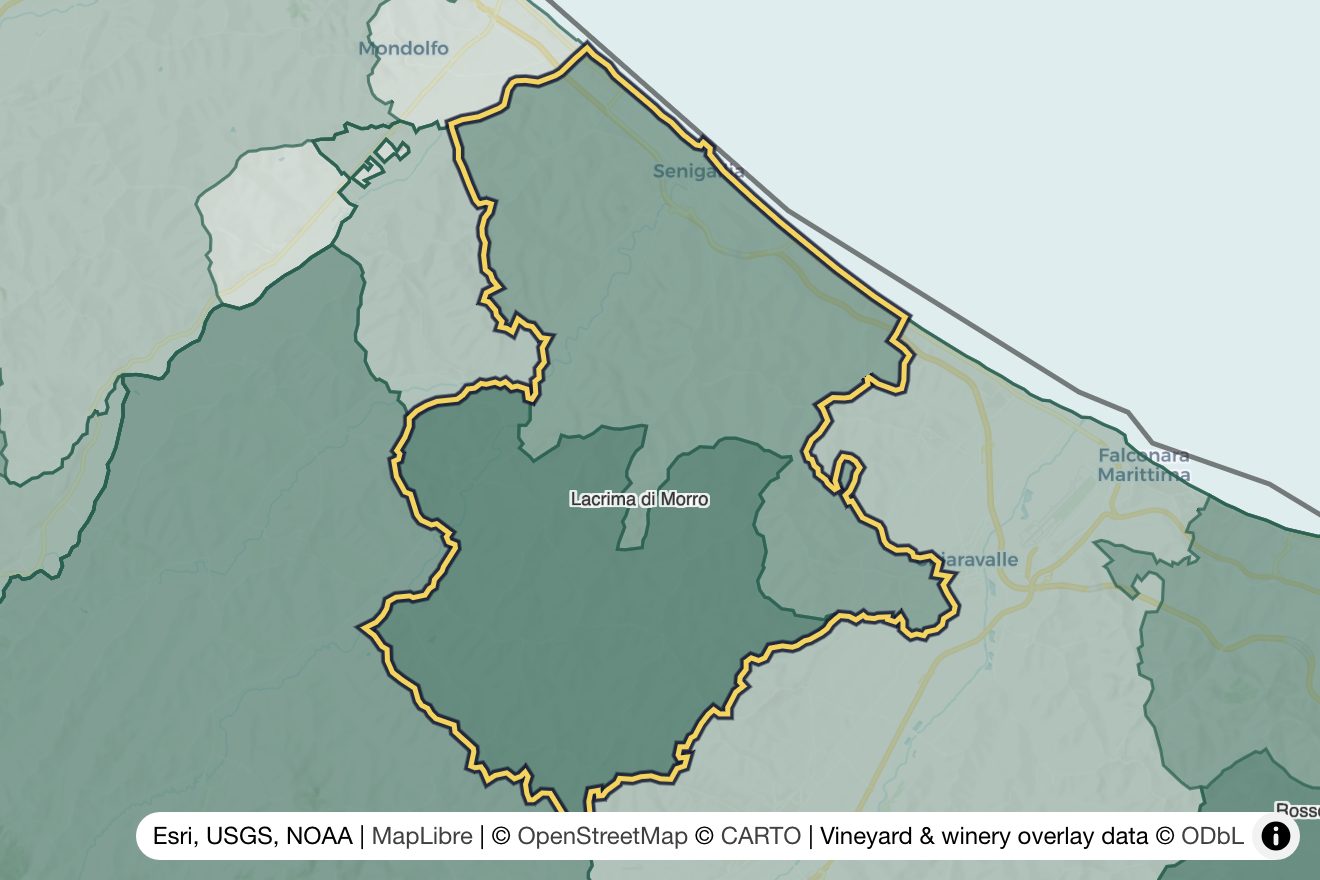
The Lacrima Grape: Aromatic Intensity in a Sea of Structure
The Lacrima grape (sometimes called Lacrima di Morro d'Alba to distinguish it from unrelated varieties) is an indigenous red cultivar that defies the structural, age-worthy profile typical of Marche reds like Montepulciano or Sangiovese. Instead, Lacrima delivers immediate, explosive aromatics (most notably wild strawberry, rose petal, and violet) with a soft, approachable tannic structure. The wines are fast-maturing, designed for early consumption rather than extended cellaring.
This represents a fundamental philosophical departure from neighboring appellations. While producers in Offida to the south chase concentration and longevity with their Montepulciano-based reds (minimum 85% Montepulciano for Offida DOCG), and Verdicchio producers build reputations on mineral-driven white wines with aging potential, Lacrima di Morro d'Alba traffics in perfume and immediacy.
Geography and Terroir
The Lacrima zone sits within the broader Verdicchio dei Castelli di Jesi territory, in the province of Ancona. The vineyards occupy hillside positions in the undulating landscape characteristic of the Marche's interior: a region defined by parallel valleys running perpendicular to the Adriatic coast. These valleys funnel maritime influences inland while the Apennines to the west provide a rain shadow effect.
The soils here share characteristics with the surrounding Verdicchio zone: predominantly calcareous marl and clay mixtures typical of the Marche's sedimentary geology. However, the specific microclimate around Morro d'Alba (slightly cooler than the lower-lying Verdicchio vineyards closer to the coast) appears crucial for preserving Lacrima's delicate aromatic compounds. The grape's thin skins make it vulnerable to both heat stress and fungal pressure, requiring careful site selection and timing.
Wine Characteristics: Perfume Over Power
Lacrima di Morro d'Alba wines are immediately recognizable by their aromatic profile. The wild strawberry descriptor is not metaphorical: the wines genuinely smell like crushed fresh strawberries, often accompanied by rose petals, violets, and occasionally a spicy note reminiscent of white pepper. This aromatic intensity comes from high concentrations of terpenes and other volatile compounds in the grape skins.
The palate typically shows medium body with soft tannins and moderate acidity. Alcohol levels generally range from 12.5% to 13.5%, keeping the wines light on their feet. The color can be surprisingly pale for a red wine, sometimes showing garnet or ruby hues with slight orange tinges even in youth. This is not a wine built for the cellar. Most producers and critics recommend consumption within 2-4 years of vintage, while the primary fruit aromatics remain vibrant.
Some producers experiment with brief skin maceration to preserve the aromatic intensity while minimizing tannin extraction: a technique that acknowledges the grape's essential character. Others produce a passito (dried grape) version, concentrating the aromatics and sugars into a dessert wine format.
The Context: An Aromatic Exception
The Marche's reputation rests primarily on two pillars: Verdicchio's mineral-driven whites and Montepulciano-based reds (whether from Conero or Offida). Lacrima di Morro d'Alba fits neither template. Where Verdicchio di Castelli di Jesi can age for a decade or more, developing honeyed complexity, and Offida Rosso demands patience for its tannins to integrate, Lacrima offers instant gratification.
This makes Lacrima something of an outlier in a region that has increasingly positioned itself around serious, age-worthy wines. The recent elevation of Offida to DOCG status (early 2010s) and the focus on lowering yields for Pecorino and Passerina reflect an ambition toward quality and longevity. Lacrima, by contrast, embraces ephemerality.
Production and Viticultural Challenges
The limited hectarage reflects genuine viticultural challenges. Lacrima's thin skins make it susceptible to downy mildew and botrytis in humid conditions: a constant risk in the Marche's maritime-influenced climate. The grape also ripens relatively early, requiring harvest timing that captures aromatic potential before the delicate compounds volatilize in late summer heat.
Yields must be carefully managed. Push the vines too hard, and the already-soft structure becomes dilute; the aromatics lose definition. Restrict yields excessively, and the wines can become jammy, losing their characteristic freshness. Finding this balance has kept Lacrima a specialist's grape rather than a commercial workhorse.
The Appellation's Future
Lacrima di Morro d'Alba remains a niche within a niche: a small appellation in a region that itself plays second fiddle to Tuscany and Piedmont in the international imagination. Yet this obscurity may be its strength. The wines offer something genuinely distinctive: an aromatic profile that stands apart in Italy's red wine landscape, and a drinking style that doesn't demand years of patience or deep pockets.
Whether Lacrima can expand beyond its current cult following depends partly on broader market trends. If the wine world continues its infatuation with immediate drinkability and distinctive aromatics over power and structure, Lacrima has a story to tell. The challenge is getting anyone to listen.
Sources:
- Robinson, J., Harding, J., and Vouillamoz, J., Wine Grapes (2012)
- Robinson, J. (ed.), The Oxford Companion to Wine, 4th edition (2015)