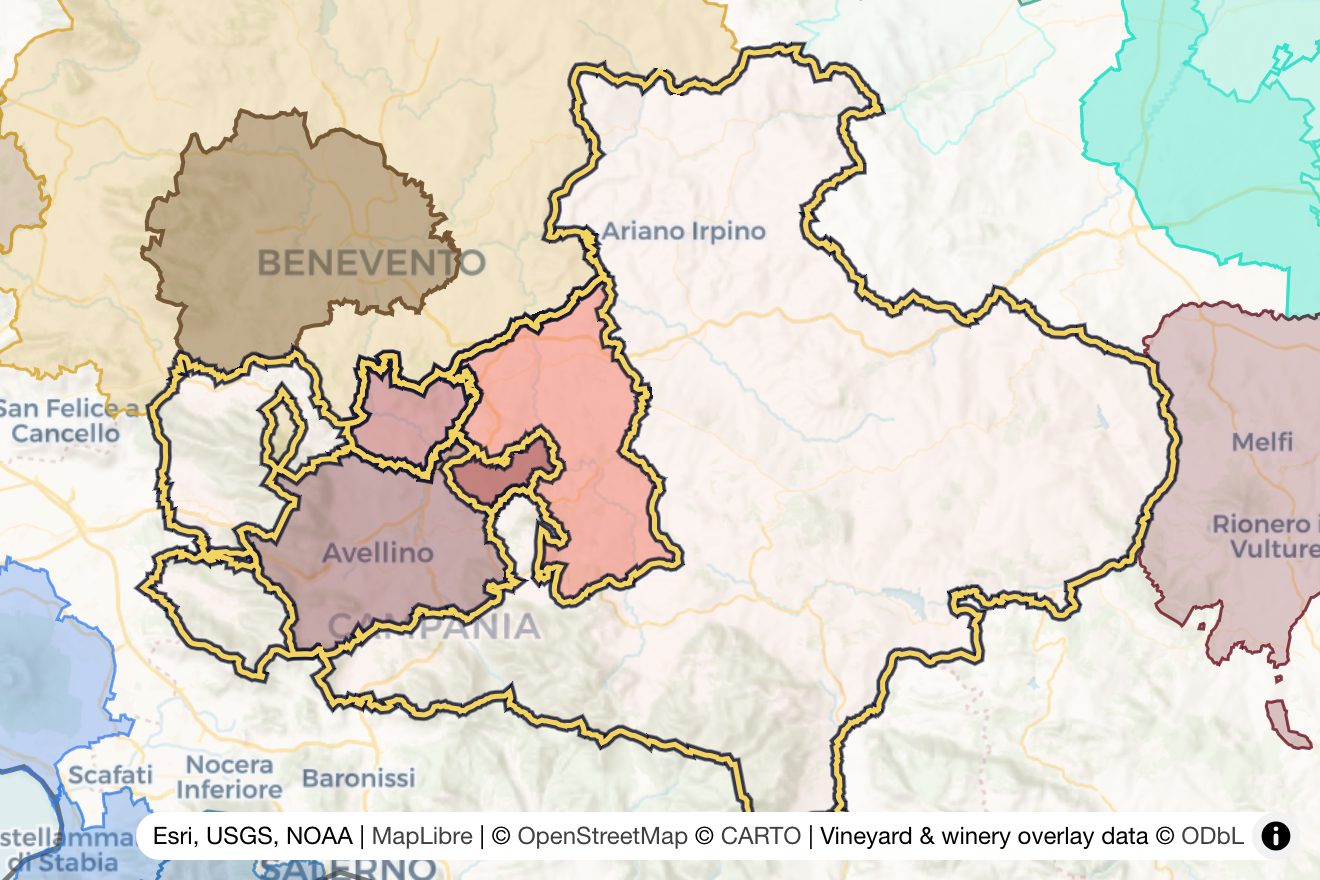
Overview
Irpinia is the historic name of the province of Avellino, the mountainous interior of Campania in southern Italy, and since 2005 a DOC covering its wines. The district is the region's fine wine engine: within its bounds sit Campania's three original DOCGs, Taurasi for Aglianico, Fiano di Avellino and Greco di Tufo, with the Irpinia DOC serving as the surrounding designation for varietal Aglianico, Falanghina, Coda di Volpe and the area's other wines.
History
Irpinia's viticulture is ancient, tied to the Greek and Roman settlement of Campania; the names of its grapes, Greco and Aglianico among them, carry that lineage. The phylloxera era and rural emigration reduced the district, and its twentieth-century survival owed much to a single house: Mastroberardino of Atripalda, which maintained the native varieties, above all Aglianico and Fiano, through decades when replanting to easier grapes was the commercial norm. Taurasi received its DOCG in 1993, Fiano di Avellino and Greco di Tufo in 2003, and the umbrella Irpinia DOC followed in 2005, by which time a generation of new estates had grown up around the historic one.
Terroir & Climate
The district is upland: vineyards commonly lie between 300 and 700 metres in the Apennine foothills, on clay and limestone enriched by volcanic ash and pumice from Vesuvius and the Campi Flegrei. The climate is continental for the latitude, with cold winters, real diurnal range, and harvests among Italy's latest; Aglianico for Taurasi is routinely picked into November. Altitude and volcanic soil together explain the district's paradox: southern latitude, northern structure.
Grape Varieties & Wine Styles
Aglianico is the red foundation, producing under the Irpinia DOC in younger, earlier-drinking form and reaching its full dimension in Taurasi: tarry, dark-fruited, ferrous wine of high acidity and firm tannin with decades of aging capacity. The whites divide by village and soil: Fiano di Avellino gives textured, hazelnut-and-orchard wines that age remarkably; Greco di Tufo, from tuff soils around its namesake village, firmer, smokier, more mineral expressions. Falanghina and Coda di Volpe supply the district's fresher whites under the DOC.
Notable Producers
Mastroberardino remains the district's historic reference. Feudi di San Gregorio, founded in 1986, is its largest modern estate and principal international presence. Quintodecimo, the estate of oenologist Luigi Moio, Pietracupa, Ciro Picariello, Guido Marsella and Colli di Lapio for Fiano, and Benito Ferrara for Greco, lead a dense tier of small growers.
What to Know
Irpinia is both a place and a DOC label; the district's summit wines carry the three DOCG names, with Irpinia-designated bottles typically the earlier or broader expressions of the same estates. The district's wines run structural rather than sunny, and the whites are among Italy's most age-worthy, a point still under-recognized in the market. Elevation is the constant behind the style.