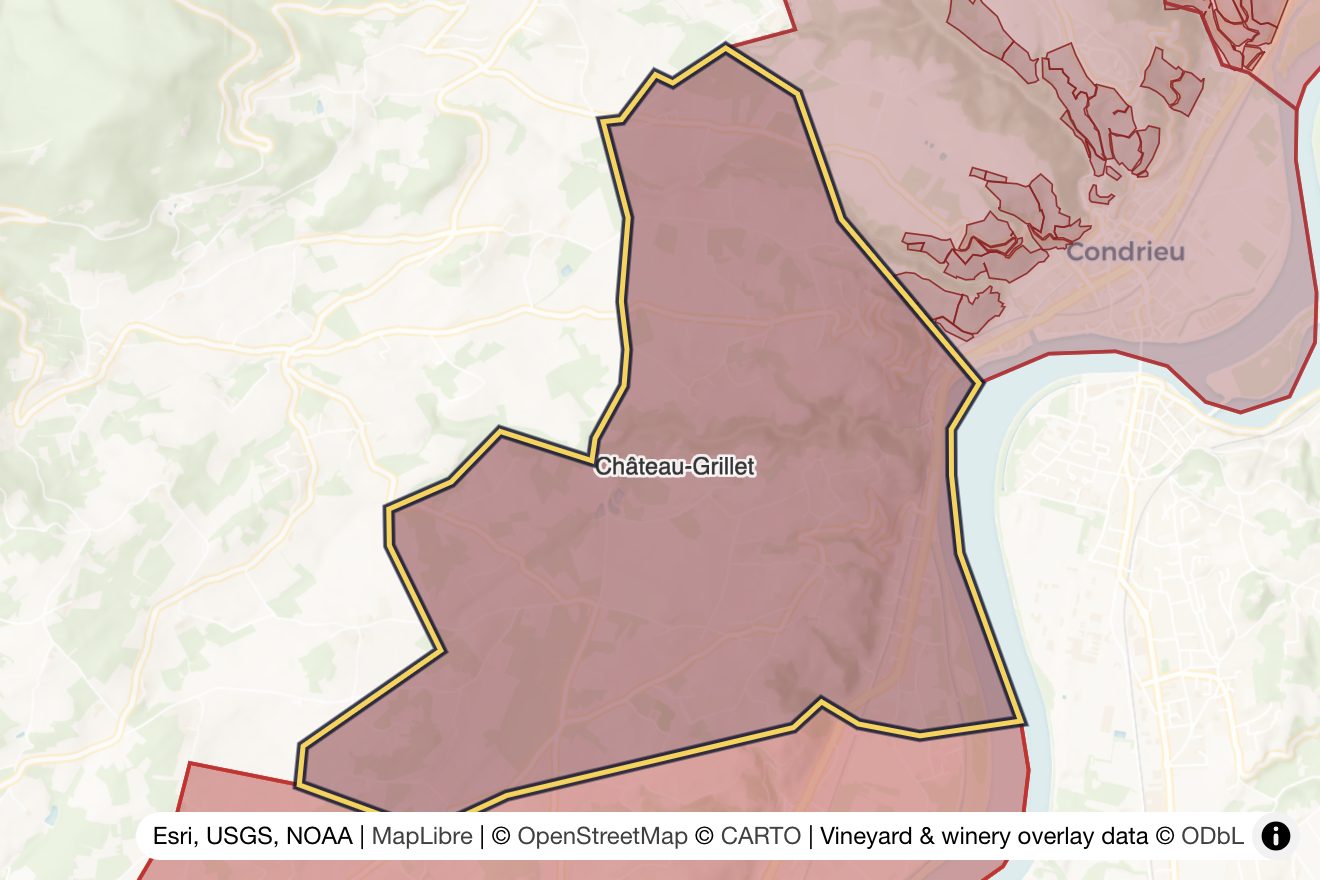
The appellation received official AOC status in 1936, making it one of the earliest recognized French wine regions. In 1976, it was declared a National Heritage site. Yet despite this official recognition and centuries of cultivation dating to Roman times, Château-Grillet has long divided critics. Some praise its capacity for extended aging and distinctive mineral character; others question whether its wines justify their premium pricing compared to top Condrieu bottlings.
Geography & The Amphitheatre Effect
Château-Grillet sits between the communes of Vérin and St-Michel-sur-Rhône in the Northern Rhône, forming an enclave within the broader Condrieu zone. The vineyard occupies a natural amphitheatre: a geological formation that creates a dramatically different mesoclimate from surrounding areas.
The site faces south-southeast, with steep terraced slopes that capture maximum solar radiation. The amphitheatre's curved topography shields vines from cold northern winds while concentrating heat. This sheltered position creates what viticulturists call a "heat trap." The estate's name derives from this phenomenon: "grillet" refers to hillsides roasted by intense sun exposure.
Elevation ranges from approximately 150 to 250 meters above sea level across the narrow terraces. The gradient is severe enough that vineyard work remains entirely manual. The proximity to the Rhône River (visible from the upper terraces) moderates temperature extremes, though the amphitheatre effect generally produces warmer conditions than found in most Condrieu sites.
Prior to 1971, only 1.7 hectares were planted, making Château-Grillet temporarily France's smallest appellation. The expansion to 3.5 hectares doubled production capacity but maintained the estate's boutique scale.
Terroir: Granite Decomposition & Arzelle
The geological foundation is granite, specifically, the same Massif Central granite that underlies much of the Northern Rhône's finest sites. However, Château-Grillet's granite has undergone extensive weathering, creating a distinctive soil profile.
The topsoil consists of decomposed granite mixed with a local element called arzelle, a powdery, mica-rich sand that results from granite breakdown. This sandy, free-draining material forces vines to root deeply in search of water and nutrients. The mica content contributes to excellent drainage while the granite base provides what growers describe as "freshness" to the wines, likely a function of moderate water stress and the soil's thermal properties rather than any direct mineral flavor transfer.
Unlike the alluvial deposits and loess found in some Condrieu sites, Château-Grillet's pure granite origin creates uniformly well-drained conditions across all terraces. The soil depth varies considerably: upper terraces feature shallower soils with more exposed rock, while lower sections have deeper accumulations of decomposed material.
The scientific literature on terroir (van Leeuwen and de Rességuier, 2018) emphasizes that soil influence on wine character operates indirectly through water and nutrient availability rather than through any literal mineral transfer. Château-Grillet's granite-derived soils regulate vine vigor through moderate fertility and controlled water stress, conditions that typically promote concentration and phenolic development in grapes.
Viticultural Approach: Old Vines & Recent Modernization
Until 2011, Château-Grillet remained in the Neyret-Gachet family, who acquired the property in 1825. Isabelle Baratin, the last family owner, sold the estate to François Pinault's Artemis holding company: the same entity that owns Château Latour in Pauillac.
The Pinault acquisition triggered comprehensive modernization. In 2012, the winemaking facilities underwent complete renovation, including installation of modern stainless steel fermentation vats. Alessandro Noli assumed winemaking responsibilities that same year, bringing technical precision to a property that had operated somewhat traditionally under family management.
The vineyard itself contains old-vine Viognier, though specific planting dates for individual parcels remain unpublished. The steep terracing requires hand-harvesting and manual vineyard maintenance. Yields are naturally low, both from vine age and the stress imposed by shallow, sandy soils.
Viognier presents particular viticultural challenges. The variety achieves physiological ripeness in a narrow window; harvest too early and wines taste green and bitter; wait too long and alcohol soars while aromatic intensity diminishes. The amphitheatre's heat accumulation accelerates ripening, requiring careful monitoring during harvest season.
Winemaking Philosophy: Elegance Over Power
Fermentation can occur in stainless steel tanks or French oak barrels, depending on parcel characteristics and vintage conditions. This flexibility represents post-2012 modernization, earlier vintages relied more exclusively on barrel fermentation.
The wine ages for approximately 18 months in French oak barrels, with roughly 20% new wood. This relatively modest new oak percentage aims to preserve Viognier's aromatic intensity rather than imposing heavy toast or vanilla flavors.
The stylistic goal post-acquisition has emphasized elegance and aging potential over immediate richness. This distinguishes Château-Grillet from many Condrieu producers, who often pursue opulent, fruit-forward profiles designed for early consumption.
Wine Characteristics: The Aging Question
The fundamental debate surrounding Château-Grillet concerns its aging potential. The estate has long claimed that its wines develop distinctively with cellaring, gaining complexity over 10 to 20 years. Critics counter that Viognier's aromatic intensity (its primary appeal) diminishes with extended aging, making the wine's evolution a loss rather than a gain.
Young Château-Grillet typically displays white flowers, stone fruit, and subtle herbal notes. The texture tends toward medium body with bright acidity, less overtly rich than many Condrieu bottlings. Alcohol levels generally range from 13% to 14% ABV, moderate for Viognier in the Northern Rhône's warm sites.
With age, proponents describe the development of honeyed complexity, dried apricot, and what some call "minerality", though this term lacks scientific precision regarding its origin. The wine's structure, built on acidity and phenolic content rather than residual sugar, theoretically supports extended cellaring better than fruit-driven styles.
The reality likely falls somewhere between promotional claims and skeptical dismissal. Well-stored bottles from strong vintages do develop tertiary complexity, but whether this evolution represents improvement depends on personal preference. Viognier's primary aromatic compounds (particularly the terpenes and thiols responsible for its floral and stone fruit character) do diminish with oxidative aging.
Comparison to Condrieu: Style & Scale Differences
The comparison to neighboring Condrieu is inevitable. Both appellations plant exclusively Viognier on granite-based soils. Yet the wines diverge in character.
Condrieu, with 135 hectares spread across multiple communes and dozens of producers, shows considerable stylistic variation. Top producers like Georges Vernay, Yves Cuilleron, and André Perret craft wines ranging from mineral-driven and restrained to opulently rich and barrel-influenced. Condrieu's best sites (particularly those in Vérin and Chavanay) rival Château-Grillet's amphitheatre for sun exposure and drainage.
Château-Grillet traditionally presents a leaner, more structured profile. The wine shows less immediate fruit sweetness and more pronounced acidity. Whether this reflects terroir differences, winemaking choices, or simply vintage variation remains debated. The amphitheatre's heat concentration might logically produce riper, richer wines, yet the estate's house style trends toward restraint.
One measurable difference: Château-Grillet's single-estate consistency versus Condrieu's diversity. A consumer purchasing Château-Grillet encounters one wine from one site with one winemaking approach. Condrieu offers multiple interpretations of Viognier across varied terroirs and producer philosophies.
The aging potential claim represents Château-Grillet's primary differentiation argument. Most Condrieu producers recommend consumption within 3 to 5 years of vintage. Château-Grillet positions itself as the Northern Rhône's age-worthy white: an unusual claim for Viognier.
The Neyret-Gachet Era: Traditional Stewardship
The Neyret-Gachet family's 186-year ownership (1825-2011) provided remarkable continuity. The estate was one of the first Rhône Valley properties to bottle and sell its own wine, beginning in 1830, decades before estate bottling became standard practice.
Henri Gachet managed the property when it received AOC status in 1936. The family maintained traditional practices: barrel fermentation, extended aging, minimal intervention. Production remained tiny, with the estate selling primarily through traditional distribution channels to collectors and restaurants.
Thomas Jefferson visited Château-Grillet in 1787, noting the wine in his travel journals, evidence of the property's reputation even in the 18th century. Roman ruins near the estate confirm viticulture dating to antiquity, though continuity of production through the medieval period remains undocumented.
The family's conservative approach meant limited investment in modern equipment. Fermentation vessels, temperature control, and cellar hygiene operated at standards common to small French estates of the mid-20th century but dated by contemporary benchmarks.
The Pinault Transformation: Investment & Expectation
François Pinault's 2011 acquisition brought Bordeaux first-growth resources to a tiny Northern Rhône property. The investment included:
- Complete winery renovation with modern fermentation vessels
- New barrel cellar with climate control
- Prooftag anti-counterfeiting system for bottle authentication
- Hiring of Alessandro Noli as technical winemaker
- Vineyard drainage and terrace restoration
The scale of investment relative to production volume (roughly 10,000 bottles annually) suggests prestige positioning rather than commercial return. Pinault's Artemis group operates Château Latour, Domaine d'Eugénie in Vosne-Romanée, and Eisele Vineyard in Napa, properties where quality investment precedes profitability concerns.
The 2012 vintage marked the first full harvest under new management. Subsequent vintages have shown more consistent quality and clearer stylistic definition, though whether this reflects technical improvements, better viticulture, or favorable weather remains difficult to isolate.
Critics note that Château-Grillet's pricing increased following the acquisition, moving from expensive to very expensive relative to top Condrieu. The wine now sells at levels comparable to white Burgundy grand crus: a positioning that invites scrutiny.
Pontcin: The Second Wine Phenomenon
Château-Grillet produces a second wine called Pontcin from Viognier vines the estate owns contiguous to the appellation boundary. Because these parcels fall outside the tiny AOC delimitation, Pontcin carries the Côtes du Rhône appellation despite its proximity and presumed terroir similarity to Château-Grillet proper.
This situation mirrors Bordeaux's second wine tradition but with an unusual twist: the "second wine" designation results from administrative geography rather than quality selection. The vines grow in similar granite soils at comparable elevations, yet legal boundaries determine appellation status.
Pontcin offers a lower-priced entry point to the estate's winemaking approach, though production volume remains undisclosed. The wine presumably reflects similar techniques (barrel fermentation, oak aging) applied to fruit from younger vines or slightly less favored exposures.
Vintage Variation: Heat, Acidity, & Harvest Timing
Viognier's narrow ripening window makes vintage variation significant at Château-Grillet. The amphitheatre's heat accumulation amplifies differences between cool and warm growing seasons.
In hot, dry vintages (2003, 2009, 2015), the challenge becomes maintaining acidity while achieving full phenolic ripeness. The free-draining granite soils provide some natural regulation through water stress, but extreme heat can produce overripe flavors and elevated alcohol.
Cooler vintages with moderate rainfall (2010, 2014, 2016) typically yield more balanced wines with better acid retention. The amphitheatre's sheltered position provides insurance against underripeness: a risk in exposed Condrieu sites during marginal years.
Vintage 2012 marked the post-acquisition turning point, with improved sorting and cellar hygiene. The 2015, 2016, and 2017 vintages have received positive critical reception, suggesting the estate has found its modern identity.
Spring frost represents an occasional threat, though the amphitheatre's elevation and air drainage provide some protection. The greater risk comes from summer drought, which can shut down photosynthesis in the free-draining soils if irrigation isn't applied judiciously (though irrigation practices at the estate remain unpublicized).
Historical Context: Roman Origins to Modern Monopole
Archaeological evidence confirms Roman viticulture in the area, with ruins visible near the estate. The Romans recognized the amphitheatre's agricultural potential, likely planting mixed crops including vines on the terraced slopes.
Documentation of continuous wine production through the medieval period is sparse. The property's modern identity crystallized in the 19th century when the Neyret-Gachet family established commercial bottling operations.
The 1936 AOC designation recognized Château-Grillet's distinctiveness but also locked the appellation into its tiny boundaries. Unlike Condrieu, which has expanded significantly as Viognier gained popularity, Château-Grillet cannot grow beyond its 3.5 hectares without legal reformation.
This fixed size creates both scarcity value and limitation. The estate cannot respond to market demand by expanding production. Quality improvements must come from viticultural refinement and winemaking precision rather than site selection or parcel acquisition.
The National Heritage designation in 1976 added cultural protection but limited development flexibility. Any significant changes to terracing, buildings, or vineyard layout require governmental approval: a constraint that delayed modernization during the late Neyret-Gachet period.
The Viognier Near-Extinction Story
Château-Grillet's historical importance extends beyond its own production. In 1982, total Viognier plantings in Condrieu measured just 14 hectares. Adding Château-Grillet's 3.5 hectares and scattered Côte-Rôtie co-plantings, global Viognier approached extinction, fewer than 20 hectares worldwide.
The variety's revival began in the 1980s as quality-focused growers like Georges Vernay championed Condrieu. By 2000, Condrieu alone exceeded 100 hectares. Today, Viognier grows across southern France, California, Australia, and South America: a remarkable reversal from near-disappearance.
Château-Grillet's continuous cultivation through Viognier's nadir preserved genetic material and winemaking knowledge. The estate's single-variety focus (unusual in an era when most Northern Rhône whites blended Viognier with Marsanne and Roussanne) maintained pure Viognier tradition when the variety nearly vanished.
Critical Assessment: Reputation Versus Reality
Château-Grillet occupies an uncomfortable position in contemporary wine criticism. Its historical importance, legal uniqueness, and tiny production generate interest. Yet blind tastings often fail to distinguish Château-Grillet from top Condrieu bottlings, raising questions about terroir distinctiveness and value proposition.
The estate's aging potential claims remain controversial. Extended cellaring does produce evolved wines, but whether this evolution represents improvement or simply change divides opinion. Viognier's aromatic appeal (its defining characteristic) diminishes with oxidative aging, making the case for long-term cellaring difficult to sustain.
Post-2011 quality improvements appear genuine. Modern winemaking has brought cleaner fruit expression, better acid balance, and more consistent results. Whether these improvements justify premium pricing relative to Condrieu's best producers (Vernay, Cuilleron, Perret) remains subjective.
The monopole structure eliminates comparative context within the appellation itself. A consumer cannot taste multiple producers' interpretations of Château-Grillet terroir to assess whether the site or the winemaking drives character. This contrasts with appellations like Corton-Charlemagne or Montrachet, where multiple producers farming the same geology enable terroir evaluation.
Conclusion: Unique But Contested
Château-Grillet represents a singular expression in French wine: a tiny appellation, single owner, one grape variety, and centuries of continuous production. The amphitheatre's natural advantages (shelter, sun exposure, granite drainage) create conditions favorable for quality Viognier production.
Whether these advantages produce wines materially superior to top Condrieu remains debated. The estate's historical significance is unquestionable. Its contemporary quality, post-Pinault investment, shows improvement. But the fundamental question persists: does Château-Grillet's terroir justify its distinct appellation and premium positioning?
The answer likely depends on perspective. For collectors valuing rarity, history, and monopole status, Château-Grillet offers unique appeal. For consumers prioritizing immediate sensory pleasure and value, top Condrieu bottlings at lower prices present compelling alternatives.
The estate's future trajectory under well-resourced ownership will determine whether Château-Grillet evolves into a universally acknowledged Northern Rhône benchmark or remains a historical curiosity, respected for its past but questioned on its present merits.
Sources:
- Robinson, J., ed., The Oxford Companion to Wine, 4th ed. (2015)
- van Leeuwen, C., and de Rességuier, L., 'Major soil-related factors in terroir expression and vineyard siting', Elements, 14/3 (2018)
- Maltman, A., Vineyards, Rocks, and Soils: The Wine Lover's Guide to Geology (2018)
- Producer documentation and historical records