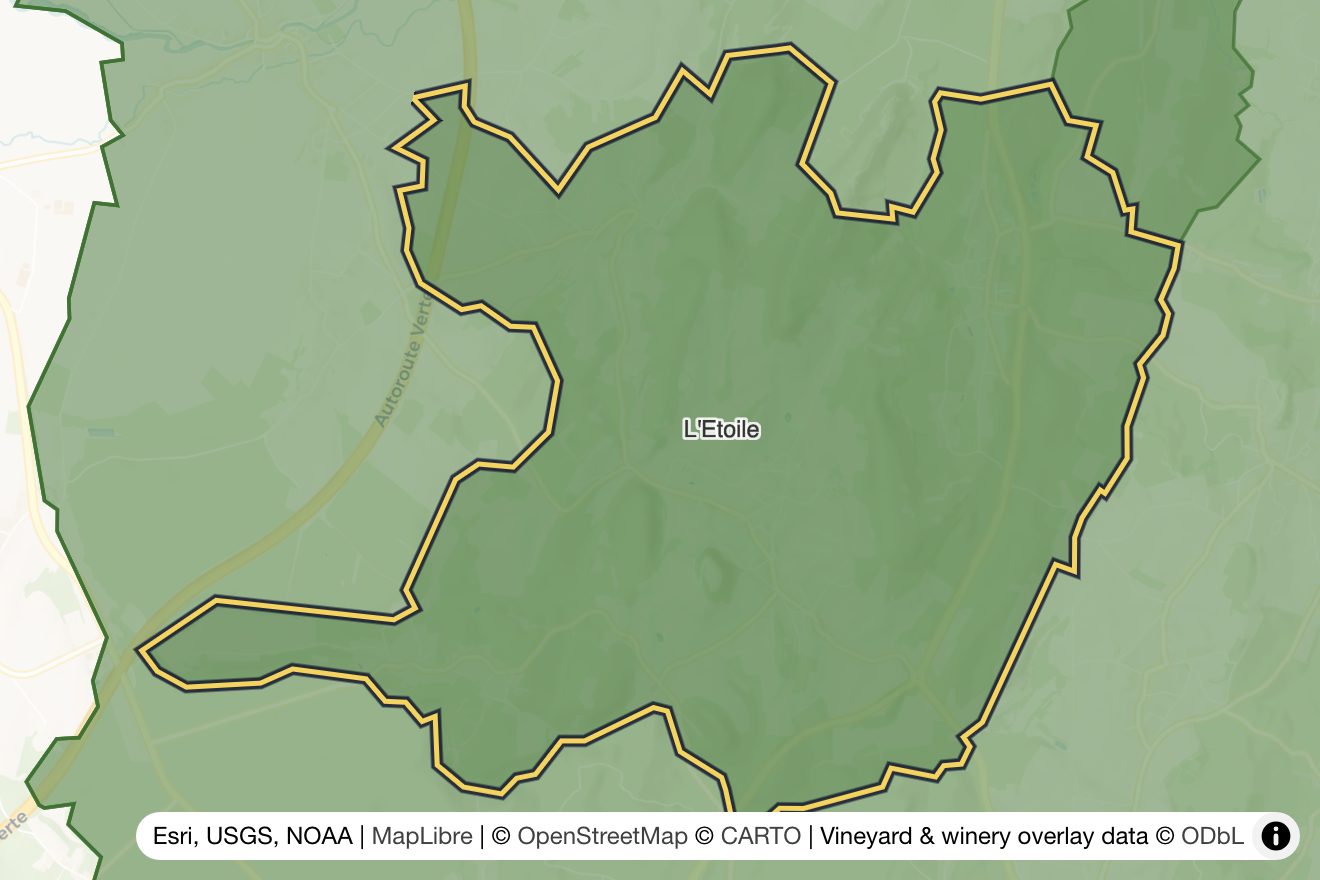
This is not merely a picturesque detail. The fossiliferous limestone that defines L'Étoile's terroir produces wines of distinct mineral tension and finesse that set them apart from neighboring appellations. The appellation occupies a privileged position on southeast-facing slopes between 250 and 400 meters elevation, surrounding five small villages: L'Étoile itself, Plainoiseau, Saint-Didier, Quintigny, and Château-Chalon (though vines within Château-Chalon's boundaries destined for L'Étoile wines must be declassified from that more prestigious appellation).
The Terroir Distinction
L'Étoile's geology represents the purest expression of Jurassic limestone in the region. Unlike the Revermont slopes to the north where marl dominates, recall that the Jura inverts Burgundy's ratio, with roughly 80% marl to 20% limestone, L'Étoile's bedrock consists almost entirely of hard Liassic limestone. The topsoil remains thin, rarely exceeding 30-40 centimeters, forcing vines to root deeply into fissured rock. This naturally limits yields and concentrates mineral elements.
The specific limestone here (known locally as calcaire à gryphées) contains not only the star-shaped pentacrinus fossils but also abundant gryphaea (oyster-like mollusks). These marine fossils contribute calcium carbonate and trace minerals that influence both vine nutrition and, arguably, wine character. The well-drained, poor soils combined with limestone's high pH (typically 7.5-8.0) create moderate water stress even in wet years, a key factor in the concentration and longevity of L'Étoile's whites.
Small pockets of red marl appear in lower-lying sectors, particularly around Plainoiseau, but these represent exceptions. The appellation's regulations acknowledge this terroir homogeneity: only Chardonnay, Savagnin, and Poulsard (the latter exclusively for oxidative wines) are permitted. No red wine production is allowed, a rarity in the Jura where most appellations embrace the full range.
Mesoclimate and Exposure
The southeast-facing amphitheater of slopes captures morning sun while avoiding the harshest afternoon heat, critical for maintaining acidity in Chardonnay while allowing Savagnin's extended hang time. Elevation moderates temperatures; the 250-400 meter range places L'Étoile's vineyards in a thermal sweet spot, warmer than Château-Chalon's highest sites (which can struggle with ripening in cool years) but cooler than the Côtes du Jura plains where excessive heat can flatten wines.
Proximity to the Seille River valley creates air drainage that mitigates frost risk in spring, though the 2021 frost still devastated portions of the appellation. The Jura's continental climate (with cold winters, warm summers, and significant diurnal temperature variation) expresses itself more gently here than in northern sectors. Annual rainfall averages 1,100mm, with autumn often bringing the persistent fog necessary for sous voile aging of vin jaune and other oxidative styles.
Wine Styles and Characteristics
Chardonnay: Mineral Precision
L'Étoile Chardonnay differs markedly from both Burgundian and broader Jura expressions. The limestone imparts pronounced chalky minerality and saline tension, with less of the rich, buttery character associated with Côte d'Or villages or the broader fruit of Arbois Chardonnay. Acidity remains high, typically pH 3.1-3.3 at harvest, creating wines of vertical structure.
Young L'Étoile Chardonnay shows white flowers (acacia, hawthorn), green apple, and citrus zest, often with a distinctive flint-like mineral note. With 3-5 years of age, the wines develop almond, white truffle, and subtle oxidative notes even when vinified under flor protection. The best examples age 10-15 years, gaining waxy texture and complex tertiary aromatics while retaining their mineral spine.
Alcohol levels remain moderate (12.5-13.5%) compared to modern Burgundy, reflecting both cooler temperatures and the preference for elegance over power. Most producers employ neutral oak or stainless steel; new oak overwhelms the delicate mineral profile.
Savagnin: The Oxidative Spectrum
While Château-Chalon monopolizes the vin jaune appellation, L'Étoile produces exceptional oxidative Savagnin under its own designation. The wines undergo similar sous voile aging (minimum three years and three months in barrel without topping up, allowing flor yeast to develop) but may be bottled in standard 750ml bottles rather than the clavelin (620ml) required for vin jaune.
The limestone terroir produces Savagnin of particular finesse and salinity. The characteristic curry spice, walnut, and dried apple notes appear, but with greater lift and mineral cut than examples from heavier marl soils. Acidity remains piercing even after extended aging; pH rarely exceeds 3.4. These wines age indefinitely (50+ years for top examples) developing extraordinary complexity: iodine, dried mushroom, saffron, oxidized apple, and that distinctive taste the French call goût de jaune.
Some producers also make ouillé (topped-up, non-oxidative) Savagnin, which emphasizes the grape's citrus and herbal character. These wines show Meyer lemon, white pepper, and chamomile, with the limestone adding saline minerality absent in richer-soil examples.
Vin de Paille: Concentrated Elegance
L'Étoile produces some of the Jura's most refined vin de paille (straw wine), made by drying grapes (typically Chardonnay with some Savagnin) for a minimum of six weeks before pressing and fermenting the concentrated must. The limestone terroir maintains higher acidity than other sectors, preventing these sweet wines from becoming cloying.
The result balances 80-120 g/l residual sugar with 6-7 g/l acidity, creating wines of remarkable freshness despite their richness. Flavors run to dried apricot, quince paste, honey, and candied citrus, with that persistent mineral undertow. Minimum aging of three years in small barrels adds complexity without oak dominance. These wines age 30+ years, developing amber hues and increasingly complex dried fruit and spice notes.
Notable Lieux-Dits and Parcels
Unlike Burgundy or Barolo with their precisely demarcated climats and MGAs, the Jura's lieu-dit system remains informal, with few names appearing on labels. However, certain sites within L'Étoile have established reputations among producers and cognoscenti.
Les Chaillots occupies the upper slopes above L'Étoile village, where the limestone bedrock lies closest to the surface and drainage proves most severe. Vines struggle here, yielding concentrated, mineral-driven Chardonnay with pronounced salinity. Several producers source their top cuvées from this sector.
En Banode southeast of the village offers slightly deeper soils with more clay in the mix, producing Chardonnay of greater texture and body while maintaining the appellation's characteristic tension.
Les Planches near Plainoiseau includes some of the red marl pockets, creating richer, more textured wines that some producers favor for vin de paille production, where the extra body supports the concentration process.
The small size of most holdings (many producers farm 2-4 hectares total) means vineyard designations rarely appear on labels. The appellation name itself carries sufficient specificity given the terroir homogeneity.
Key Producers and Approaches
Domaine de Montbourgeau
The Gros family has farmed 6 hectares in L'Étoile since 1920, with Nicole Deriaux (née Gros) now managing the estate. Montbourgeau produces the full range: ouillé and sous voile Savagnin, Chardonnay, vin de paille, and Crémant du Jura. Their Savagnin L'Étoile undergoes six years of élevage sous voile (longer than the minimum) developing profound complexity while retaining remarkable freshness.
The estate's Chardonnay, from vines averaging 40 years, shows L'Étoile's mineral precision in its purest form: steely, saline, with just enough fruit to balance the chalky minerality. Deriaux works organically (though not certified) and employs only indigenous yeasts. Her vin de paille, from Chardonnay dried for eight weeks, achieves the appellation's ideal balance of sweetness and acidity.
Château de l'Etoile
This historic property, now owned by the Vandelle family, farms 30 hectares, nearly half the entire appellation. The scale allows for parcel selection and multiple cuvées. Their entry-level Chardonnay demonstrates the appellation's baseline quality: bright, mineral, food-friendly. The single-parcel "Cuvée Spéciale" from old vines shows greater depth and aging potential.
Château de l'Etoile's vin jaune (labeled as such, sourced from Château-Chalon) and L'Étoile Savagnin sous voile both undergo extended aging, with the latter offering exceptional value for those seeking the oxidative style without vin jaune's premium pricing. The estate pioneered modern quality standards in the appellation during the 1980s and 1990s.
Domaine de la Renardière
Philippe Butin's small estate focuses on Chardonnay and Savagnin with minimal intervention. His Chardonnay sees no new oak and minimal sulfur, allowing the limestone terroir to speak clearly. The wines can show slight reduction in youth (a signature of low-SO₂ winemaking) but air reveals intense mineral and citrus character.
Butin's sous voile Savagnin undergoes five years of aging, developing classic oxidative character with perhaps more restraint than examples from heavier soils. The estate represents a newer generation of L'Étoile producers emphasizing terroir transparency over stylistic imposition.
Domaine Geneletti
This small domaine produces textbook L'Étoile Chardonnay: taut, mineral-driven, built for the table rather than the tasting room. Vinification in old barrels and extended lees contact (12-18 months) adds texture without obscuring the limestone signature. Their modest production rarely leaves France, but the wines exemplify the appellation's everyday quality level.
Comparison to Neighboring Appellations
The contrast with Arbois, just 10 kilometers north, proves instructive. Arbois encompasses diverse terroirs (limestone, marl, and clay) across a much larger area (850 hectares) and produces the full spectrum of Jura wines including reds from Poulsard, Trousseau, and Pinot Noir. Arbois Chardonnay tends toward riper fruit, rounder texture, and less pronounced minerality than L'Étoile. The difference reflects both terroir (more marl in Arbois) and mesoclimate (Arbois's lower elevations and varied exposures).
Château-Chalon, which partially overlaps L'Étoile geographically, restricts itself to vin jaune from Savagnin. The highest vineyards (300-450 meters) sit above L'Étoile's range, creating cooler conditions that extend hang time and concentrate Savagnin's intensity. Château-Chalon's stricter regulations (including mandatory vintage declassification in weak years) and smaller production (35-40 hectares) command premium pricing. L'Étoile's sous voile Savagnin offers a similar if slightly less concentrated experience at more accessible prices.
The broader Côtes du Jura appellation surrounds L'Étoile but permits red wine production and encompasses far more varied terroirs. Côtes du Jura Chardonnay from limestone sites can approach L'Étoile's quality, but the appellation name lacks the specificity to guarantee terroir character. L'Étoile's focused identity (small size, white-only production, limestone homogeneity) creates clear consumer expectations.
Vintage Variation and Aging Potential
L'Étoile's continental climate creates significant vintage variation, though the oxidative wines show less sensitivity than the ouillé styles. For Chardonnay and topped-up Savagnin, vintage matters considerably.
Cool, late-ripening vintages (2013, 2014, 2021) produce wines of razor-sharp acidity and pronounced minerality, sometimes at the expense of mid-palate texture. These vintages require 3-5 years to integrate and show best with food. Extended aging (10+ years) often reveals surprising complexity as the fruit fades and tertiary notes emerge.
Warm vintages (2015, 2018, 2019, 2020) bring riper fruit and lower acidity, creating more immediately approachable wines with broader appeal. The risk in hot years is losing L'Étoile's characteristic tension; the best producers harvest earlier to preserve freshness. These vintages drink well young but may lack the aging potential of cooler years.
Balanced vintages (2016, 2017) hit the sweet spot: adequate ripeness with retained acidity. These years produce L'Étoile's most complete wines, showing both fruit and mineral character with the structure to age 15+ years.
For sous voile wines, vintage variation matters less. The extended élevage and oxidative aging process homogenizes vintage differences, with the terroir's influence outweighing the year's weather. A 2010 and 2015 sous voile Savagnin from the same producer will show more similarity than difference after six years in barrel.
Vin de paille requires warm, dry autumns for successful drying. Years with September rain can compromise quality or prevent production entirely. The best vin de paille vintages align with warm, dry years: 2015, 2018, 2019.
Historical Context and Modern Evolution
L'Étoile received AOC status in 1937, the same year as Arbois and Château-Chalon, but has always remained the smallest and least known of the Jura's appellations. The appellation's focus on white wines and oxidative styles fell out of fashion during the mid-20th century when French consumers preferred red wine and international markets had little awareness of Jura wines.
The 1980s and 1990s brought crisis. Vineyard area contracted as producers abandoned marginal sites and young people left for cities. By 1990, only about 50 hectares remained in production. The turning point came in the 2000s as sommeliers and wine writers rediscovered the Jura's distinctive wines. L'Étoile's tiny production and unique terroir expression positioned it well for this revival.
Recent years have seen quality improvements across the appellation. Organic and biodynamic viticulture has expanded: the thin soils and good drainage make disease pressure manageable without heavy chemical intervention. Younger producers have brought fresh perspectives while respecting traditional methods, particularly for oxidative wines. The challenge remains scale: with only 68 hectares and modest yields (typically 40-50 hl/ha), L'Étoile cannot meet growing demand.
Climate change presents both opportunities and risks. Warmer temperatures improve ripening reliability and reduce frost risk, but excessive heat threatens the acidity that defines L'Étoile's style. The limestone terroir's natural water stress may become problematic in drought years, though irrigation remains prohibited under AOC rules. Producers are experimenting with canopy management and earlier harvests to maintain freshness.
The future likely holds continued small-scale production focused on quality over quantity. L'Étoile's clear identity (limestone-driven white wines of mineral precision) positions it well in a market increasingly interested in terroir specificity and distinctive regional styles. Whether the appellation can preserve this identity while adapting to changing climate and market conditions remains the central question for the next generation.
Sources: Oxford Companion to Wine (4th Edition), Jancis Robinson MW; The Wines of Jura, Wink Lorch; GuildSomm; personal producer interviews and vineyard visits.