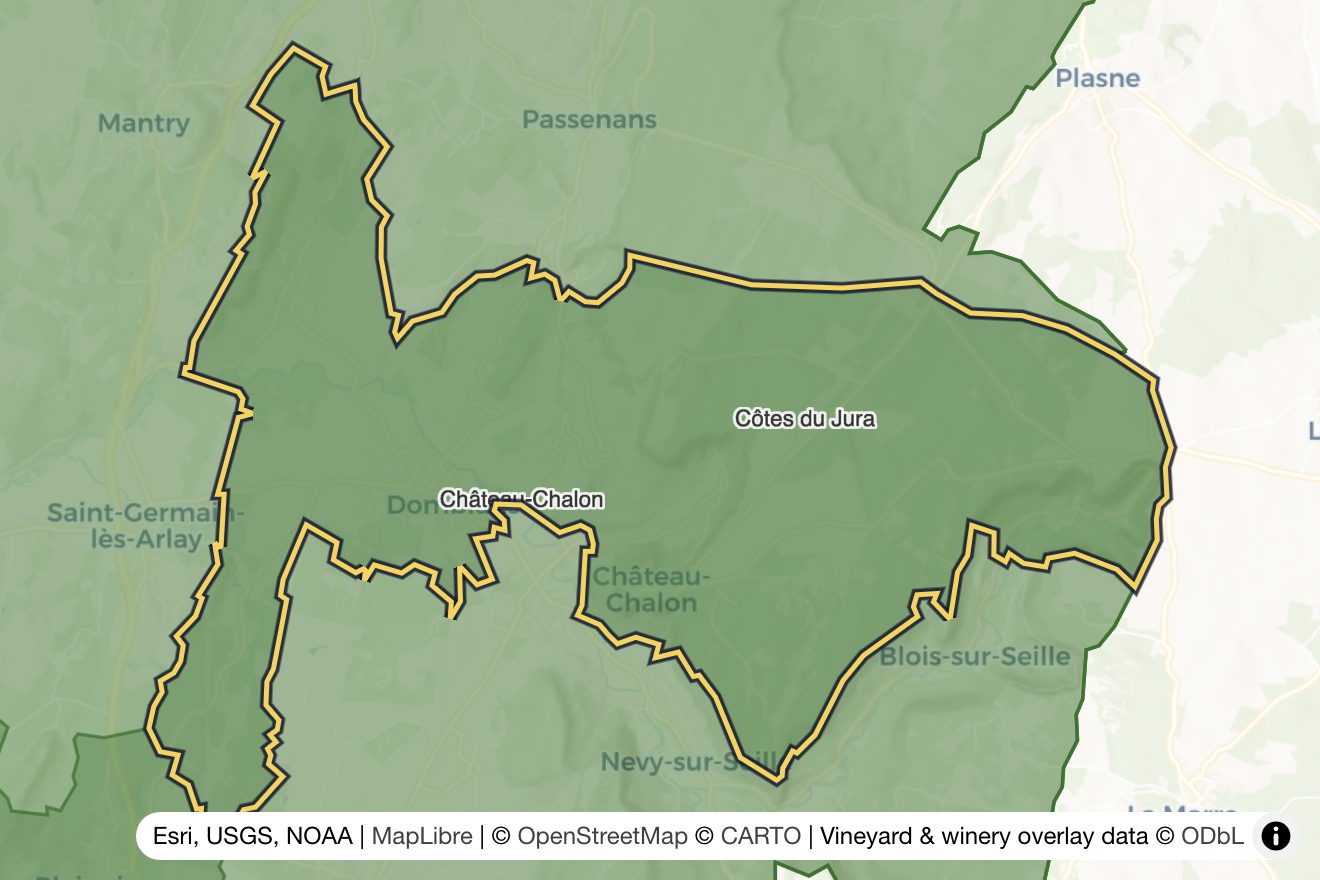
The village itself perches dramatically on a rocky promontory overlooking the Seille Valley, its medieval silhouette visible for miles. This is not accidental geography. The elevation, exposure, and underlying geology converge to create conditions that make oxidative aging under flor not just possible, but predictable.
Geography & Microclimate
Château-Chalon's vineyards cling to steep south and southwest-facing slopes at elevations between 280 and 400 meters. This is significantly higher than most Jura vineyard sites, and the altitude matters. The exposure provides maximum sunlight hours during the growing season, critical for ripening Savagnin, which naturally produces small berries and requires extended hang time to achieve proper phenolic maturity.
The topography creates a mesoclimate distinct from the broader Revermont slope. Cold air drains into the valley below, while the elevated vineyards benefit from air circulation that reduces humidity and disease pressure. This natural ventilation proves essential during autumn, when Savagnin must remain on the vine well into October, sometimes November, to achieve the concentration and sugar levels required for vin jaune production.
The village sits directly atop the vineyard area, with the most prized sites positioned immediately beneath the medieval settlement. The lieu-dit Sous la Roche (literally "under the rock") occupies this prime position, where tumbled limestone blocks from the caprock above mix with the marl-dominated soils below. En Beaumont, another notable lieu-dit, extends along the mid-slope, offering slightly deeper soils and wines of different structure.
Terroir: The Liassic Foundation
The geological story begins 200 million years ago during the Early Jurassic, when this region lay beneath a shallow sea. The resulting Liassic marls (blue-grey clays interbedded with thin limestone bands) form the dominant substrate throughout Château-Chalon. These marls are softer than the hard limestone caprock that crowns the promontory, and they weather into soils with moderate water-holding capacity and excellent drainage.
This marl dominance distinguishes Château-Chalon from limestone-heavy sites elsewhere in the Jura. Where Arbois shows roughly 50-50 limestone-to-marl ratios in many sectors, Château-Chalon tilts heavily toward marl, perhaps 70-80%. The hard Jurassic limestone that does appear tends to be in scattered blocks that have tumbled downslope from the cliff face above, creating pockets of rockier, more skeletal soils.
The practical consequence? Vines here experience moderate water stress during summer, enough to concentrate flavors without shutting down photosynthesis. The marl's clay component provides sufficient moisture reserves during dry spells, while its structure prevents waterlogging during wet periods. This balance proves crucial for Savagnin, which requires physiological ripeness without excessive alcohol accumulation.
Wine Characteristics: Beyond the Walnut Cliché
Vin jaune from Château-Chalon spends a minimum of six years and three months in barrel before release, including the mandatory sous voile aging under a film of indigenous yeast. The resulting wines are unlike anything else in the wine world, not quite Sherry, certainly not white Burgundy, but occupying their own category entirely.
The "nutty and spicy" descriptor appears in countless texts. This is incomplete at best, misleading at worst. Yes, walnut notes appear, along with curry spice, but these are surface characteristics. The profound aspect of Château-Chalon lies in its structural complexity: the interplay of oxidative character with surprising freshness, the way acidity cuts through the richness, the phenolic grip that gives the wine almost tannic structure despite being white.
Younger vin jaune (10-15 years) shows pronounced oxidative notes (bruised apple, hazelnut, turmeric) alongside citrus peel and saline minerality. The texture is simultaneously rich and lean, with alcohol typically between 13-14.5% providing body without weight. With age, these wines develop extraordinary tertiary complexity: saffron, dried apricot, beeswax, iodine, and that elusive curry note that comes from specific aldehydes formed during oxidative aging.
The wines possess remarkable longevity. Fifty-year-old examples remain vibrant, their acidity still piercing, their aromatic complexity deepening rather than fading. The 620ml clavelin bottle (unique to vin jaune) theoretically represents what remains after six years of evaporation from a standard 750ml bottle, though this romantic notion doesn't quite align with actual cellar losses.
The Inspection Committee: Quality as Law
The 1952 regulations establishing Château-Chalon's inspection committee created a quality control mechanism without parallel in French wine law. Representatives from INAO, the Société de Viticulture du Jura, local laboratories, producers, and négociants visit each parcel before harvest. They assess grape health, sugar levels, and potential yield. Based on these findings, the committee can (and has) declared entire vintages unworthy of the AOC.
This is not theoretical. When 1974, 1980, 1984, and 2001 failed to meet standards, every producer in the appellation had to declassify their wine to Côtes du Jura. The financial impact is severe, but the reputational protection is absolute. Château-Chalon on a label guarantees that someone other than the producer judged those grapes worthy of the appellation's name.
Comparison to Neighboring Sites
Château-Chalon's distinctiveness becomes clear when compared to L'Étoile, just 15 kilometers south. L'Étoile's soils contain significantly more limestone, including distinctive star-shaped fossilized crinoids that give the appellation its name. The wines there, while capable of producing excellent vin jaune, tend toward greater delicacy and less structural intensity than Château-Chalon.
The comparison to Arbois proves equally instructive. Arbois produces more vin jaune by volume, from both marl and limestone sites. The limestone-derived versions often show more immediate aromatic lift and floral notes, while marl-based examples approach Château-Chalon's density. Yet even Arbois's finest vin jaune rarely achieves the concentrated power and aging potential that Château-Chalon delivers with consistency.
Key Producers and Approaches
Approximately 180 properties own vines within Château-Chalon's 50 hectares, though many holdings are minuscule. Some producers make their own wine, others deliver grapes to the Voiteur Fruitière cooperative, and a substantial portion (roughly half the crop) goes to La Maison du Vigneron for vinification. This fragmentation reflects the region's history of smallholder viticulture and the economic challenges that plagued the area after World War II.
Domaine Berthet-Bondet and Domaine Macle stand as the largest vineyard owners, each farming approximately 4 hectares, enormous by local standards. Jean Macle, until his recent retirement, represented the traditional approach: extended barrel aging, minimal intervention, patience as winemaking philosophy. His wines epitomize Château-Chalon's austere power, requiring decades to fully express themselves.
The Domaine d'Arlay, owned by the de Laguiche family, maintains significant holdings and has worked to elevate tourism and awareness of the appellation. Their wines tend toward slightly more approachable styles in youth while maintaining the aging potential expected from the appellation.
Stone markers throughout the vineyards bear the appellation name and individual plot owners' names: a visible reminder of the intense pride and territorial specificity that defines this small area. Many of these families have farmed the same parcels for generations, their knowledge of specific sites passed down through observation rather than formal study.
Historical Context and Modern Challenges
André Jullien noted in the early 19th century that Château-Chalon's wines, while capable of greatness after 20 years' aging, "weren't what they had been." The pattern of decline and recovery has repeated throughout the appellation's history. The post-World War II period brought particular devastation, economic hardship, rural depopulation, and vineyard abandonment reduced plantings dramatically.
Recovery has been slow and incomplete. Today, a hectare of vineyard in Château-Chalon can be purchased for approximately €50,000: a fraction of what comparable grand cru sites command in Burgundy or Champagne. This creates both opportunity and challenge: the appellation remains accessible to committed vignerons, but lacks the capital investment that might accelerate quality improvements and marketing reach.
The modern question facing Château-Chalon is how to frame its most famous terroir progressively rather than merely historically. Recent interest in specific lieux-dits like Sous la Roche and En Beaumont suggests a path forward, emphasizing site specificity and terroir expression within the broader appellation identity, much as Arbois has done successfully.
Vintage Variation and Ideal Conditions
Vin jaune's extended aging under flor partially buffers vintage variation, but the initial grape quality matters enormously. Château-Chalon requires warm, dry autumns that allow extended hang time without rot. Years with September and October rainfall often struggle to achieve the concentration and phenolic ripeness necessary.
The best vintages combine a warm growing season with dry, sunny autumn conditions. Moderate summer heat stress concentrates flavors without excessive alcohol, while autumn sunshine completes phenolic maturation. Conversely, cool, wet years may produce wines with insufficient concentration or, in extreme cases, trigger the inspection committee's declassification.
The four declassified vintages (1974, 1980, 1984, 2001) all suffered from problematic autumn weather, either excessive rain, early frost, or insufficient ripeness. This underscores the appellation's uncompromising standards: vin jaune from Château-Chalon must meet specific quality thresholds, regardless of economic pressure.
Sources: Oxford Companion to Wine (4th Edition), The Wines of Jura by Wink Lorch, GuildSomm Reference