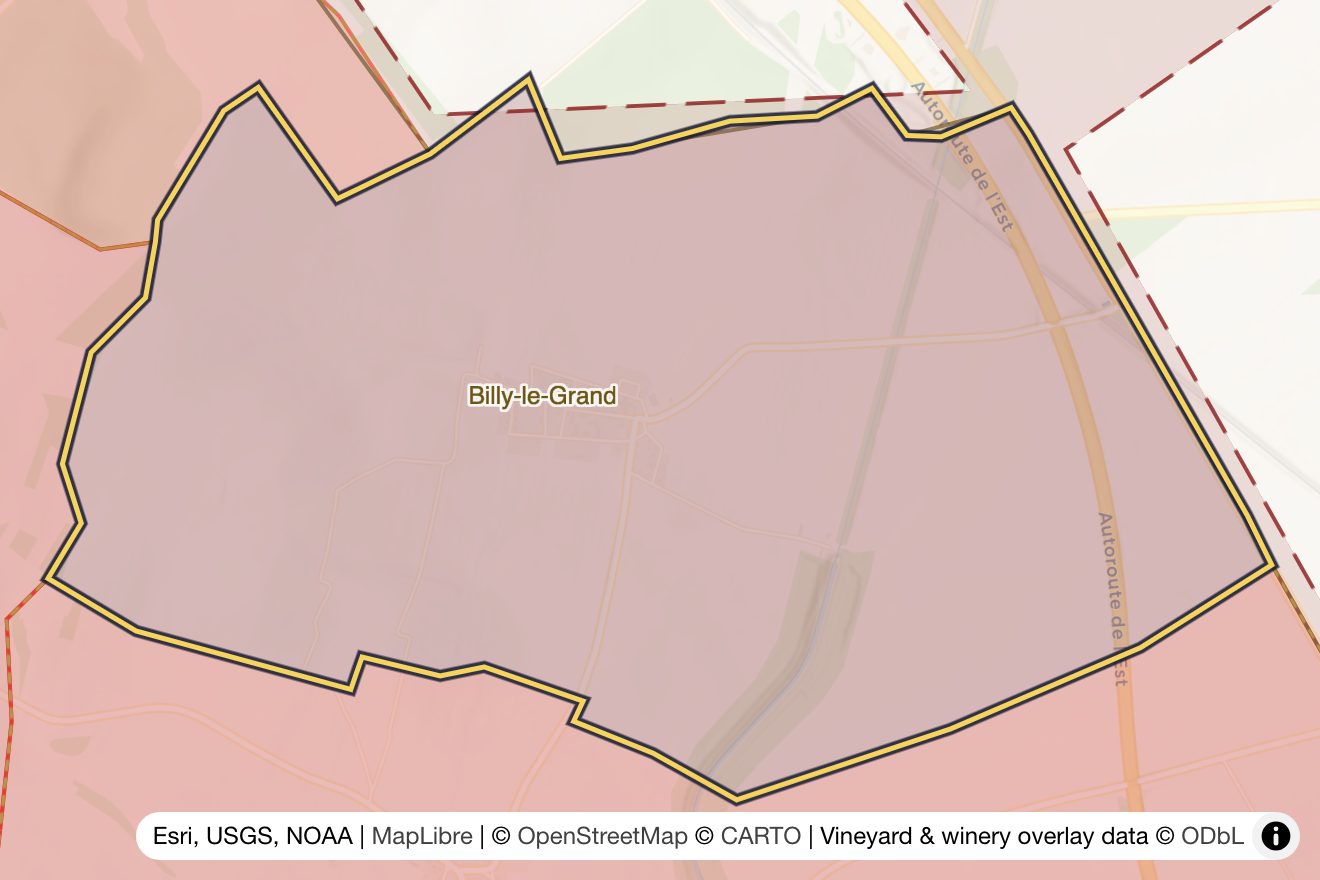
The village sits on the south-eastern slope of the Montagne de Reims, positioned on the eastern side of the Montagne de Reims, close to the Premier Cru communes of Vaudemange, Trépail and Villers-Marmery. This geographic placement matters. Billy-le-Grand captures the best attributes of its celebrated neighbors while maintaining a distinct identity shaped by its specific mesoclimate and soil composition.
The Échelle Discrepancy
Billy-le-Grand's 95% rating dates to the Échelle des Crus system established in 1919 and revised through the mid-20th century. The classification determined grape prices: a Grand Cru village (rated 100%) received full price, while Premier Cru villages received a percentage of that benchmark. Billy-le-Grand's 95% placed it in the upper echelon of Premier Cru communes, Trépail, Vaudemange, Vertus, Villers-Marmery and several others share this rating.
But the Échelle was always an imperfect instrument. It measured villages as monolithic units rather than accounting for individual vineyard quality. Many growers and producers privately acknowledge that certain parcels in Billy-le-Grand (particularly those on the mid-slope exposures) produce base wines indistinguishable from Grand Cru fruit. The classification persists largely through institutional inertia and political considerations rather than objective quality assessment.
This matters for two reasons. First, growers in Billy-le-Grand have historically received 5% less for their fruit than their Grand Cru neighbors, despite comparable quality. Second, consumers often overlook the village when hunting for value, assuming the 95% rating reflects a meaningful quality gap. It does not.
Terroir: The Geology of the Southern Slope
Billy-le-Grand's vineyards occupy the southern-facing slopes of the Montagne de Reims at elevations between 120 and 180 meters. The aspect is critical. While the northern Grand Cru villages of Verzenay and Verzy face north and northeast, producing wines of power and structure. Billy-le-Grand's southern exposure generates wines with more immediate accessibility and aromatic expression.
The geology here inverts the typical Champagne ratio. In the Côte des Blancs, limestone dominates with roughly 80% limestone to 20% marl. Billy-le-Grand's vineyards lie over a bedrock of Campanian chalk. This distinction is not subtle.
Marl (a mudstone containing both clay and calcium carbonate) retains water more effectively than pure chalk. The clay component provides structure and mineral nutrition, while the carbonate fraction ensures adequate drainage. Vines rooted in marl-dominant soils experience less water stress during dry periods but avoid waterlogging during wet vintages. The result is consistent ripening across vintage variation: a valuable attribute in a region where vintage quality can fluctuate dramatically.
The Campanian chalk beneath Billy-le-Grand dates to approximately 83-72 million years ago, during the Late Cretaceous period. This chalk layer (composed of countless coccolithophore shells compressed over geological time) extends throughout the prime vineyard sites of Champagne. But its depth and purity vary. At Billy-le-Grand, the chalk sits relatively close to the surface, typically within 1-2 meters of the topsoil. Vine roots penetrate this layer, accessing both moisture reserves and the chalk's natural pH buffering capacity.
The village's mesoclimate deserves equal attention. Southern exposures in this part of the Montagne de Reims receive extended sunlight hours during the growing season, promoting phenolic ripeness in Pinot Noir while maintaining the high acidity essential for quality Champagne. The slope angle (generally between 8-15%) provides natural air drainage, reducing frost risk during spring and minimizing humidity accumulation during summer. This air movement creates a drier canopy microclimate, reducing disease pressure from powdery mildew and botrytis bunch rot.
Temperature moderation comes from the village's position on the mountain's southern face. Cold air descends during night hours, pooling in the valley below, while daytime heating is tempered by altitude and the thermal mass of the chalk substrate. The diurnal temperature variation during August and September (often exceeding 15°C) preserves aromatic precursors in the grapes while allowing physiological ripeness to advance.
Grape Varieties and Planting Patterns
Billy-le-Grand is predominantly Chardonnay territory. The village has about 64 hectares under vine, mostly Chardonnay, with the rest Pinot Noir.
The Pinot Noir from Billy-le-Grand expresses itself differently than fruit from the northern Grand Cru villages. Verzenay Pinot Noir tends toward dark fruit, structure, and aging potential, wines built for long-term cellaring. Billy-le-Grand's Pinot Noir shows more red fruit character: cherry, raspberry, and strawberry rather than blackcurrant and plum. The tannin profile is finer, less aggressive. The wines offer immediate charm while maintaining sufficient structure for extended aging in bottle.
This stylistic difference reflects both terroir and viticultural practice. The marl-rich soils promote slightly more vigorous growth than pure chalk, requiring careful canopy management to avoid excessive shade and underripeness. Most quality-focused growers maintain yields between 9,000-10,500 kg/ha, below the appellation maximum of 15,500 kg/ha for non-vintage Champagne but above the 8,000-9,000 kg/ha common in the most quality-obsessed Grand Cru sites.
The Chardonnay plantings concentrate on the higher-elevation parcels where chalk content increases and marl diminishes. These sites produce Chardonnay with more tension and minerality than the opulent, buttery Chardonnay from Côte des Blancs villages like Avize or Cramant. Billy-le-Grand Chardonnay leans toward citrus, green apple, and white flowers: a profile closer to Chablis than to Meursault.
Key Producers and Their Approaches
Billy-le-Grand remains largely a grower village. Most vineyard owners sell fruit to the major Champagne houses rather than producing wine under their own labels. This economic reality explains the village's relative obscurity. Billy-le-Grand fruit that goes into house blends receives no mention on the label. The consumer remains unaware.
Several grower-producers deserve attention:
His approach emphasizes minimal intervention: indigenous yeast fermentations, no malolactic fermentation for Chardonnay, extended lees aging, and low dosage.
Jérôme Prévost of La Closerie (based in Gueux, west of Reims) makes Les Béguines from a single, mostly Pinot Meunier vineyard there. Prévost's philosophy centers on single-variety, single-vintage, single-vineyard Champagnes fermented in old barrels.
Several smaller growers produce estate-bottled Champagnes, though distribution remains limited to local markets and direct sales. These offerings typically appear as vintage-dated, single-village wines that showcase Billy-le-Grand's specific character. Dosage levels tend toward the lower end (Brut or Extra Brut) allowing the terroir expression to remain unmasked by residual sugar.
The major houses maintain long-term contracts with Billy-le-Grand growers.
Notable Lieux-Dits and Vineyard Parcels
Billy-le-Grand's vineyard land is divided into multiple lieux-dits, named parcels officially recorded in cadastral maps. These designations predate the appellation system and reflect centuries of local geographic knowledge. While Champagne producers rarely reference lieux-dits on labels (unlike Burgundy, where the practice is standard), these parcels exhibit meaningful differences in soil, exposure, and mesoclimate.
The soil here shows higher chalk content than surrounding parcels, producing Pinot Noir with particular finesse and aging potential. Several growers consider Les Gros Grès their finest parcel, comparable to Grand Cru sites.
The Pinot Noir from this lieu-dit shows more immediate fruit expression but less structural backbone. It typically enters non-vintage blends rather than prestige cuvées.
The wines from this sector show pronounced minerality and high acidity, classic markers of chalk-influenced Chardonnay.
These distinctions matter in the cellar. Producers blending across multiple lieux-dits can balance structure with aromatics, power with elegance, immediate appeal with aging potential. The village's diversity of terroir within a compact geographic area provides blending flexibility comparable to much larger appellations.
Wine Characteristics: Tasting Billy-le-Grand
Champagnes with significant Billy-le-Grand content (whether labeled as such or hidden within multi-village blends) display consistent stylistic markers:
Aromatics: Red fruit dominates over dark fruit. Cherry, raspberry, and wild strawberry appear frequently, along with floral notes of rose petal and white flowers. Extended aging develops brioche, toast, and hazelnut characteristics from autolysis, but the underlying fruit remains in the red spectrum.
Palate Structure: The texture is finer and more silken than Grand Cru Pinot Noir from Verzenay or Ambonnay. Tannins integrate smoothly rather than providing aggressive grip. The marl influence creates a subtle creaminess in the mid-palate, not the overt richness of Chardonnay-dominant wines, but a textural roundness that buffers acidity.
Acidity: Billy-le-Grand maintains the high natural acidity essential for quality Champagne. The southern exposure and marl soils do not compromise acid retention. pH values typically range from 3.0-3.2 in base wines, slightly higher than the most austere Grand Cru sites but well within the ideal range for balance and aging.
Aging Potential: This is where Billy-le-Grand defies its Premier Cru classification. Well-made vintage Champagnes with substantial Billy-le-Grand content age gracefully for 15-20 years, developing the tertiary complexity associated with Grand Cru wines. The combination of acidity, fruit concentration, and structural integrity supports extended cellaring.
Dosage Sensitivity: Billy-le-Grand fruit responds well to lower dosage levels. The natural fruit sweetness and textural richness allow producers to reduce residual sugar without creating aggressive, angular wines. Extra Brut and Brut Nature styles work particularly well with this terroir.
Comparative Context: Billy-le-Grand vs. Its Neighbors
Understanding Billy-le-Grand requires comparison with surrounding villages:
Verzenay (100%): The northern Grand Cru produces more powerful, structured Pinot Noir with darker fruit and firmer tannins. Verzenay faces north, receives less direct sunlight, and sits on purer chalk. The wines require more time to integrate and show their best. Billy-le-Grand offers more immediate accessibility.
Verzy (100%): Similar to Verzenay but with slightly more elegance. Still more structured and age-demanding than Billy-le-Grand.
Villers-Marmery (95%): A Chardonnay-focused village to the east. The Chardonnay shows more floral, delicate character than Billy-le-Grand's more structured expression.
Trépail (95%): Another Chardonnay village with similar rating but different style, more minerally and tense than Billy-le-Grand.
Avenay-Val-d'Or (93%): A Premier Cru village near Aÿ, on south-facing slopes and dominated by Pinot Noir. The wines show similar accessibility but less concentration and aging potential.
The comparison reveals Billy-le-Grand's unique position: it combines the accessibility and aromatic expression of southern-slope terroir with the structure and aging potential typically associated with Grand Cru sites. This duality makes it particularly valuable for blending and underappreciated for single-village bottlings.
Viticulture and Winemaking Practices
Most Billy-le-Grand vineyards follow conventional viticulture with increasing adoption of sustainable practices. Herbicide use has declined over the past two decades as growers recognize the long-term soil health benefits of maintaining grass cover between rows. The marl-rich soils respond particularly well to organic matter incorporation, improving water retention and microbial activity.
Canopy management is critical. The southern exposure and relatively vigorous marl soils can produce excessive vegetative growth if left unchecked. Careful shoot positioning, leaf removal in the fruit zone, and crop thinning ensure adequate sunlight exposure and air circulation. Most quality-focused growers perform green harvesting in July, removing 10-20% of clusters to concentrate the remaining fruit.
Harvest timing represents a crucial decision. Billy-le-Grand typically ripens 7-10 days earlier than northern Grand Cru sites, with picking usually beginning in mid-September (in recent, warmer vintages, early September or even late August). The key is balancing physiological ripeness with acid retention. Growers monitor both sugar accumulation and pH levels, often picking at slightly lower potential alcohol than they might in cooler sites to preserve freshness.
Pressing follows standard Champagne protocols: whole-cluster pressing in traditional vertical or modern pneumatic presses, with only the cuvée (first 2,050 liters per 4,000 kg of grapes) and taille (next 500 liters) fractions used for quality wines. The taille from Billy-le-Grand shows more phenolic extraction due to Pinot Noir's dominance but remains suitable for non-vintage blends.
First fermentation occurs in stainless steel tanks for most commercial production, though some grower-producers employ neutral oak barrels or concrete eggs. Temperature control during fermentation preserves aromatic compounds, typically maintaining 16-18°C for white varieties and 20-22°C for Pinot Noir.
Malolactic fermentation is nearly universal for Pinot Noir-based wines, softening acidity and adding textural complexity. Chardonnay treatment varies: some producers block malolactic to preserve freshness, while others allow partial or complete conversion depending on the base wine's acid structure and intended style.
Blending is where Billy-le-Grand fruit demonstrates its versatility. The village's wines contribute mid-palate richness, aromatic complexity, and textural finesse to multi-village assemblages. In vintage-dated prestige cuvées, Billy-le-Grand provides the accessible fruit character that makes wines approachable on release while maintaining sufficient structure for aging.
The Value Proposition
Billy-le-Grand represents one of Champagne's better quality-to-price ratios, when you can find single-village bottlings. Grower-producers from the village typically price their wines 20-30% below comparable Grand Cru offerings, despite minimal quality differences. For consumers willing to explore beyond the famous names, this gap presents opportunity.
The challenge is identification. Most Billy-le-Grand fruit disappears into multi-village blends from major houses, unlabeled and unheralded. Seeking out the few grower-producers who bottle under their own names requires effort but rewards with wines of genuine distinction at reasonable prices.
For collectors, vintage-dated Billy-le-Grand Champagnes age gracefully and cost significantly less than Grand Cru equivalents. A 10-year-old Billy-le-Grand vintage bottling often delivers complexity and development comparable to Grand Cru wines at half the price.
Recommended Bottles
Finding single-village Billy-le-Grand Champagnes requires persistence, but several options exist:
The wine shows the characteristic red fruit, fine texture, and aging potential that define Billy-le-Grand terroir. Extended lees aging and low dosage allow the terroir to speak clearly.
Small grower-producers: Several estate bottlers in Billy-le-Grand produce vintage-dated, single-village wines available primarily through direct sales or local restaurants. These offerings (often labeled simply "Champagne Premier Cru") provide the purest expression of the village's terroir. Look for producers practicing sustainable viticulture and minimal-intervention winemaking.
Prestige cuvées from major houses: While not labeled as Billy-le-Grand, vintage Champagnes from Bollinger, Pol Roger, and Krug contain fruit from the village. Tasting these wines provides insight into how the village's fruit performs in expertly crafted blends.
Food Pairing Considerations
Billy-le-Grand Champagnes' red fruit character and fine texture make them particularly food-friendly. The wines work well with:
Charcuterie and pâté: The wine's acidity cuts through fat while the red fruit complements pork-based preparations. Avoid overly spicy preparations that might clash with the wine's elegance.
Poultry in cream sauces: The textural richness of Billy-le-Grand Pinot Noir mirrors cream-based preparations without overwhelming delicate chicken or guinea fowl.
Gruyère and aged Comté: The nutty, savory character of aged Alpine cheeses harmonizes with the wine's autolytic development while the cheese's fat content smooths the wine's acidity.
Salmon and richer fish: The wine's body and structure support salmon (whether smoked, grilled, or poached) better than more delicate Chardonnay-dominant Champagnes.
Mushroom-based dishes: The earthy notes that develop in aged Billy-le-Grand Champagnes complement mushroom preparations, particularly when cream or butter is involved.
Avoid overtly sweet preparations or heavily spiced Asian cuisines that might overwhelm the wine's finesse. Billy-le-Grand Champagnes reward food pairings that respect their elegance rather than challenging their structure.
The Future of Billy-le-Grand
Climate change is altering Champagne's quality map. Rising temperatures and earlier harvests benefit southern-slope villages like Billy-le-Grand, which historically struggled with ripening in cool vintages. The village's southern exposure (once a mixed blessing that risked overripeness in hot years) now provides consistent ripening across vintage variation.
The Échelle's role in setting grape prices has already been abandoned, and some observers speculate that the cru classification itself may eventually be revised. If quality-based reclassification occurs, Billy-le-Grand stands among the strongest candidates for promotion to Grand Cru status. The village's consistent performance, terroir quality, and producer commitment support such recognition.
Meanwhile, the gap between Billy-le-Grand's official classification and its qualitative output persists. For informed consumers, this discrepancy represents opportunity: a chance to access Grand Cru quality at Premier Cru prices. The village's relative obscurity won't last forever. As Champagne prices continue rising and consumers seek value in less-famous villages, Billy-le-Grand will receive the recognition it deserves.
The question is not whether Billy-le-Grand produces wines worthy of Grand Cru status. The evidence is clear. The question is when the official classification will catch up with reality.