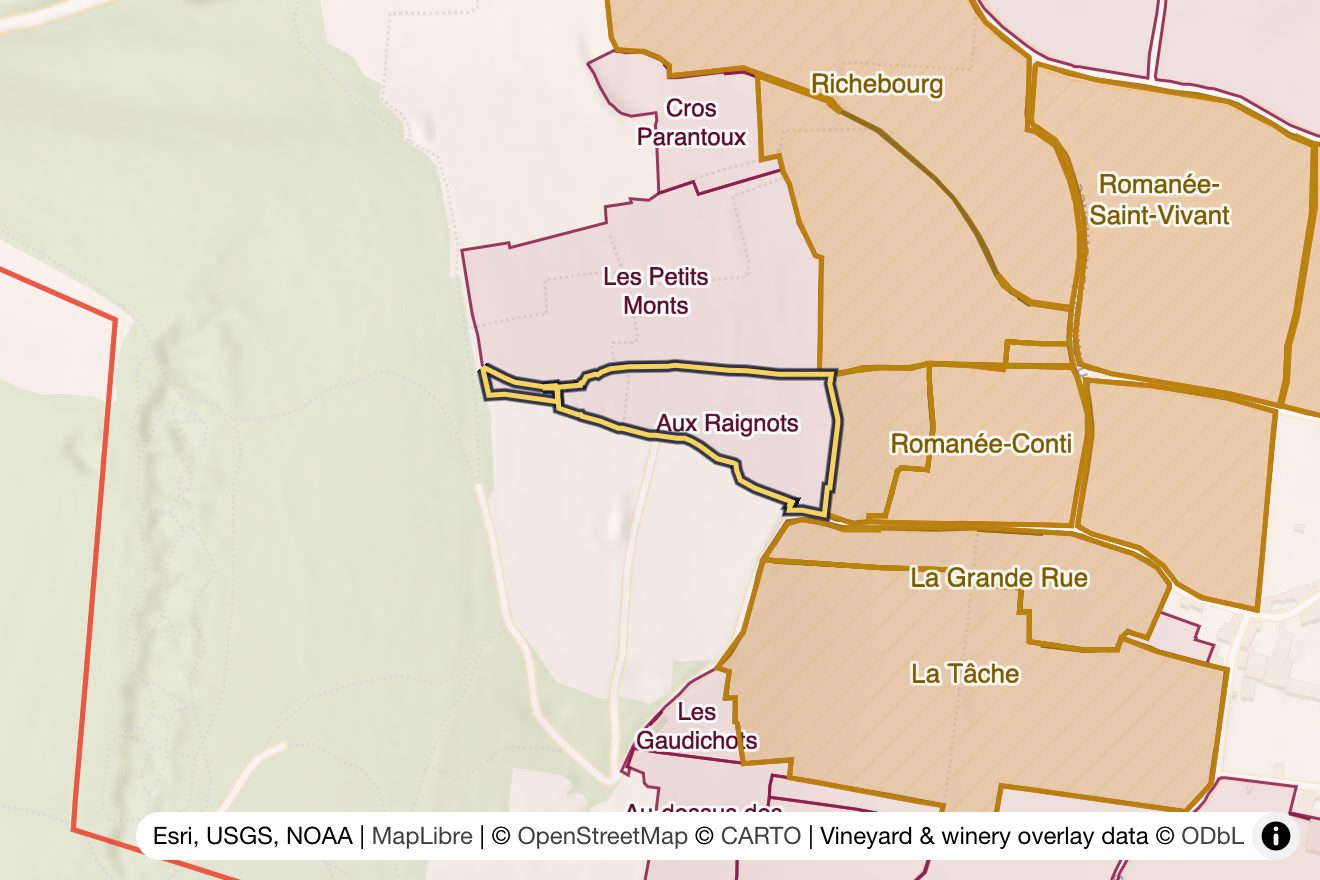
Overview & Location
The vineyard's position within the Côte de Nuits places it on the northern half of the Côte d'Or, the famous hillside that stretches from Dijon to Santenay, forming the backbone of Burgundy's most celebrated red wine region. Aux Raignots benefits from the same fundamental geological and climatic conditions that have made Vosne-Romanée synonymous with exceptional Pinot Noir, while maintaining its own distinct personality shaped by its specific terroir characteristics.
Within the broader context of the Côte de Nuits, Aux Raignots represents the continuation of the limestone-rich slope that produces some of the world's most sought-after wines. Its location provides an excellent case study in how subtle variations in geology, exposition, and elevation can create distinctly different wine styles even within the same commune.
Size
Aux Raignots encompasses approximately 1.62 hectares (4.0 acres), making it one of the smaller Premier Crus within Vosne-Romanée's portfolio of classified vineyards. This relatively compact size is typical of Burgundy's fragmented vineyard structure, where centuries of inheritance laws have divided prestigious sites into numerous small parcels owned by different producers.
The climat's modest size ensures that total production remains limited, with output varying with vintage conditions and individual producer yields. This scarcity contributes to the wine's exclusivity and helps maintain quality standards through naturally restricted production volumes.
Terroir & Geology
The geological foundation of Aux Raignots reflects the complex sedimentary history of the Côte de Nuits, with soils derived primarily from Jurassic limestone formations dating back roughly 165 to 170 million years. The vineyard sits on a mixture of Bathonian and Bajocian limestone, with the upper sections containing more prominent limestone fragments and the lower portions showing increased clay content.
The soil composition varies notably across the climat, with the upper slopes featuring shallow, well-drained soils rich in limestone scree and fossil fragments. These lighter soils, often very shallow, sit directly over fractured limestone bedrock that provides excellent drainage while forcing vine roots to penetrate deeply in search of water and nutrients.
Moving down the slope, the soil profile gradually transitions to deeper, more clay-rich compositions. The middle section contains a balanced mixture of limestone debris and reddish-brown clay derived from weathered limestone and iron-rich deposits. This zone, typically 60-80 centimeters deep, provides slightly more water retention while maintaining good drainage characteristics.
These soils contain more silt and fine particles, creating a terroir that produces wines with different structural characteristics compared to the upper slopes.
The vineyard faces predominantly east-southeast, providing optimal morning sun exposure while protecting the grapes from excessive afternoon heat. This orientation proves particularly beneficial for Pinot Noir, allowing for gradual, even ripening while preserving the variety's characteristic acidity and aromatic complexity.
Slopes within Aux Raignots range from gentle to moderate, typically around 15% gradient, which provides natural drainage. The elevation varies from the lower edge just above La Romanée to some of the highest points among Vosne-Romanée's crus, placing it within the optimal elevation band for premium Pinot Noir production in this region.
Climate & Microclimate
Aux Raignots benefits from the classic semi-continental climate of the Côte de Nuits, characterized by warm summers, cool autumns, and cold winters with moderate rainfall. However, its specific position creates several microclimate effects that distinguish it from other sites within Vosne-Romanée.
The vineyard's eastern exposure ensures early morning sunshine, which helps dry dew and reduces disease pressure while providing gentle warming during the crucial ripening period. The slight southeast orientation offers protection from prevailing westerly winds while maximizing beneficial sun exposure throughout the growing season.
Its high position on the slope gives Aux Raignots a cool mesoclimate.
Air circulation patterns around Aux Raignots benefit from the natural topography, with cool air drainage from the higher slopes helping to moderate extreme temperatures during hot summer days. The vineyard's position allows for good air movement, reducing humidity levels and minimizing fungal disease pressure.
Frost risk remains moderate due to the eastern exposure and good air drainage, though the lower portions of the vineyard can occasionally experience frost damage in severe spring conditions. The site typically experiences harvest dates similar to other Vosne-Romanée Premier Crus, usually occurring in mid to late September.
Viticulture
Aux Raignots is planted exclusively to Pinot Noir, following the regulations for red wine Premier Cru vineyards in Vosne-Romanée. The vineyard features a mix of vine ages, with some sections containing vines over 50 years old, while other areas have been replanted with younger vines over the past two decades.
Planting density typically ranges from 10,000 to 12,000 vines per hectare, following traditional Burgundian practices designed to encourage competition among vines and promote deep root penetration. The higher density also helps control individual vine vigor and encourages smaller berry size, leading to more concentrated flavors.
Most producers employ Guyot pruning systems, either simple or double depending on vine vigor and soil conditions. The varied soil depths across the climat require different approaches, with the deeper, more fertile lower slopes often managed more restrictively to control yield and maintain quality.
Viticultural practices in Aux Raignots have evolved significantly over recent decades, with most producers now employing sustainable or organic farming methods. The vineyard's good air circulation and drainage characteristics make it well-suited to reduced chemical intervention, though careful attention to disease prevention remains essential.
Site-specific challenges include managing the varied soil conditions across the climat, requiring different approaches to soil cultivation, fertilization, and canopy management. The transition zones between different soil types can be particularly challenging, demanding precise viticultural techniques to optimize quality across all parcels.
Yield management remains crucial for quality, with most serious producers targeting yields between 35-45 hectoliters per hectare. The natural fertility variations across the site require different approaches to achieve optimal crop levels, with more restrictive pruning and green harvesting typically employed in the deeper, more fertile soils.
Wine Character & Style
Wines from Aux Raignots display a distinctive character that sets them apart within the Vosne-Romanée Premier Cru hierarchy. The wines typically exhibit greater power and structure compared to some of the more elegant Premier Crus in the commune, while maintaining the essential finesse and complexity expected from this prestigious appellation.
The aromatic profile often features intense red fruit characteristics, particularly cherry, raspberry, and strawberry, complemented by subtle spice notes including cinnamon, clove, and white pepper. Floral elements, especially violet and rose petal, frequently appear, along with earthy undertones of forest floor, mushroom, and wet leaves that reflect the limestone-rich terroir.
With age, Aux Raignots develops remarkable complexity, evolving toward darker fruit flavors of blackberry and plum while gaining secondary aromas of leather, tobacco, game, and truffle. The limestone influence becomes more apparent with time, contributing mineral notes and a distinctive chalky finish.
Structurally, these wines typically show medium to full body with well-integrated tannins that provide backbone without overwhelming the fruit. The varied soil composition across the climat contributes to complexity, with different parcels contributing different structural elements to create wines of considerable depth and layering.
Acidity levels remain vibrant, reflecting both the terroir characteristics and the eastern exposure that helps preserve freshness. This acidity provides excellent aging potential while maintaining food compatibility and preventing the wines from becoming heavy or overly extracted.
The texture of Aux Raignots tends toward richness and density, with a silky mouthfeel that gains complexity and refinement with proper cellaring. The wines often display excellent concentration without sacrificing elegance, achieving the balance that defines great Burgundy.
Comparison to Surrounding Crus
Within the context of Vosne-Romanée's Premier Cru portfolio, Aux Raignots occupies a distinctive position, offering more power and structure than the ethereally elegant Les Suchots or the delicate Aux Brûlées, while maintaining more finesse than the robust Les Chaumes.
Compared to Les Malconsorts, perhaps the most prestigious Premier Cru in the commune, Aux Raignots typically shows less immediate complexity but greater aging potential. While Malconsorts wines often display remarkable harmony from youth, Aux Raignots requires more time to integrate its components and reveal its full character.
The contrast with Clos des Réas is particularly interesting, as the two sit in very different parts of the commune and express terroir differently. Aux Raignots tends toward greater mineral expression and structural backbone, while Clos des Réas often emphasizes fruit purity and immediate charm.
When compared to the Grand Cru vineyards of Vosne-Romanée, Aux Raignots naturally shows less complexity and aging potential than Romanée-Conti, La Tâche, or Richebourg. However, well-made examples can approach the quality level of some Grand Cru wines from less favorable vintages, particularly after extended cellaring.
Aux Raignots can also be compared with Premier Crus from Nuits-Saint-Georges. Aux Raignots typically displays more elegance and finesse than most Nuits-Saint-Georges Premier Crus, while showing similar power and structure. The limestone influence in Aux Raignots contributes to greater mineral complexity compared to the more iron-rich soils common in Nuits-Saint-Georges.
Notable Producers
Several distinguished producers own parcels within Aux Raignots, each bringing different philosophies and techniques that highlight various aspects of the terroir. The fragmented ownership typical of Burgundy means that multiple interpretations of this climat exist, offering wine enthusiasts the opportunity to explore different expressions of the same terroir.
Domaine de la Romanée-Conti owns a small plot in Aux Raignots, which is leased to Domaine du Comte Liger-Belair.
Domaine du Comte Liger-Belair is the largest owner, with around 45% of the climat, and bottles it as Aux Reignots.
Other producers with holdings include Sylvain Cathiard, Arnoux-Lachaux, Bruno Clair and Jean Grivot, and Bouchard Père & Fils long bottled an Aux Reignots.
Smaller domaines with holdings in the climat include several family operations that have maintained parcels for generations. These producers often create more traditional expressions that emphasize terroir over winemaking technique, offering insight into the vineyard's historical character.
The stylistic variations among producers reflect different approaches to viticulture and winemaking. Some emphasize extraction and concentration, creating powerful wines that require extended aging, while others focus on elegance and early approachability. These differences demonstrate the terroir's versatility and complexity.
Historical Background & Classification
The history of Aux Raignots extends back to medieval times, when the vineyard was likely established by monastic communities that played crucial roles in developing Burgundy's viticultural traditions. The name "Raignots" may derive from local dialectical terms related to the vineyard's topographical characteristics or historical ownership patterns.
The climat was officially classified as Premier Cru in 1936 when the French appellation system was formalized, recognizing its consistent quality and distinctive terroir characteristics. This classification acknowledged centuries of reputation building and confirmed Aux Raignots' position among Vosne-Romanée's most valued vineyards.
Historical records indicate that wines from this site commanded premium prices well before formal classification, suggesting that local merchants and consumers recognized the terroir's quality long before official recognition. The vineyard's reputation was built through consistent performance across multiple vintages and its ability to produce wines that aged gracefully.
During the 20th century, Aux Raignots benefited from advances in viticultural understanding and winemaking technology, allowing producers to better express the terroir's potential. The post-World War II period saw significant investments in replanting and modernization that enhanced quality while respecting traditional methods.
The vineyard's modern reputation has been shaped by dedicated producers who recognized its potential and invested in careful viticulture and precise winemaking. This commitment to quality has elevated Aux Raignots' status within the competitive landscape of Vosne-Romanée Premier Crus.
Aging Potential & Quality Level
Aux Raignots produces wines with exceptional aging potential, typically requiring 8-12 years to reach initial maturity and capable of improving for 20-30 years in favorable vintages. The combination of structured tannins, vibrant acidity, and concentrated fruit provides the foundation for extended cellaring.
Young wines often display considerable power and concentration that can seem overwhelming in their youth. The integration of tannins, acid, and fruit typically requires significant time, with the wines beginning to show their true character only after several years of bottle age.
The evolution trajectory typically shows initial fruit-forward character giving way to more complex secondary and tertiary aromas. The mineral characteristics become more prominent with age, while the tannins soften and integrate, creating wines of remarkable harmony and sophistication.
Quality consistency has improved significantly over recent decades as producers have gained better understanding of the terroir and refined their techniques. Modern vintages show more reliable quality than historical examples, though weather conditions continue to influence yearly variations.
The best examples from exceptional vintages can rival wines from more prestigious sites, particularly after extended aging when the terroir's true character emerges. These wines demonstrate that Premier Cru sites, when properly managed and vinified, can achieve extraordinary quality levels that justify their classification and reputation.
Aux Raignots represents the essence of what makes Vosne-Romanée special: the ability to combine power with elegance, structure with finesse, and immediate appeal with long-term aging potential. For serious Burgundy enthusiasts, wines from this climat offer both current drinking pleasure and the promise of future rewards for those patient enough to allow proper cellar aging.