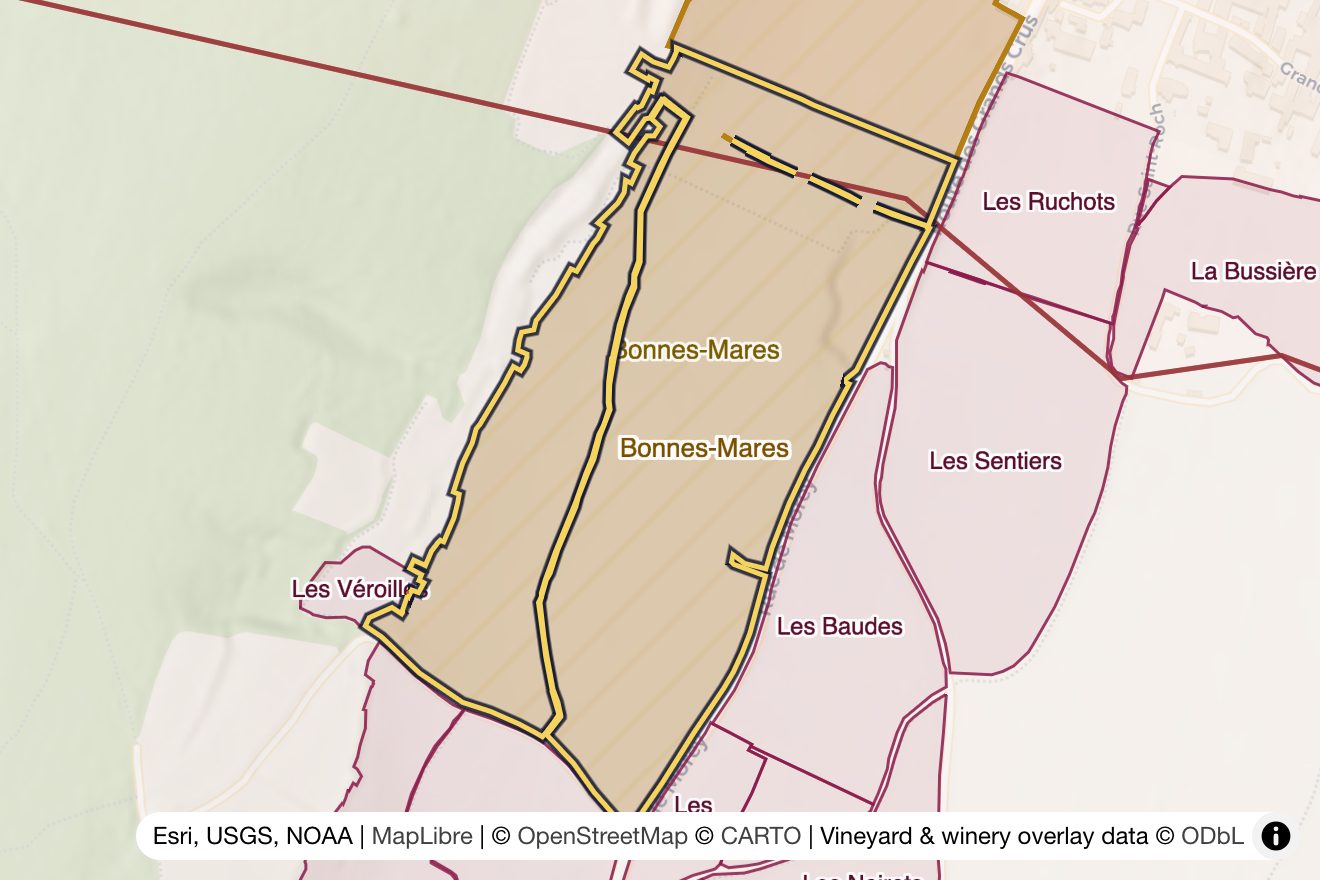
Overview & Location
Located in the southern section of Morey-Saint-Denis, this vineyard forms the northern end of the Grand Cru Bonnes-Mares, most of which lies within Chambolle-Musigny. The vineyard occupies a strategic position on the hillside, benefiting from optimal exposition and elevation that mirrors many of the characteristics found in Burgundy's most prestigious sites. The designation "Bonnes-Mares Morey" distinguishes this Premier Cru from its Grand Cru neighbor while acknowledging their shared geological and climatic heritage.
The vineyard's positioning within Morey-Saint-Denis places it among some of Burgundy's most respected terroirs, surrounded by other distinguished Premier Cru sites and sharing boundaries with Grand Cru vineyards. This location provides the vineyard with the same fundamental geological substrate and climatic influences that have made this section of the Côte de Nuits legendary among wine enthusiasts and professionals worldwide.
The precise boundaries of Bonnes-Mares Morey reflect centuries of viticultural tradition, where local knowledge and experience have defined which parcels possess the requisite quality and character to merit Premier Cru status. These boundaries have been refined over generations, taking into account subtle variations in soil composition, drainage patterns, and microclimate that significantly influence wine quality and character.
Size
Bonnes-Mares Morey encompasses approximately 1.5 hectares (3.7 acres) of vineyard land, making it a small part of the Bonnes-Mares Grand Cru. This limited size contributes to the exclusivity and rarity of wines produced from this vineyard.
The compact size of the vineyard allows for intensive management and attention to detail that would be challenging to maintain across larger sites. Viticulturists can monitor every vine individually, adjusting cultivation practices to respond to the specific needs of different sections within the vineyard. This granular approach to vineyard management is essential for maximizing the potential of Premier Cru terroir.
The small scale also means that ownership is typically concentrated among a limited number of producers, each holding parcels that may measure only a few rows of vines. This fragmentation, characteristic of Burgundy's inheritance laws and historical development, means that each producer must maximize the potential of their holdings through meticulous attention to viticulture and winemaking practices.
The limited production from Bonnes-Mares Morey creates significant market demand, particularly given its proximity to and association with the Grand Cru Bonnes-Mares. Collectors and enthusiasts specifically seek out wines from this Premier Cru, recognizing that it often delivers quality levels that approach those of neighboring Grand Cru sites while remaining more accessible in terms of availability and pricing.
Terroir & Geology
The geological foundation of Bonnes-Mares Morey reflects the complex sedimentary history of the Côte de Nuits, characterized by Jurassic limestone formations that provide the mineral backbone for exceptional Pinot Noir production. The vineyard sits on Bathonian limestone, specifically the same geological stratum that underlies many of Burgundy's most celebrated sites, including portions of the adjacent Grand Cru Bonnes-Mares.
The soil composition varies subtly across the vineyard's modest expanse, with the upper sections featuring thinner topsoil over limestone bedrock, while lower sections display deeper clay-limestone mixtures with increased iron content. This variation creates distinct microzones within the vineyard, each contributing different characteristics to the final wine. The limestone provides essential drainage and mineral complexity, while clay components contribute to water retention and fuller body structure.
Soil depth across Bonnes-Mares Morey typically ranges from 30 to 60 centimeters, forcing vine roots to penetrate the underlying limestone bedrock in search of water and nutrients. This deep root penetration is crucial for developing the complex mineral character that distinguishes Premier Cru wines from those produced on deeper, more fertile soils found at lower elevations.
The vineyard's terroir benefits from optimal drainage due to its hillside position and limestone substrate. This drainage is essential for preventing root rot and encouraging deep root development, while also moderating vine vigor to concentrate flavors in the grapes. The limestone's capacity to retain and slowly release moisture provides vines with consistent water access during dry periods while preventing waterlogging during heavy rainfall.
Iron-rich veins within the limestone contribute to the wine's color intensity and tannin structure, while calcium carbonate provides the mineral backbone that supports long-term aging potential. The interaction between these geological elements and the organic matter in the topsoil creates a complex chemical environment that influences grape composition and flavor development throughout the growing season.
Climate & Microclimate
Bonnes-Mares Morey benefits from a continental climate moderated by its position within the Côte de Nuits, experiencing warm summers and cold winters with moderate rainfall distributed throughout the year. The vineyard's elevation, typically ranging from 250 to 280 meters above sea level, places it within the optimal zone for Pinot Noir cultivation, high enough to benefit from cooler temperatures and good air circulation while avoiding the risks associated with higher altitude sites.
The vineyard's east-southeast exposure ensures optimal morning sunlight exposure while providing some protection from the intense afternoon heat that can stress vines during hot summer days. This exposition allows for gradual warming throughout the day, promoting steady photosynthesis and sugar accumulation while preserving the acidity levels essential for balanced, age-worthy wines.
Diurnal temperature variation is significant throughout the growing season, with warm days promoting sugar development and phenolic maturity while cool nights preserve acidity and aromatic compounds. This temperature differential is particularly pronounced during the crucial ripening period in September and October, when cool nighttime temperatures help maintain freshness while warm days complete the maturation process.
The vineyard's position on the hillside creates specific microclimatic conditions that differ from those found at lower or higher elevations. Air drainage is excellent, reducing the risk of frost damage in spring and minimizing humidity-related disease pressure throughout the growing season. The limestone substrate absorbs heat during the day and radiates it slowly at night, moderating temperature extremes and extending the effective growing season.
Wind patterns play a crucial role in the vineyard's microclimate, with prevailing winds from the west and southwest providing air circulation that reduces disease pressure while avoiding the harsh northern winds that can damage vines and delay ripening. The protected position within the Côte de Nuits provides some shelter from extreme weather events while maintaining the air movement essential for healthy vine development.
Viticulture
Viticultural practices in Bonnes-Mares Morey reflect centuries of accumulated wisdom adapted to the specific challenges and opportunities presented by this Premier Cru terroir. Vine density typically ranges from 10,000 to 12,000 plants per hectare, significantly higher than in most New World wine regions, promoting competition between vines and encouraging deep root development essential for terroir expression.
Pruning follows traditional Burgundian methods, with most producers employing the Guyot system that limits each vine to 6-8 buds, controlling yield while ensuring adequate canopy development. Pruning decisions are made individually for each vine, taking into account its age, vigor, and health status to optimize both current vintage production and long-term vine sustainability.
Soil management practices emphasize maintaining the delicate balance between vine nutrition and stress that produces high-quality grapes. Most producers practice minimal tillage, using light cultivation to control weeds while avoiding soil compaction that could impede root development. Cover crops may be employed in alternating rows to prevent erosion and improve soil structure while competing with vines for water and nutrients.
Canopy management throughout the growing season requires careful attention to leaf removal and shoot positioning to optimize sun exposure and air circulation. Excessive leaf removal can expose grapes to sunburn, while insufficient removal may promote disease development and delay ripening. The timing and extent of these operations vary according to vintage conditions and individual producer philosophy.
Harvest timing represents perhaps the most critical viticultural decision, with producers monitoring sugar levels, acidity, tannin ripeness, and flavor development to determine optimal picking dates. The small size of Bonnes-Mares Morey allows for precise harvest timing, with some producers picking different sections on different days to account for microclimate variations and varying maturity levels.
Sustainable and organic viticulture practices are increasingly common, with many producers eliminating or significantly reducing synthetic chemical inputs in favor of natural alternatives. These approaches require more intensive management but often result in improved soil health and more authentic terroir expression in the finished wines.
Wine Character & Style
Wines from Bonnes-Mares Morey exhibit a distinctive character that reflects both their Premier Cru terroir and their proximity to the Grand Cru Bonnes-Mares. The style typically combines the elegance and finesse associated with Morey-Saint-Denis with the power and structure characteristic of the broader Bonnes-Mares terroir, creating wines of exceptional complexity and aging potential.
The color profile generally displays deep ruby to garnet hues with excellent intensity and clarity, indicating proper phenolic extraction and healthy grape maturity. Young wines often show purple highlights that evolve toward brick and orange tones with extended aging, following the classic evolution pattern of premium Burgundy.
Aromatic complexity is a defining characteristic, with primary fruit aromas of red and black cherries, raspberries, and blackberries complemented by floral notes of rose petals and violets. Secondary aromas develop with aging, including earth, forest floor, mushrooms, and spices, while tertiary aromas of leather, game, and dried fruits emerge in fully mature wines.
The palate structure reflects the limestone terroir, with firm but refined tannins providing framework without overwhelming the fruit character. Acidity levels are typically well-balanced, contributing freshness and aging potential while supporting the wine's mineral backbone. The texture often shows silky elegance in youth, developing greater complexity and integration with proper cellaring.
Flavor development follows a progression from primary fruit characteristics through secondary and tertiary complexity. Young wines emphasize pure fruit expression with mineral undertones, while aged wines develop savory complexity including earth, spice, and game notes that reflect the terroir's influence on wine evolution.
The wines demonstrate excellent concentration without excessive weight, achieving balance between power and elegance that characterizes the finest Burgundies. Alcohol levels typically range from 12.5% to 14%, depending on vintage conditions and winemaking approach, with the best examples showing no obvious alcohol heat despite their intensity.
Comparison to Surrounding Crus
Bonnes-Mares Morey occupies a unique position within the hierarchy of Morey-Saint-Denis vineyards, sharing characteristics with several neighboring sites while maintaining its distinct personality. Compared to Clos de la Roche, located further north within Morey-Saint-Denis, Bonnes-Mares Morey typically shows more immediate accessibility and elegance, with less austere tannin structure in youth.
The relationship with the adjacent Grand Cru Bonnes-Mares is particularly interesting, as wines from this Premier Cru site often demonstrate similar power and structure while showing slightly less complexity and aging potential. The proximity means that geological and climatic conditions are nearly identical, with the Premier Cru classification reflecting subtle differences in exposure, soil depth, or historical performance rather than fundamental terroir distinctions.
Compared to Clos des Lambrays, another Grand Cru within Morey-Saint-Denis, Bonnes-Mares Morey shows more immediate fruit expression and less mineral austerity, making it more approachable in youth while potentially sacrificing some long-term development potential. The elevation difference contributes to these stylistic variations, with Bonnes-Mares Morey's slightly lower position providing warmer conditions and earlier ripening.
The Grand Cru Clos de Tart comparison reveals differences in both terroir expression and winemaking approach, as Clos de Tart's monopole status allows for unified management while Bonnes-Mares Morey's multiple owners create variation in viticultural and winemaking practices. This variation can result in a broader range of styles from Bonnes-Mares Morey, depending on individual producer approaches.
Neighboring Premier Crus such as Les Millandes and Aux Charmes typically show different character profiles, with Bonnes-Mares Morey demonstrating superior concentration and aging potential due to its optimal exposition and limestone content. The geological differences become apparent in tasting comparisons, with Bonnes-Mares Morey showing greater mineral complexity and structural integrity.
Notable Producers
Several distinguished producers hold parcels within Bonnes-Mares Morey, each bringing their individual approach to viticulture and winemaking while respecting the terroir's inherent characteristics. Domaine Hubert Lignier has established a reputation for producing exceptionally pure expressions of Morey-Saint-Denis terroirs, emphasizing minimal intervention techniques that allow terroir characteristics to dominate the wine's personality.
Domaine Dujac's holdings in Bonnes-Mares Morey benefit from the estate's commitment to biodynamic viticulture and whole-cluster fermentation techniques that preserve aromatic complexity while developing silky tannin structure. Their approach consistently produces wines that demonstrate both immediate appeal and excellent aging potential.
Georges Lignier et Fils maintains traditional winemaking methods that have proven successful over multiple generations, creating wines that faithfully express the site's character while showing consistency across varying vintage conditions. Their long experience with this specific terroir allows for precise adaptation of techniques to vintage requirements.
Domaine Perrot-Minot's modern approach to viticulture and winemaking has garnered critical acclaim for their Gevrey-Chambertin grands crus, with careful attention to extraction techniques and oak integration that enhances rather than masks terroir expression. Their wines typically show exceptional concentration and aging potential.
Several smaller producers also contribute to the reputation of Bonnes-Mares Morey, including négociant houses that source grapes from contracted growers within the vineyard. These producers often bring different perspectives and techniques to the same terroir, creating valuable diversity in wine styles while maintaining the site's fundamental character.
The limited number of producers with holdings in this small vineyard creates an interesting dynamic where reputation and quality are closely monitored by both critics and consumers, ensuring that standards remain high across all bottlings from this Premier Cru site.
Historical Background & Classification
The history of Bonnes-Mares Morey reflects the complex evolution of Burgundy's appellation system and the gradual recognition of terroir quality that has developed over centuries of viticultural experience. The vineyard's name shares etymology with the Grand Cru Bonnes-Mares, likely deriving from "bonnes mères" (good mothers) or possibly from "bonnes mares" (good pools), referring to either fertile soils or water collection areas.
Medieval records indicate continuous viticultural activity in this area, with monastic communities initially developing the vineyard and establishing quality standards that persist today. The Cistercian nuns' careful approach to vineyard classification and management laid the groundwork for modern understanding of terroir differences and quality hierarchies.
The formal recognition of Bonnes-Mares as Grand Cru occurred with the AOC decree of 1936, when authorities recognized the site's consistent quality and distinct character. This classification process involved extensive consultation with local producers and analysis of historical performance across multiple vintages.
The vineyard's boundaries were precisely defined during this classification period, taking into account geological surveys, historical records, and local expertise to ensure that only parcels with legitimate Premier Cru quality were included. These boundaries have remained largely unchanged since their initial definition, reflecting the accuracy of the original assessment.
The relationship between Premier Cru Bonnes-Mares Morey and Grand Cru Bonnes-Mares illustrates the complexity of Burgundy's classification system, where administrative boundaries sometimes create quality distinctions that reflect historical and political factors as much as pure terroir differences. This situation has led to ongoing discussions about classification accuracy and potential revisions.
Recent decades have seen increased recognition of Bonnes-Mares Morey's quality potential, with critics and collectors acknowledging that wines from this Grand Cru site often perform at the level expected of Grand Cru. This recognition has contributed to increased demand and pricing that reflects the vineyard's true quality position within Burgundy's hierarchy.
Aging Potential & Quality Level
Bonnes-Mares Morey demonstrates exceptional aging potential that rivals many Grand Cru sites, with properly stored wines developing complexity and interest for 15-25 years or more in favorable vintages. The limestone terroir provides the mineral structure necessary for long-term development, while balanced acidity preserves freshness throughout extended cellaring periods.
Quality levels have shown remarkable consistency over recent decades, with most vintages producing wines that merit serious cellaring consideration. The combination of careful viticulture, optimal terroir conditions, and experienced winemaking has resulted in a track record that justifies the site's Grand Cru status and growing reputation among collectors.
Young wines typically require 3-5 years of cellaring to integrate tannins and develop secondary complexity, with peak drinking windows generally occurring between 8-18 years after vintage. However, exceptional vintages may continue improving for significantly longer periods, with some wines showing remarkable vitality and development after 20+ years.
The aging curve typically shows rapid development during the first decade, followed by a plateau period where wines maintain peak character for several years before beginning gradual decline. Proper storage conditions are essential for realizing full aging potential, with consistent temperature and humidity control preventing premature oxidation or other storage-related defects.
Quality assessment across multiple vintages reveals that Bonnes-Mares Morey performs particularly well in years with balanced growing conditions, where the site's natural characteristics can express themselves fully without excessive stress or overly generous conditions. Cool vintages often produce wines with exceptional aging potential, while warmer years may offer more immediate accessibility with somewhat shorter optimal drinking windows.
The investment potential of Bonnes-Mares Morey has increased significantly as collectors recognize the site's quality-to-price ratio compared to neighboring Grand Cru sites. This recognition has led to increased competition for available bottles and steadily rising prices that reflect the vineyard's true position within Burgundy's quality hierarchy.
Current market positioning places Bonnes-Mares Morey among the top tier of Morey-Saint-Denis vineyards, with pricing that reflects both current quality and future potential. The limited production ensures continued scarcity value while growing recognition supports long-term price appreciation for well-stored examples from reputable producers.