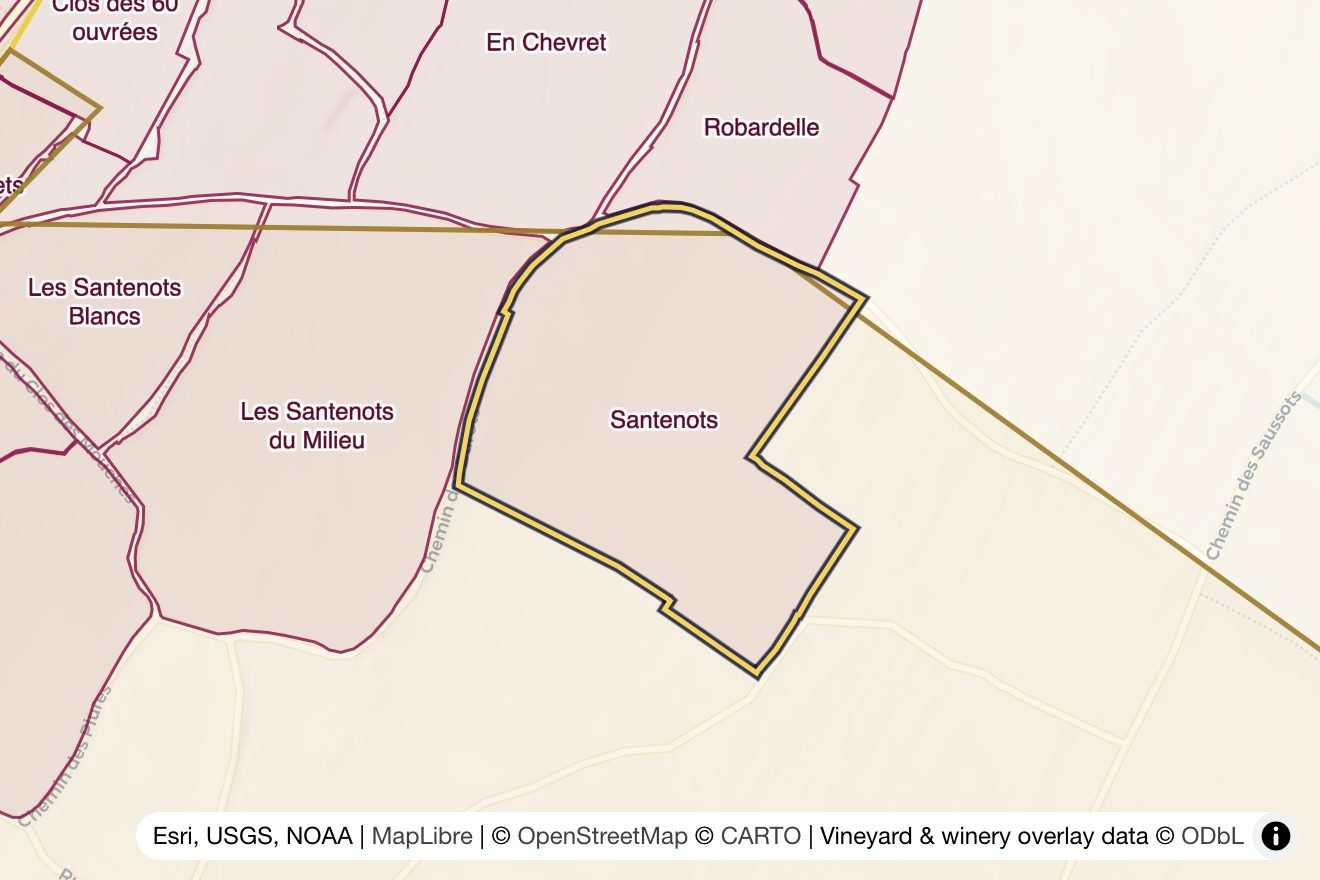
Overview & Location
The vineyard occupies a strategic position on the hillside between Meursault and Volnay, serving as a transitional zone that bridges these two renowned communes. Located on the mid-slope at elevations ranging from 250 to 280 meters above sea level, Santenots faces predominantly southeast, capturing optimal sun exposure throughout the day. The vineyard's positioning places it directly south of Volnay's famous Caillerets Premier Cru and adjacent to Meursault's white wine vineyards, creating a unique microenvironment that combines elements from both neighboring terroirs.
The appellation structure of Santenots reflects its complex identity. Red wines from the vineyard are labeled as "Volnay Premier Cru Les Santenots" or simply "Volnay Premier Cru Santenots," while the small portion dedicated to white wine production (primarily Chardonnay) carries the designation "Meursault Premier Cru Les Santenots Blancs" or "Meursault Premier Cru Les Santenots du Milieu" depending on the specific parcel location.
Size
Santenots encompasses roughly 29 hectares (about 72 acres) of vineyard land, making it one of the larger Premier Cru designations in the Côte de Beaune. This substantial size places it among the more significant Premier Cru holdings in the region, though it remains modest compared to the grand crus of the Côte d'Or. The vineyard is divided into several distinct climat designations that reflect subtle variations in terroir and exposition.
The primary sections include Les Santenots du Milieu, which occupies the central and most prestigious portion of the vineyard, and Les Santenots Blancs, located in the upper reaches where white wine production occurs. Additional subdivisions include Les Santenots Dessous, situated in the lower portions of the slope, and smaller parcels that contribute to the overall appellation.
The vineyard's considerable size allows for significant diversity among producers, with ownership distributed among numerous domaines and négociant houses. This fragmentation, typical of Burgundy's inheritance-based vineyard structure, results in varying approaches to viticulture and winemaking across the appellation, contributing to the diverse expressions of Santenots available in the market.
Most of the vineyard is planted to Pinot Noir, with the remainder in Chardonnay in the upper sections where limestone content increases and red wine quality diminishes. This distribution reflects the terroir's natural inclination toward red wine production while acknowledging the transitional nature of the site.
Terroir & Geology
The geological foundation of Santenots reveals the complex interplay of ancient marine deposits that characterize the Côte de Beaune's Premier Cru sites. The vineyard sits atop Jurassic limestone formations dating to the Bathonian and Callovian periods, approximately 165-170 million years old. These limestone substrates provide excellent drainage while maintaining sufficient water retention for vine health during dry periods.
The soil composition varies significantly across the vineyard's expanse, creating distinct microterroirs that influence wine character. The upper sections, where white wine production occurs, feature higher limestone content with white marl and fossil-rich deposits. These soils drain exceptionally well and reflect heat effectively, characteristics that favor Chardonnay cultivation and contribute to the mineral precision found in Meursault Santenots Blancs.
Moving down the slope into the red wine sections, the soil profile transitions to deeper, more complex compositions. The mid-slope areas feature a mixture of limestone, clay, and iron-rich deposits that create the reddish-brown soils typical of the site. This iron content contributes to the structured, age-worthy character of Volnay Santenots, distinguishing it from other Volnay Premier Crus with different mineral compositions.
The lower sections of the vineyard contain higher clay content, which retains more moisture and produces wines with increased power and concentration. These areas often yield Santenots with greater extraction and tannic structure, requiring longer aging to achieve optimal balance and integration.
Geological surveys have identified significant presence of oolitic limestone throughout the vineyard, particularly in the central sections. This limestone type, characterized by small, spherical grains formed in ancient shallow seas, provides exceptional drainage while contributing to the mineral complexity that defines quality Burgundian terroir. The presence of fossilized marine life within these limestone layers adds additional mineral elements that subtly influence vine nutrition and, ultimately, wine character.
Climate & Microclimate
Santenots benefits from a favorable microclimate that combines the best aspects of both Meursault and Volnay's climatic conditions. The vineyard's southeast exposure ensures optimal morning sun exposure, crucial for grape ripening in Burgundy's marginal climate, while afternoon shadows from the higher slopes provide protection from excessive heat during the warmest part of the day.
The elevation range of 250-280 meters places Santenots in the optimal zone for Pinot Noir cultivation in the Côte de Beaune. This altitude ensures sufficient cooling to maintain acidity and aromatic complexity while avoiding the excessive coolness that can affect lower-elevation sites during challenging vintages. The gentle slope gradient, averaging 8-12%, promotes excellent air circulation, reducing humidity-related disease pressure and creating conditions favorable for extended hang time.
Wind patterns play a crucial role in Santenots' microclimate. The vineyard's position allows for beneficial air movement from the Saône Valley to the east, which helps moderate temperature extremes and reduces the risk of spring frost damage. During harvest season, these gentle breezes assist in drying morning dew and maintaining healthy grape conditions.
The vineyard's relationship with surrounding forest cover influences its microclimate significantly. The wooded areas above Santenots create a buffer against harsh winds while contributing to humidity regulation and temperature moderation. This forest influence becomes particularly important during extreme weather events, providing protection from hail and excessive heat that can damage exposed vineyards.
Rainfall patterns in Santenots generally align with the broader Côte de Beaune climate, receiving approximately 750mm annually. However, the vineyard's excellent drainage ensures that excess moisture rarely causes problems, while the soil's water retention capacity helps vines survive drought conditions. The timing of precipitation proves more critical than total amounts, with dry conditions during flowering and harvest being particularly beneficial for wine quality.
Viticulture
Viticulture in Santenots reflects the high standards expected of Premier Cru production, with most producers employing sustainable or organic farming practices suited to the vineyard's specific terroir characteristics. The diverse soil composition across the site requires tailored approaches to vine management, with different sections demanding varying levels of intervention and attention.
Vine density in Santenots typically ranges from 10,000 to 12,000 vines per hectare, following traditional Burgundian practices that maximize terroir expression while ensuring adequate competition among vines. This density, combined with the vineyard's natural drainage, creates optimal conditions for root development and vine balance. Most plantings utilize traditional Burgundian training systems, primarily Guyot simple, which allows for precise crop load management essential for Premier Cru quality.
Rootstock selection proves crucial in Santenots due to the varying soil types and limestone content. Producers commonly employ SO4 and 3309 rootstocks in areas with higher limestone content, while 161-49 and Riparia Gloire selections work well in sections with more clay content. These choices reflect the need to match rootstock characteristics with specific soil conditions to optimize vine health and longevity.
Canopy management in Santenots requires careful attention to the vineyard's southeast exposure and varying soil depths. Leaf removal timing becomes critical, with early removal on the morning-sun side promoting ripening while maintaining afternoon shade protection. The vineyard's natural air circulation reduces disease pressure, allowing for more conservative canopy management that preserves grape quality without excessive intervention.
Yield management represents one of the most critical aspects of Santenots viticulture. Premier Cru regulations limit yields, but quality-focused producers often achieve significantly lower yields through green harvesting and natural vine balance. The vineyard's terroir responds well to moderate yields, typically producing optimal quality at 35-38 hectoliters per hectare.
Harvest timing in Santenots requires careful consideration of the vineyard's varied exposition and soil types. Different sections often ripen at slightly different rates, with upper sections typically achieving maturity 3-5 days earlier than lower areas. This variation allows producers with multiple parcels to optimize harvest timing for each microterroir while maintaining overall vintage consistency.
Wine Character & Style
Volnay Premier Cru Les Santenots produces wines that embody a distinctive style within the Volnay appellation, characterized by greater structure and minerality than many neighboring Premier Crus. The wines typically display a deep ruby color with excellent clarity and brilliance, reflecting the vineyard's well-drained terroir and careful viticulture practices.
The aromatic profile of Santenots consistently showcases classic Burgundian Pinot Noir characteristics enhanced by unique terroir-driven elements. Primary fruit aromas include red cherries, raspberries, and strawberries, often accompanied by floral notes of violets and roses. The vineyard's limestone-rich soils contribute distinctive mineral undertones that emerge as wet stone, chalk, and subtle metallic notes. With age, these wines develop complex secondary aromas including earth, mushroom, leather, and forest floor, while maintaining their essential fruit character.
On the palate, Santenots demonstrates remarkable balance between power and elegance, a characteristic that distinguishes it from other Volnay Premier Crus. The wine's structure reflects the iron-rich soils and limestone substratum, producing firm but refined tannins that provide excellent aging potential without overwhelming the wine's inherent finesse. Acidity levels typically remain vibrant due to the vineyard's elevation and exposition, creating wines with excellent freshness and food compatibility.
The texture of Santenots reveals layers of complexity that unfold gradually in the glass. Initial impressions often emphasize the wine's mineral precision and structural backbone, while continued aeration reveals the underlying fruit richness and terroir complexity. The wine's mid-palate consistently shows excellent density and concentration, reflecting the vineyard's ability to achieve physiological ripeness while maintaining varietal character.
Vintage variation in Santenots follows predictable patterns related to climatic conditions, but the vineyard's terroir provides excellent buffering against extreme weather. Warm vintages produce Santenots with increased concentration and power while maintaining essential acidity, while cooler years emphasize the wine's mineral character and structural elements. The vineyard's southeastern exposure ensures adequate ripeness even in challenging vintages, contributing to consistency across different years.
Comparison to Surrounding Crus
Santenots occupies a unique position within the hierarchy of Côte de Beaune Premier Crus, offering distinct characteristics that differentiate it from neighboring vineyards while maintaining the essential qualities expected of Volnay wines. Compared to Volnay's other Premier Crus, Santenots consistently demonstrates greater structure and mineral intensity, reflecting its limestone-rich terroir and iron content.
The comparison with Volnay Premier Cru Caillerets, located directly to the north, reveals fundamental differences in style and character. While Caillerets emphasizes elegance and aromatic complexity with silky tannins, Santenots provides greater power and aging potential with more pronounced mineral elements. Both wines share Volnay's characteristic finesse, but Santenots displays additional structural components that reflect its unique geological composition.
Champans, another significant Volnay Premier Cru, offers an interesting contrast to Santenots. Champans typically produces wines with more immediate charm and accessibility, featuring softer tannins and more prominent fruit character. Santenots, conversely, requires longer aging to achieve optimal integration, ultimately rewarding patience with greater complexity and longevity. The textural differences between these wines reflect their distinct terroirs, with Champans' clay-rich soils producing rounder wines compared to Santenots' limestone-driven precision.
The relationship between Santenots and Meursault's white wine Premier Crus provides insight into terroir expression across varietals. Meursault Premier Cru Les Perrières, located nearby, shares similar limestone-rich soils but expresses these characteristics through Chardonnay's mineral precision and aging potential. The parallel between red Santenots and white Perrières demonstrates how terroir translates across different grape varieties, with both wines showing exceptional mineral character and extended aging potential.
Comparing Santenots to Premier Crus from adjacent Pommard reveals significant stylistic differences. Pommard Premier Crus generally emphasize power and concentration with earthier character, while Santenots maintains greater elegance and mineral precision. This distinction reflects the geological differences between the two communes, with Santenots' limestone content contributing to its more refined expression.
Notable Producers
The fragmented ownership of Santenots includes several distinguished domaines and négociant houses, each bringing unique approaches to expressing the vineyard's terroir potential. These producers have established reputations for crafting exceptional wines that showcase different aspects of Santenots' complex character.
Domaine des Comtes Lafon stands among the most prestigious producers of Santenots, holding significant parcels in the vineyard's prime sections. The domaine, long led by Dominique Lafon before he handed over to the next generation, has farmed biodynamically across its estate since the late 1990s, achieving remarkable concentration and terroir expression. Lafon's Santenots consistently demonstrates exceptional aging potential, with wines that evolve gracefully over 15-20 years while maintaining their essential character and complexity.
Maison Louis Jadot maintains substantial holdings in Santenots, producing wines that exemplify the vineyard's structure and mineral character. Jadot's approach emphasizes traditional winemaking techniques combined with modern precision, resulting in Santenots that expresses both power and elegance. Their production benefits from extensive experience with the vineyard's varying microclimates and soil types, allowing for optimized harvesting and vinification decisions.
Domaine Marquis d'Angerville, while primarily known for their Volnay holdings, produces small quantities of exceptional Santenots from carefully selected parcels. Their approach emphasizes minimal intervention winemaking that allows the vineyard's terroir characteristics to express themselves clearly. D'Angerville's Santenots typically showcases the vineyard's mineral precision while maintaining the house style of elegance and refinement.
Bouchard Père & Fils is one of the Cote d'Or's largest vineyard owners, though its best-known Volnay holdings are in other premier crus such as Les Caillerets. Their production approach combines traditional Burgundian methods with contemporary quality control, resulting in consistent wines that express the vineyard's character across different vintage conditions. Bouchard's extensive cellars provide optimal aging conditions for their Santenots, allowing the wines to develop complexity before release.
Several smaller domaines produce exceptional Santenots from limited holdings, including Domaine Roblet-Monnot. These producers often achieve remarkable quality through intensive vineyard management and careful winemaking, creating wines that compete with larger, more established houses. Their limited production quantities make these wines particularly sought after by collectors and enthusiasts.
Historical Background & Classification
The history of Santenots extends deep into Burgundy's viticultural past, with documentation of grape growing in the area dating to the medieval period. The vineyard's unusual cross-communal status reflects historical realities that predate modern administrative boundaries, when wine classification focused more on terroir characteristics than geographical limitations.
Medieval records indicate that Santenots was cultivated by religious orders, particularly the Abbey of Cîteaux, which played a crucial role in developing Burgundian viticulture. These early cultivators recognized the vineyard's potential for red wine production despite its location within what would later become Meursault commune boundaries. The monks' careful observation and documentation established the precedent for treating Santenots as part of the Volnay terroir family.
The origin of the name Santenots is uncertain; one theory links it to the Latin sentes (brambles), another to a word for path. Historical documents from the 17th and 18th centuries consistently reference Santenots wines as possessing characteristics more similar to Volnay than to Meursault, supporting the eventual classification decision.
Under the Volnay AOC, recognized by decree on 9 September 1937, red wines from Santenots carry the Volnay name while white wines remain classified under Meursault.
This decision represented one of the most significant exceptions in Burgundy's classification system, acknowledging that terroir characteristics supersede administrative boundaries in determining wine identity. The classification established specific regulations governing Santenots production, including yield limitations, grape variety restrictions, and quality standards consistent with Premier Cru status.
Post-World War II developments saw increased recognition of Santenots' quality potential, with several prestigious domaines acquiring vineyard holdings and investing in improved viticulture. The 1960s and 1970s brought modernization of winemaking facilities and techniques, while the 1980s saw the beginning of sustainable farming practices that continue to evolve today.
Aging Potential & Quality Level
Santenots demonstrates exceptional aging potential that places it among the longer-lived wines of the Côte de Beaune. The vineyard's limestone-rich terroir and iron content contribute to wines with excellent structural components, allowing for graceful evolution over extended periods. Well-made examples from quality producers regularly age successfully for 15-20 years, with exceptional vintages maintaining their character and complexity for even longer periods.
The aging curve of Santenots follows a predictable pattern that reflects its terroir characteristics. Young wines often display prominent tannins and mineral elements that require 3-5 years to integrate fully. During this initial period, the wines benefit from decanting and show best with substantial foods that complement their structural intensity. Primary fruit flavors remain prominent during the first decade, gradually giving way to secondary and tertiary development.
The wine's evolution through its second decade reveals the true quality potential of Santenots terroir. Tannins integrate seamlessly while maintaining structural integrity, and the mineral components that characterize young wines develop into complex earth and stone flavors. Fruit character evolves from primary berry notes to more complex expressions of dried fruits, leather, and forest floor, while maintaining sufficient freshness to prevent over-maturity.
Quality levels in Santenots vary significantly based on producer philosophy, vineyard management, and winemaking approach. Top examples from quality-focused domaines consistently achieve ratings comparable to Grand Cru wines from other regions, reflecting the vineyard's exceptional terroir potential. These wines demonstrate remarkable consistency across different vintage conditions, with the vineyard's natural balance providing excellent buffering against climatic variations.
The vineyard's Premier Cru status accurately reflects its quality potential within Burgundy's hierarchical system. Santenots consistently produces wines that exceed the quality expectations of many Premier Cru sites while approaching the complexity and aging potential associated with Grand Cru designations. This quality level justifies the vineyard's premium pricing and collector interest, particularly for wines from established producers with proven track records.
Storage considerations for Santenots follow standard Burgundy guidelines, with consistent cool temperatures and proper humidity being essential for optimal aging. The wines respond well to proper cellaring conditions, developing complexity and integration that reward patient collectors. Professional storage becomes particularly important for wines intended for extended aging, as temperature fluctuations can significantly impact development patterns and ultimate quality potential.