Overview & Location
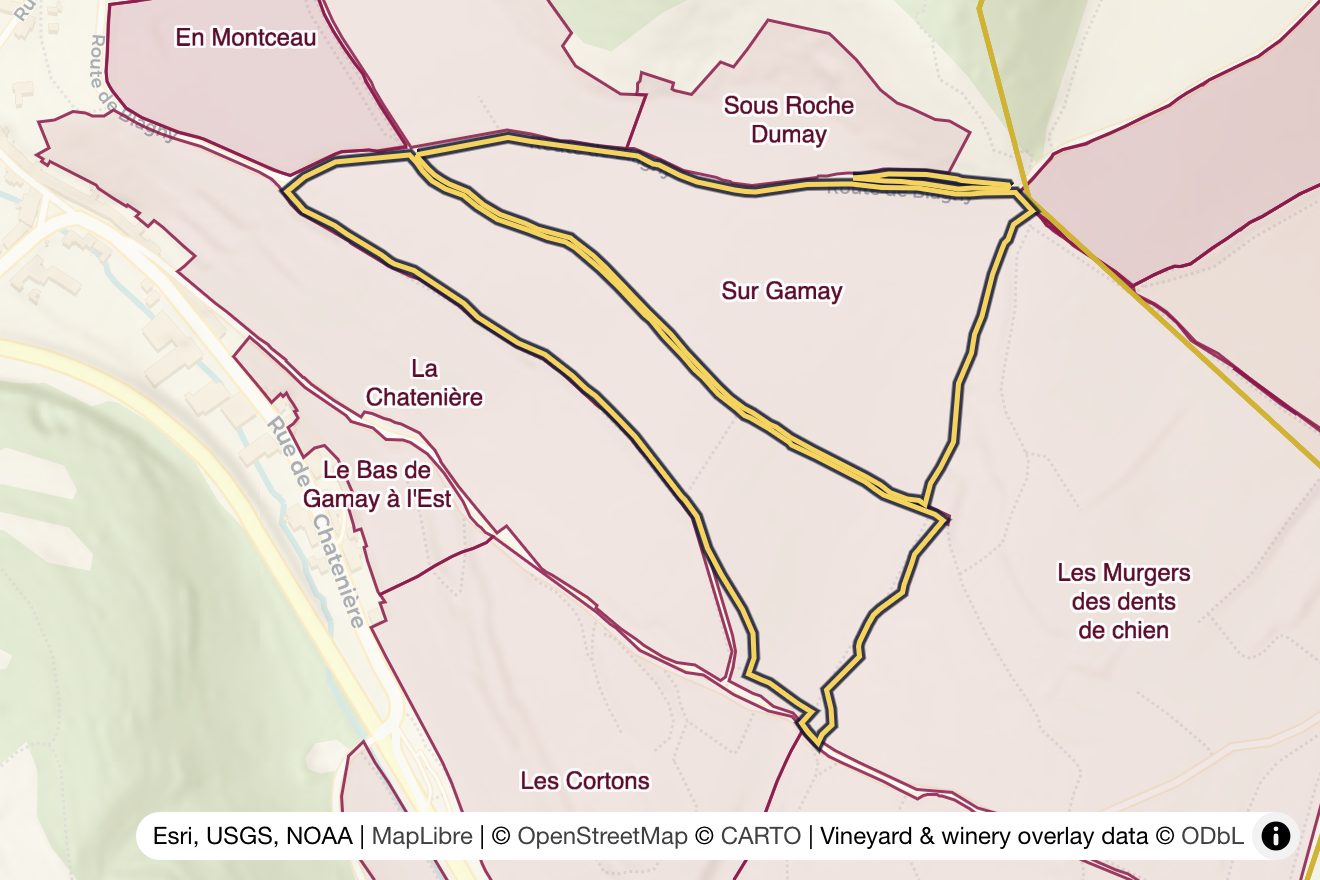
The climat sits on the slope of the Montagne du Ban above the hamlet of Gamay, facing mainly south to southwest. This positioning places Sur Gamay in direct dialogue with some of Burgundy's most celebrated terroirs, lying close to the Puligny-Montrachet boundary, in the valley just behind the Montrachet slope.
Within Saint-Aubin's Premier Cru hierarchy, Within Saint-Aubin's Premier Cru hierarchy, Sur Gamay lies on the commune's eastern side, toward Puligny-Montrachet.
Size
Sur Gamay encompasses approximately 7.2 hectares (17.8 acres) of vineyard land, making it a moderately sized climat within Saint-Aubin's Premier Cru portfolio. This relatively intimate scale allows for detailed attention to terroir expression while providing sufficient volume to support multiple quality-focused producers. The vineyard's boundaries are clearly delineated by geological markers and historical usage patterns, with the climat extending roughly 400 meters along its east-west axis and maintaining an average width of 180 meters from top to bottom of the slope.
The parcellation within Sur Gamay reflects centuries of Burgundian inheritance traditions, resulting in a complex mosaic of ownership that includes both established négociant houses and smaller domaines. This fragmentation, while challenging from a viticultural management perspective, contributes to the diversity of winemaking approaches and stylistic expressions that emerge from Sur Gamay.
Terroir & Geology
The geological foundation of Sur Gamay reveals the complex interplay of limestone formations that characterize the finest Burgundian terroirs. The vineyard sits on limestone and clay with marls, over Jurassic limestone bedrock. This hard limestone substrate provides excellent drainage while retaining sufficient moisture during dry periods, creating optimal conditions for vine root development and mineral uptake.
Above this limestone bedrock lies a variable layer of clay-limestone soil that ranges from 40 to 80 centimeters in depth across different sections of the climat. The clay content varies between 25 and 35 percent, with higher concentrations found in the lower portions of the vineyard where colluvial deposits have accumulated over millennia. This clay component provides essential water retention capacity and contributes to the wines' characteristic depth and aging potential.
The soil profile includes significant quantities of limestone fragments and fossil debris, particularly in the upper portions of the vineyard where erosion has exposed more of the underlying bedrock. These limestone elements contribute to excellent drainage during wet periods while reflecting heat during the day and releasing it gradually at night, moderating temperature fluctuations that could stress the vines.
The slope characteristics of Sur Gamay range from gentle 8-degree inclines in the lower sections to more pronounced 15-degree gradients in the upper reaches. This variation in slope angle creates distinct mesoclimates within the single climat, with the steeper sections providing superior drainage and sun exposure, while the gentler slopes offer deeper soils and greater water retention capacity.
Climate & Microclimate
Sur Gamay benefits from a distinctive microclimate that combines continental influences with moderating factors specific to its topographical position. This exposure pattern typically results in harvest dates that fall 3-5 days earlier than Premier Crus with more northern exposures within Saint-Aubin.
The vineyard's elevation positions it within an ideal thermal zone for Burgundian varieties. Daytime temperatures during the growing season average 2-3 degrees Celsius cooler than valley floor locations, while nighttime cooling is enhanced by cold air drainage from the higher slopes of the Montagne du Ban. This diurnal temperature variation is crucial for maintaining the natural acidity that provides structure and aging potential in both Chardonnay and Pinot Noir.
Wind patterns play a significant role in Sur Gamay's mesoclimate. The vineyard receives moderate morning breezes from the east that help reduce humidity and minimize disease pressure, while afternoon winds from the west are partially blocked by the rising topography, reducing desiccation stress during hot summer periods. These wind dynamics contribute to excellent air circulation throughout the canopy while preventing the excessive moisture loss that can compromise phenolic development.
Annual precipitation in the Sur Gamay area averages 650-700 millimeters, with the vineyard's well-drained limestone soils effectively managing water availability throughout the growing season. The combination of moderate rainfall and excellent natural drainage creates optimal conditions for controlled vine stress, promoting concentration without compromising vine health.
Viticulture
Sur Gamay is planted overwhelmingly to Chardonnay. This distribution reflects both historical preferences and the terroir's particular suitability for white wine production, though exceptional Pinot Noir also emerges from carefully selected parcels within the climat.
Chardonnay plantings in Sur Gamay typically utilize selections from established Burgundian clones, particularly clone 76 and clone 96, chosen for their ability to express terroir characteristics while maintaining reasonable yields. Vine age across the climat averages 25-35 years, with some parcels containing vines over 50 years old that produce wines of exceptional concentration and complexity. Newer plantings follow spacing patterns of approximately 10,000 vines per hectare, though older sections may have slightly lower densities reflecting historical planting practices.
The limestone-rich soils of Sur Gamay provide excellent conditions for Pinot Noir root development, allowing vines to access deep water reserves while maintaining the mineral uptake essential for complex flavor development.
Viticultural practices in Sur Gamay emphasize sustainable approaches that preserve soil health and promote natural vine balance. Canopy management focuses on selective leaf removal to improve air circulation and sun exposure while maintaining sufficient foliage to prevent sunburn and excessive water stress.
Harvest timing in Sur Gamay typically occurs during the second week of September for Chardonnay and the third week for Pinot Noir, though vintage variation can shift these dates by 7-10 days in either direction. The limestone soils' excellent drainage allows for extended hang time when weather permits, enabling optimal phenolic development and natural sugar concentration.
Wine Character & Style
Chardonnay from Sur Gamay exhibits a distinctive mineral-driven character that reflects the vineyard's limestone-dominant terroir. The wines typically display bright acidity balanced by subtle richness, with primary aromatics featuring citrus zest, white flowers, and subtle stone fruit elements. The mineral backbone provides a distinctive saline quality that distinguishes Sur Gamay Chardonnays from their more opulent neighbors.
On the palate, Sur Gamay Chardonnays demonstrate excellent tension between fruit concentration and mineral precision. The limestone influence manifests as a characteristic chalky texture that coats the mid-palate without overwhelming the wine's inherent finesse. Secondary development often reveals notes of hazelnuts, brioche, and subtle honey, while maintaining the crisp mineral finish that defines exceptional Burgundian Chardonnay.
The wines exhibit medium to medium-plus body, with alcohol levels typically ranging from 12.5 to 13.5 percent, reflecting the climat's ability to achieve full ripeness while preserving natural acidity. Malolactic fermentation practices vary among producers, with some choosing partial malolactic conversion to maintain acidity and emphasize the terroir's mineral characteristics.
The wines typically show red fruit characteristics (cherry, raspberry, and strawberry) supported by subtle earthy undertones and distinctive mineral elements. The limestone influence contributes to fine-grained tannins that provide structure without heaviness, creating wines of considerable elegance and aging potential.
The wines demonstrate excellent color intensity despite their elegant structure, with the limestone terroir contributing to phenolic extraction that emphasizes finesse over power.
Comparison to Surrounding Crus
Sur Gamay's eastern position and specific geological characteristics create wines that differ markedly from other Saint-Aubin Premier Crus. Compared to En Remilly, located on the western side of the commune, Sur Gamay produces wines with greater mineral precision and earlier maturity, while En Remilly tends toward more robust structure and extended aging requirements.
While La Chatenière wines often show more immediate fruit expression, Sur Gamay emphasizes mineral complexity and structural elegance. The differences reflect subtle variations in soil depth and clay content between these neighboring sites.
When compared to the Derrière Chez Edouard Premier Cru, Sur Gamay demonstrates greater consistency across vintages, likely due to its superior exposure and drainage characteristics. Derrière Chez Edouard can produce exceptional wines in optimal years but shows more vintage variation than the more reliably consistent Sur Gamay.
Saint-Aubin has no Grand Cru vineyards. While lacking the extraordinary concentration and complexity of Montrachet itself, Sur Gamay Chardonnays share certain mineral characteristics and structural elements that reflect their similar limestone foundations, offering remarkable quality at significantly more accessible pricing.
Notable Producers
Several distinguished producers craft exceptional wines from Sur Gamay holdings, each bringing distinctive approaches to expressing the climat's terroir. The domaine's approach emphasizes minimal intervention winemaking that allows the limestone terroir to express itself clearly.
Smaller producers including Domaine Gérard Thomas, Domaine Bertrand Bachelet and Domaine Henri Prudhon also make Sur Gamay, contributing to the diversity of stylistic expressions from this single climat. These producers often emphasize traditional Burgundian winemaking techniques, including indigenous yeast fermentation and extended barrel aging, which can reveal additional layers of terroir complexity.
Historical Background & Classification
Fine wine was probably made on the slopes near the hamlet of Gamay as early as the Middle Ages. The climat name itself reflects historical land usage, with "Sur" meaning above and "Gamay" the hamlet of that name, above which the vineyard lies.
The Saint-Aubin appellation was recognised in 1937, and the list of premier cru climats, which includes Sur Gamay, dates from 1943. This classification recognized Sur Gamay's consistent ability to produce wines of superior quality compared to Saint-Aubin's village-level vineyards, acknowledging both its favorable terroir characteristics and its historical reputation among local vignerons.
During the phylloxera crisis of the late 19th century, Sur Gamay was among the first Saint-Aubin vineyards to be replanted on American rootstock, allowing it to maintain continuity of production while many other sites remained fallow. This early replanting contributed to the climat's reputation for reliability and quality, establishing relationships with négociant houses that continue today.
The post-World War II period saw significant improvements in Sur Gamay's viticultural practices, with many producers investing in drainage improvements and vine selection programs that enhanced wine quality. The 1980s and 1990s brought increased international recognition for Saint-Aubin Premier Crus generally, with Sur Gamay benefiting from growing appreciation for the commune's distinctive terroir expressions.
Aging Potential & Quality Level
Sur Gamay produces wines with exceptional aging potential that reflects the limestone terroir's influence on wine structure and development. Chardonnay from this climat typically reaches optimal drinking quality 3-5 years after vintage, with well-made examples continuing to develop complexity for 12-15 years in appropriate cellaring conditions. The wines' natural acidity and mineral backbone provide the structural foundation necessary for extended aging.
Quality consistency in Sur Gamay is notably high compared to many Burgundian climats, with the vineyard's excellent drainage and favorable exposure minimizing vintage variation. Even in challenging years, Sur Gamay typically produces wines that maintain their characteristic mineral precision and structural integrity, though concentration levels may vary with weather conditions.
The aging trajectory of Sur Gamay wines follows classic Burgundian patterns, with initial fruit-driven characteristics gradually giving way to secondary development that emphasizes mineral and earth elements. Chardonnay examples often develop attractive golden color and complex aromatics featuring honey, dried fruits, and subtle oxidative notes that complement rather than mask the underlying terroir characteristics.
Pinot Noir from Sur Gamay demonstrates similar aging potential, with most wines showing optimal development between 5-8 years post-vintage and capable of maintaining quality for 15-20 years in exceptional examples. The limestone influence contributes to tannin integration that occurs more rapidly than in some neighboring sites, allowing for earlier approachability without sacrificing long-term development potential.
Investment-grade examples from top producers can command significant premiums as they age, with mature Sur Gamay wines from established vintages often selling for multiples of their original release prices. This appreciation reflects both the wines' intrinsic quality and the growing recognition of Saint-Aubin's Premier Crus within the international fine wine market.
The consistent quality level achieved in Sur Gamay positions these wines as exceptional values within the Burgundian hierarchy, offering terroir complexity and aging potential that rivals more famous appellations while remaining accessible to serious wine enthusiasts. This combination of quality, consistency, and relative value ensures Sur Gamay's continued prominence among Burgundy's most respected Premier Cru vineyards.