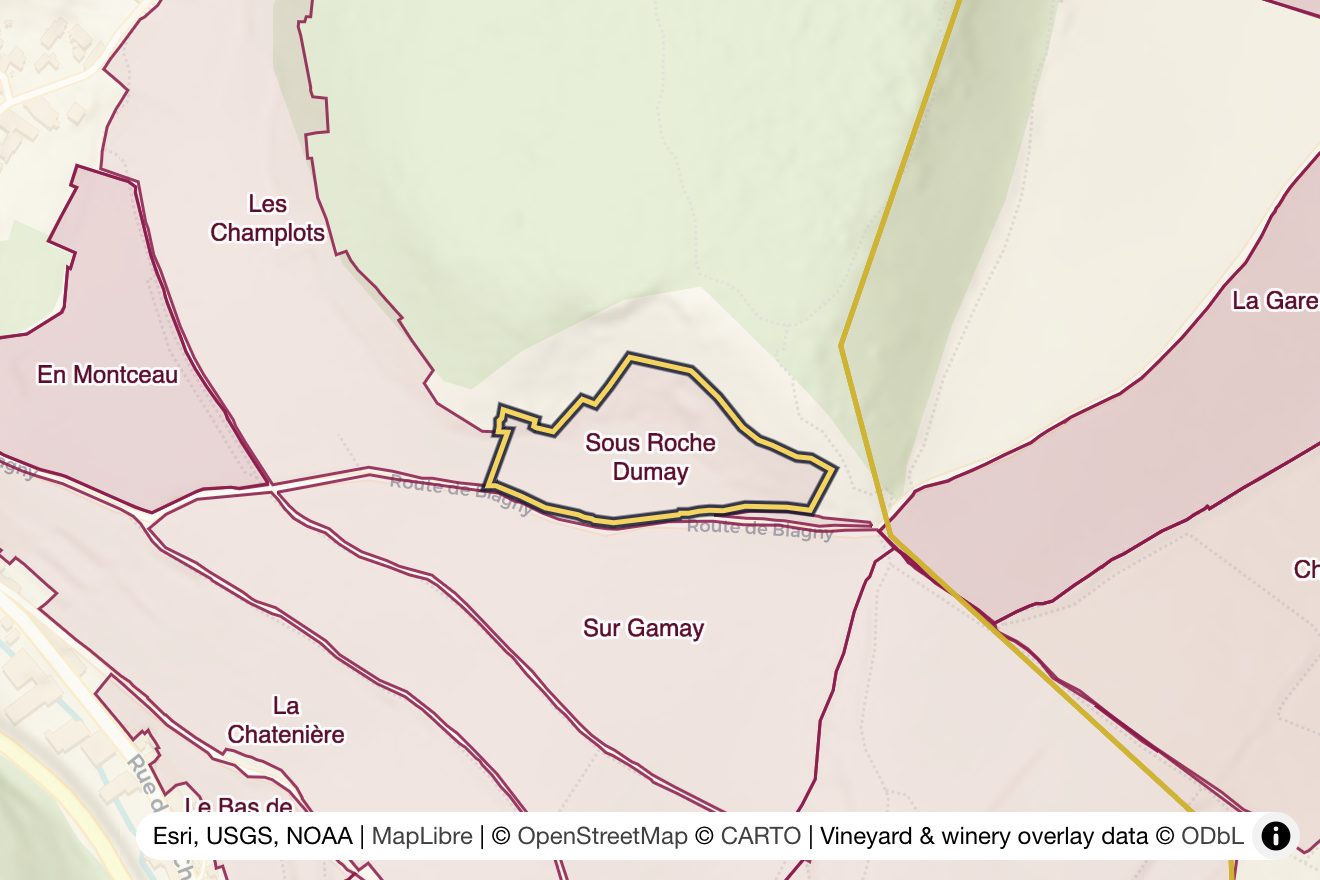
Overview & Location
The climat of Sous Roche Dumay sits strategically positioned on the mid-slope section of Saint-Aubin's eastern-facing escarpment, nestled on the side of Saint-Aubin that borders Puligny-Montrachet and Chassagne-Montrachet. This positioning places it within the extended geological and climatic influence of some of Burgundy's most revered white wine terroirs, while maintaining its own distinct characteristics that have earned recognition since the appellation's establishment.
The vineyard's name, translating roughly to "Under Dumay Rock," provides immediate insight into its geological foundations. The "roche" reference points to the substantial limestone bedrock that defines this site's fundamental character, while "Dumay" likely derives from historical ownership or toponymic references that have been lost to time but remain embedded in the vineyard's identity.
Within the broader context of the Côte de Beaune, Sous Roche Dumay is one of the appellation's Premier Cru white wine sites, sitting at the geographical crossroads where the limestone-rich soils that produce Burgundy's greatest Chardonnays begin their transition toward the different geological formations found further south.
Size and Boundaries
Sous Roche Dumay encompasses a relatively small area, making it a modest climat within Saint-Aubin's Premier Cru portfolio.
The vineyard's boundaries are carefully delineated according to geological and topographical features that have been recognized for centuries. The upper boundary follows the natural break where the soil depth decreases significantly and bedrock exposure becomes more prominent, while the lower boundary is marked by the transition to deeper, more alluvial soils that characterize the village-level appellations.
Terroir & Geology
The geological foundation of Sous Roche Dumay rests upon Jurassic limestone formations dating to approximately 150-200 million years ago. The bedrock consists primarily of Middle to Upper Jurassic limestone that provides the primary growing medium for the vines.
The soil profile reveals a complex stratification that exemplifies Premier Cru terroir characteristics. The topsoil layer, typically 30-50 centimeters deep, consists of brown limestone-clay mixture with significant stone content, providing excellent drainage while retaining sufficient moisture for vine health.
Beneath this active soil layer lies a subsoil of fragmented limestone mixed with marl deposits, creating a permeable yet water-retentive foundation. The limestone fragments, ranging from pebble-sized pieces to larger rock formations, facilitate root penetration while providing the mineral foundation that contributes to the wines' characteristic precision and longevity.
The vineyard's aspect faces primarily east-southeast, capturing the morning sun while receiving protection from the harsh afternoon heat that can stress vines during summer months. This orientation proves particularly beneficial for Chardonnay, allowing for optimal photosynthesis during cooler morning hours while preserving acidity through moderated afternoon temperatures.
The slope gradient averages 8-12%, providing natural drainage while preventing excessive erosion. This moderate pitch allows for mechanized viticulture where appropriate while ensuring that water runoff doesn't strip away precious topsoil during heavy rainfall events.
Elevation is roughly 300 to 350 meters above sea level, positioning the vineyard in the optimal altitude band for Premier Cru quality in this sector of the Côte de Beaune. This elevation provides sufficient elevation for air circulation and temperature moderation while remaining low enough to benefit from the valley's warmth retention.
Climate & Microclimate
Sous Roche Dumay benefits from a continental climate modified by its specific topographical position and limestone bedrock. The vineyard experiences the classic Burgundian pattern of cold winters, mild springs, warm summers, and extended autumns that allow for optimal grape maturation.
The site's eastern exposure creates a distinctive microclimate characterized by early morning warming and afternoon shadow from the hillside above. This pattern promotes steady, consistent ripening without the extreme heat stress that can compromise acid retention in Chardonnay. Morning dew formation, enhanced by the limestone's thermal properties, provides additional moisture during dry periods.
The limestone bedrock acts as a natural temperature regulator, absorbing heat during the day and releasing it gradually during cooler evening hours. This thermal mass effect moderates temperature fluctuations, reducing vintage variation and contributing to the consistent quality for which this climat is known.
Wind patterns in the vineyard are influenced by the natural amphitheater formation of Saint-Aubin's valley. Cool air drainage from the higher elevations creates natural ventilation that reduces humidity and minimizes disease pressure, while the valley's protection shields vines from destructive winds that might damage developing clusters.
Precipitation patterns favor the vineyard's drainage characteristics, with the sloped terrain and limestone substrate preventing waterlogging while the soil's clay content ensures adequate moisture retention during dry spells. Annual rainfall averages 700-800 millimeters, distributed primarily during winter and spring months when vines can best utilize the moisture for canopy development.
Viticulture
Chardonnay dominates plantings in Sous Roche Dumay, and the climat's known bottlings are white wines. The Chardonnay selections planted include traditional Burgundian clones, primarily the renowned Clone 76 and Clone 95, chosen for their adaptation to limestone soils and ability to express terroir characteristics.
Vine age varies significantly across the climat, ranging from recently replanted sections with 5-10 year old vines to venerable parcels containing vines over 60 years old. The average vine age approximates 35-40 years, representing the optimal balance between youthful vigor and mature root development that produces Premier Cru quality fruit.
Planting density follows traditional Burgundian practices, averaging 10,000-12,000 vines per hectare, depending on the specific parcel and producer preferences. This density ensures appropriate competition between vines while allowing sufficient space for mechanical cultivation and harvest operations.
Rootstock selection focuses primarily on SO4 and 161-49C, both well-adapted to limestone soils and capable of providing controlled vigor in this terroir. Some older parcels retain ungrafted vines, though these become increasingly rare due to phylloxera pressure and replanting necessities.
Pruning follows the Guyot system predominantly, with some parcels utilizing cordon training where vine age and vigor permit. Bud counts are carefully managed to control yield, typically limiting to 8-10 buds per vine to concentrate flavors and ensure complete ripening.
Vineyard management emphasizes sustainable practices, with most producers employing organic or biodynamic principles. Cover cropping between rows helps manage soil erosion, improve organic matter content, and provide natural pest management. Green harvesting typically occurs in July, removing excess clusters to ensure optimal ripening of remaining fruit.
Harvest timing requires careful consideration of the vineyard's exposure and microclimate variations. Eastern-facing slopes typically ripen 3-5 days earlier than other exposures, requiring selective harvesting to optimize fruit quality across different parcels.
Wine Character & Style
Wines from Sous Roche Dumay exhibit the refined elegance and mineral precision characteristic of premier limestone terroirs in the Côte de Beaune. The Chardonnay expressions demonstrate remarkable purity and focus, combining rich textural elements with vibrant acidity that defines great white Burgundy.
Aromatic profiles typically begin with precise citrus notes (lemon zest, lime, and occasional grapefruit) supported by white flower expressions including acacia, hawthorn, and subtle honeysuckle. As wines develop complexity, stone fruit characteristics emerge, particularly white peach and apricot, while maintaining the citrus framework that provides structure and longevity.
The limestone influence manifests as a distinctive mineral backbone, often described as crushed stone, wet limestone, or saline qualities that add complexity without overwhelming the fruit expression. This mineral component integrates seamlessly with the wine's texture, creating a sense of place that clearly identifies the terroir source.
Textural characteristics reveal medium to full body with remarkable precision and definition. The clay component in the soil contributes to textural richness without heaviness, while the limestone drainage ensures maintained acidity and freshness. Wines exhibit excellent concentration balanced by elegant restraint, avoiding the excessive richness that can compromise food compatibility.
Oak integration varies by producer but generally follows traditional Burgundian practices, utilizing 20-40% new French oak barrels for 12-15 months of aging. The limestone terroir provides sufficient natural structure to support oak influence without being dominated by it, allowing wood spices (vanilla, subtle toast, baking spices) to complement rather than mask terroir expression.
Vintage variation in Sous Roche Dumay reflects the site's ability to maintain character across different climatic conditions. Cooler vintages emphasize mineral precision and citrus purity, while warmer years develop greater stone fruit richness while retaining the characteristic limestone backbone.
The wines demonstrate exceptional aging potential, developing tertiary aromas of honey, toasted nuts, dried fruits, and complex spice notes over 8-15 years. The limestone acidity provides the structural foundation for extended cellaring, while the site's natural concentration ensures flavor development rather than decline over time.
Comparison to Surrounding Crus
Within Saint-Aubin's Premier Cru portfolio, Sous Roche Dumay occupies a distinctive position, sharing characteristics with neighboring climats while maintaining unique personality traits. Compared to the adjacent Les Murgers des Dents de Chien, Sous Roche Dumay typically produces wines with greater textural richness and fuller body, attributed to slightly deeper soils and more favorable sun exposure.
The contrast with En Remilly, another prominent Saint-Aubin Premier Cru, reveals Sous Roche Dumay's greater mineral intensity and aging potential. En Remilly's wines often show more immediate charm and accessibility, while Sous Roche Dumay requires additional cellaring to reveal its full complexity and depth.
When compared to the prestigious white wine climats of neighboring Chassagne-Montrachet, Sous Roche Dumay wines exhibit similar limestone-driven minerality but with distinctive Saint-Aubin character, typically more restrained alcohol levels, brighter acidity, and more pronounced citrus elements. While lacking the power and concentration of Chassagne's Grand Crus, Sous Roche Dumay offers comparable elegance and finesse at premier cru level.
The relationship to Puligny-Montrachet's Premier Crus reveals interesting parallels and contrasts. Sous Roche Dumay shares the limestone foundation that defines Puligny's terroir but expresses it with Saint-Aubin's characteristic restraint and precision. Where Puligny Premier Crus might show greater opulence and immediate appeal, Sous Roche Dumay emphasizes structure and longevity.
Notable Producers
Several distinguished producers craft wines from Sous Roche Dumay, each bringing unique approaches while respecting the terroir's fundamental character. Domaine Joseph Colin, a family estate, bottles a Saint-Aubin Premier Cru Sous Roche Dumay.
Domaine Marc Colin maintains significant holdings in Sous Roche Dumay, producing wines that showcase the terroir's aging potential through extended lees aging and judicious oak usage. Their parcels, located in the climat's central section, benefit from optimal exposition and mature vine age that contributes to wine complexity and depth.
Domaine Larue also bottles a Sous Roche Dumay.
Domaine Bertrand Bachelet also bottles a Sous Roche Dumay.
Historical Background & Classification
The history of Sous Roche Dumay parallels the broader development of Saint-Aubin as a recognized wine-producing commune within the Côte de Beaune. Fine wine production in the Saint-Aubin valley is thought likely from the Middle Ages, particularly on the slopes near the hamlet of Gamay.
Saint-Aubin's appellation was recognized in 1937, and its list of Premier Cru climats was first drawn up in 1943. Sous Roche Dumay was among the original Premier Crus designated, reflecting its recognized quality and distinct terroir characteristics that distinguished it from village-level sites.
During the medieval period, the vineyard likely belonged to religious institutions, following the pattern common throughout Burgundy where monasteries developed viticultural expertise and maintained detailed records of wine quality and terroir characteristics. The name "Dumay" may reference historical ownership or toponymic features that have since been forgotten but remain embedded in official records.
The 19th century brought significant changes to Sous Roche Dumay, as phylloxera devastation required complete replanting and modernization of viticultural practices. Recovery efforts in the early 20th century focused on rootstock selection and clone development that would preserve terroir expression while providing resistance to pest pressure.
Post-World War II development saw increased recognition of Saint-Aubin's quality potential, with Sous Roche Dumay gaining attention from wine critics and collectors who discovered exceptional value in these terroir-driven wines. This recognition led to increased investment in vineyard management and winemaking facilities that elevated quality standards throughout the 1980s and 1990s.
Aging Potential & Quality Level
Wines from Sous Roche Dumay demonstrate exceptional aging potential, typically reaching initial maturity 4-6 years after vintage while continuing to develop complexity for 12-20 years in optimal cellaring conditions. The limestone acidity provides structural foundation for extended aging, while natural fruit concentration ensures flavor development rather than decline over time.
Quality consistency across vintages reflects the terroir's natural balance and the increasing expertise of producers working within the climat. While vintage variation exists, reflecting annual climatic differences, the fundamental character and quality level remain remarkably stable due to the limestone bedrock's moderating influence and optimal drainage characteristics.
The investment potential of Sous Roche Dumay wines has grown significantly over the past two decades, as collectors recognize the exceptional quality-to-price ratio compared to more famous Côte de Beaune appellations. Limited production and increasing demand have created a strong secondary market for mature vintages from respected producers.
Quality assessment reveals wines that consistently achieve scores in the 88-93 point range from international critics, with exceptional vintages and producers reaching 94+ points. This quality level places Sous Roche Dumay among the finest Premier Cru expressions in Saint-Aubin and demonstrates its legitimacy within Burgundy's hierarchy of terroirs.
The climat's future prospects appear exceptionally bright, with climate change potentially favoring Saint-Aubin's elevation and exposition compared to lower-lying sites. Young vignerons entering the appellation bring fresh perspectives while respecting traditional methods, ensuring continued quality development and terroir expression that honors Sous Roche Dumay's distinguished heritage within Burgundy's complex terroir mosaic.