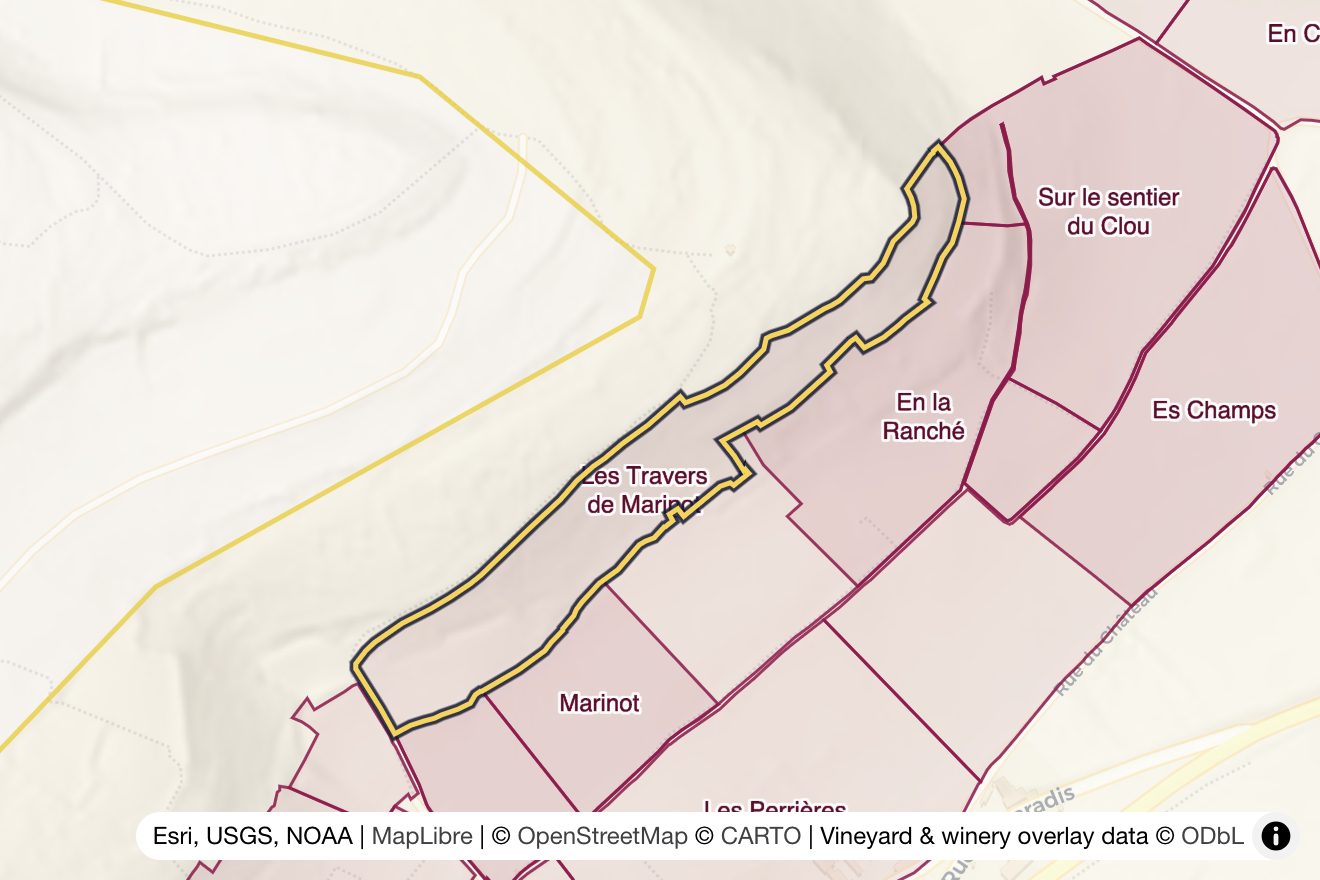
Saint-Aubin, Côte de Beaune, Burgundy
Overview & Location
Les Travers de Marinot stands as one of Saint-Aubin's most distinguished Premier Cru vineyards, positioned in the heart of this emerging commune within the Côte de Beaune. Located approximately 15 kilometers southwest of Beaune, Saint-Aubin occupies a unique geographical position that lies in a side valley just west of the prestigious white wine communes of Puligny-Montrachet and Chassagne-Montrachet.
The climat sits on the eastern-facing slopes above the village of Saint-Aubin, forming part of a continuous geological formation that extends from the legendary slopes of Montrachet. This positioning places Les Travers de Marinot within the broader Côte de Beaune's limestone backbone, sharing fundamental geological characteristics with some of Burgundy's most celebrated vineyards while maintaining its own distinct terroir expression.
The vineyard's name, "Travers de Marinot," reflects the traditional Burgundian nomenclature system, with "Travers" indicating a traverse or crossing of the slope, and "Marinot" likely deriving from a historical proprietor or topographical reference. This linguistic heritage underscores the site's long-standing viticultural importance within the Saint-Aubin commune.
Saint-Aubin itself represents one of Burgundy's most compelling value propositions, offering Premier Cru wines that express the fundamental characteristics of Côte de Beaune terroir at prices significantly below those of neighboring communes. Les Travers de Marinot exemplifies this quality-to-price ratio, delivering wines of remarkable complexity and aging potential.
Size
Les Travers de Marinot encompasses approximately 3.97 hectares (9.8 acres), making it a moderately-sized Premier Cru within Saint-Aubin's classification system. This size allows for meaningful production while maintaining the intimate scale characteristic of Burgundy's finest climats.
The vineyard's relatively compact size ensures geological and microclimatic consistency across the site, though subtle variations exist within different parcels that contribute to the complexity of wines produced from this climat. The total planted area may vary slightly from the official appellation boundaries due to historical vineyard abandonment and replanting initiatives, but the core producing area remains stable at approximately 3.97 hectares.
Within this total area, the vineyard is divided among several proprietors, with parcel sizes ranging from small holdings of less than 0.5 hectares to somewhat larger plots. This fragmentation, typical of Burgundian ownership patterns, results in multiple interpretations of the site's terroir potential while maintaining overall stylistic coherence.
Terroir & Geology
The geological foundation of Les Travers de Marinot reflects the broader Côte de Beaune's limestone-dominated structure, specifically representing the Bathonian stage of the Middle Jurassic period. The vineyard sits atop a complex mixture of limestone bedrock overlaid with varying depths of clay-limestone soils that directly influence vine development and wine character.
The soil composition consists primarily of brown limestone soils with moderate clay content, typically ranging from 15-25% clay depending on the specific parcel location. This clay percentage provides sufficient water retention for vine health during dry periods while maintaining the excellent drainage characteristics essential for quality viticulture. The limestone component, rich in marine fossils, contributes the mineral backbone that distinguishes Premier Cru Burgundy.
Soil depth varies across the vineyard, ranging from 40-80 centimeters before reaching the underlying limestone bedrock. Shallow soil areas produce wines of greater concentration and mineral intensity, while deeper soil sections yield wines with more generous fruit expression and textural richness. This variation within the climat contributes to the complexity achievable through careful vineyard management and selective harvesting.
The vineyard faces primarily east-southeast, providing optimal morning sun exposure while avoiding the potentially excessive heat of late afternoon western exposure. This orientation ensures steady ripening conditions throughout the growing season, particularly important for both Pinot Noir and Chardonnay cultivation.
Slopes range from 8-15% gradient, providing natural drainage while preventing excessive erosion. The moderate slope angle allows for mechanization where appropriate while maintaining the hand-harvesting accessibility essential for quality-focused producers.
Elevation ranges from roughly 300 to 350 meters above sea level, positioning the vineyard within the optimal altitude band for Côte de Beaune viticulture. This elevation provides protection from late spring frosts while ensuring sufficient diurnal temperature variation for flavor development and acidity retention.
Climate & Microclimate
Les Travers de Marinot benefits from Saint-Aubin's distinctive mesoclimate, which combines the broader Côte de Beaune's continental characteristics with specific local influences created by the commune's topographical position. The vineyard experiences a semi-continental climate with oceanic influences, characterized by warm summers, cool nights, and moderate precipitation levels.
The eastern orientation creates favorable morning sun exposure, allowing for gentle warming after cool nights while avoiding the potentially detrimental effects of excessive afternoon heat. This exposure pattern proves particularly beneficial for Chardonnay, which requires steady ripening conditions to develop its characteristic complexity and mineral expression.
Local air circulation patterns, influenced by the valley topography, create beneficial cooling effects during warm summer days. Cool air drainage from higher elevations flows down through the vineyard during evening hours, preserving natural acidity and extending the growing season for optimal phenolic development.
Annual precipitation averages 700-800mm, with most rainfall occurring during winter and spring months. Summer drought stress occasionally occurs, though the limestone subsoil's water retention capabilities generally provide sufficient moisture for vine health. The well-drained soils prevent waterlogging during wet periods, maintaining root health and preventing dilution of fruit concentration.
Growing season temperatures average 15-16°C, with significant diurnal temperature variation reaching 10-12°C during harvest periods. This temperature differential proves crucial for maintaining acidity while achieving phenolic ripeness, particularly important for producing age-worthy Premier Cru wines.
Frost risk remains minimal due to the vineyard's elevation and eastern exposure, though occasional late spring frosts can affect flowering. The site's position above the valley floor provides natural frost protection through air drainage patterns.
Viticulture
Les Travers de Marinot produces both Pinot Noir and Chardonnay, though Chardonnay represents the dominant plantation, comprising approximately 70% of the total vineyard area. This varietal distribution reflects the site's particular suitability for white wine production, though the Pinot Noir sections produce wines of notable quality and character.
Vine age varies considerably across the climat, with some sections containing vines over 50 years old while others feature more recent plantings from the 1990s and 2000s. The older vine sections, particularly those planted in the 1960s and 1970s, produce fruit of exceptional concentration and complexity, contributing to the wines' aging potential and terroir expression.
Planting density typically ranges from 10,000-12,000 vines per hectare, following modern Burgundian practices that balance vine competition for optimal fruit concentration with practical vineyard management considerations. Higher density plantings generally produce superior wine quality through increased root competition and reduced per-vine yields.
Rootstock selection focuses primarily on SO4 and 3309C for their adaptation to limestone soils and moderate vigor characteristics. These rootstocks provide appropriate vine nutrition uptake while preventing excessive vegetative growth that could compromise fruit quality.
Common viticultural practices include traditional Burgundian techniques such as careful canopy management, selective green harvesting for yield control, and hand harvesting at optimal ripeness. Most producers employ sustainable or organic farming methods, recognizing the long-term benefits for soil health and wine quality.
Yield management remains crucial for achieving Premier Cru quality standards. Legal base yields stand at 55 hectoliters per hectare for white wine and 48 hectoliters per hectare for red, though quality-conscious producers often achieve yields 10-20% below these limits through careful vineyard management.
Site-specific challenges include occasional summer drought stress on shallow soil sections, requiring careful canopy management to protect fruit from excessive sun exposure. The limestone soils can become compacted during wet periods, necessitating regular soil cultivation to maintain proper root development conditions.
Wine Character & Style
Chardonnay from Les Travers de Marinot exhibits a distinctive mineral-driven profile that reflects the limestone-dominated terroir while displaying the textural richness characteristic of quality Côte de Beaune whites. The wines typically show brilliant golden-yellow color with excellent clarity and luminosity.
Aromatic profiles feature primary fruit notes of white peach, pear, and citrus, particularly lemon zest and grapefruit. Secondary characteristics develop through careful winemaking and include subtle vanilla and spice notes from judicious oak treatment, along with distinctive mineral notes of limestone dust and wet stone that reflect the vineyard's geological foundation.
Tertiary aromatics develop with bottle aging, revealing complex notes of honey, hazelnut, and brioche, along with more pronounced mineral characteristics that distinguish Premier Cru quality levels. These evolved aromatics typically emerge after 5-8 years of cellaring.
Palate structure demonstrates excellent balance between fruit concentration and mineral acidity. The limestone terroir provides a characteristic tension that supports the wine through extended aging while maintaining freshness and vitality. Alcohol levels typically range from 13-13.5%, providing sufficient body without overwhelming the delicate terroir expression.
Textural qualities include medium to medium-full body with excellent concentration and length. The clay component in the soil contributes to the wine's textural richness while the limestone provides the mineral backbone that extends the finish. Well-made examples display seamless integration of fruit, acidity, and oak influences.
Pinot Noir from Les Travers de Marinot shows the elegant, mineral-driven style characteristic of limestone terroir. Color typically ranges from medium ruby to garnet, with excellent clarity and appropriate concentration for Premier Cru status.
Red wine aromatics feature primary red fruit notes of cherry, raspberry, and strawberry, often accompanied by floral notes of violet and rose. The limestone influence contributes distinctive mineral undertones that differentiate these wines from those produced on clay-dominated sites.
Palate structure emphasizes elegance over power, with silky tannins and bright acidity providing excellent aging potential. The wines typically show medium body with excellent concentration and length, displaying the classic Côte de Beaune balance between fruit and terroir expression.
Comparison to Surrounding Crus
Within Saint-Aubin's Premier Cru hierarchy, Les Travers de Marinot produces wines of notable distinction compared to neighboring climats. Relative to En Remilly, which lies at slightly higher elevation, Les Travers de Marinot wines show greater textural richness and earlier accessibility while maintaining excellent aging potential.
Compared to Les Murgers des Dents de Chien, perhaps Saint-Aubin's most celebrated Premier Cru, Les Travers de Marinot produces wines of similar quality but with distinctly different character profiles. While Murgers des Dents de Chien emphasizes mineral precision and linear structure, Les Travers de Marinot offers greater fruit generosity and textural roundness.
Les Travers de Marinot is one of the lieux-dits grouped within the Sur le Sentier du Clou premier cru.
Relative to the broader Côte de Beaune context, Les Travers de Marinot Chardonnay shares stylistic similarities with Premier Cru Meursault, particularly Les Perrières, though typically with greater mineral precision and less overt richness. The limestone influence creates wine profiles more similar to Puligny-Montrachet Premier Crus than to the clay-influenced sites of Chassagne-Montrachet.
Saint-Aubin contains no Grand Cru vineyards, though some of its premier crus lie close to Montrachet; Les Travers de Marinot sits in the side valley above the village, on a different slope. While lacking the ultimate concentration and complexity of Grand Cru sites, Les Travers de Marinot wines display similar mineral characteristics and aging potential at a more accessible quality level.
Notable Producers
Several distinguished producers craft wines from Les Travers de Marinot, each bringing unique approaches to vineyard management and winemaking while respecting the site's terroir characteristics.
Domaine Hubert Lamy represents one of the most respected Saint-Aubin producers, with holdings in Les Travers de Marinot that date back multiple generations. The domaine's approach emphasizes traditional Burgundian techniques with modern precision, producing Chardonnay of remarkable complexity and aging potential.
Domaine Jean-Claude Bachelet et Fils produces Saint-Aubin premier cru wines. The domaine's winemaking philosophy emphasizes minimal intervention, allowing the terroir characteristics to express themselves through careful vineyard management and traditional fermentation techniques.
Domaine Marc Colin et Fils produces both white and red wines from Les Travers de Marinot, with their white wine receiving particular acclaim for its mineral precision and aging capability.
Henri Prudhon et Fils, a smaller family domaine, crafts Saint-Aubin premier cru wines, including Sur le Sentier du Clou. Their approach produces wines of particular terroir transparency and authenticity.
Domaine Pierre-Yves Colin-Morey, though based in Chassagne-Montrachet, is a notable Saint-Aubin premier cru producer, with bottlings such as En Remilly and La Chatenière. Their approach combines traditional techniques with innovative precision, resulting in wines that showcase the climat's full potential.
Several négociant houses, including Maison Louis Jadot and Bouchard Père et Fils, source fruit from Les Travers de Marinot, contributing to the climat's broader market recognition while maintaining quality standards appropriate for Premier Cru classification.
Historical Background & Classification
Les Travers de Marinot's viticultural history extends back centuries, with documented wine production from the site dating to medieval periods when Saint-Aubin served as a supplier to nearby monasteries and nobility. The climat's name appears in historical documents from the 16th century, indicating established recognition of its distinct terroir characteristics.
The vineyard gained Premier Cru classification in 1937 as part of the broader Burgundian appellation system establishment. This classification recognized the site's superior terroir characteristics and consistent wine quality relative to Saint-Aubin's village-level vineyards.
During the 20th century, Les Travers de Marinot experienced the typical challenges of Burgundian viticulture, including phylloxera replanting, world war disruptions, and subsequent quality renaissance. The post-1970s period marked significant quality improvements as producers embraced modern viticulture while respecting traditional techniques.
The climat's reputation has grown considerably since the 1990s as Saint-Aubin gained recognition among wine enthusiasts seeking high-quality Burgundy at reasonable prices. This recognition has led to increased investment in vineyard management and winemaking equipment, further improving wine quality.
Recent decades have seen consolidation of vineyard holdings and increased focus on organic and sustainable viticulture, reflecting broader Burgundian trends toward environmental responsibility and terroir expression.
Aging Potential & Quality Level
Les Travers de Marinot Chardonnay demonstrates excellent aging potential, with well-made examples developing complexity and depth over 10-15 years from vintage. The limestone terroir provides the mineral backbone necessary for extended cellaring, while careful winemaking preserves the freshness essential for graceful evolution.
Young wines, typically consumed within 2-4 years, display primary fruit characteristics and mineral precision. The intermediate aging period, 5-8 years, reveals the wines' full complexity as secondary characteristics develop while maintaining fruit vibrancy. Mature wines, beyond 10 years, show the tertiary complexity that distinguishes Premier Cru quality.
Quality consistency has improved markedly since the 1990s as producers have refined their understanding of the site's potential. Annual vintage variation exists, with warmer years producing wines of greater richness and concentration, while cooler vintages emphasize mineral precision and elegant structure.
Pinot Noir from Les Travers de Marinot shows excellent aging potential over 8-12 years, developing complex secondary characteristics while maintaining the elegant structure characteristic of limestone terroir. The wines' moderate tannin levels and bright acidity provide excellent balance for extended cellaring.
The Premier Cru classification accurately reflects the site's quality potential, with the best examples comparing favorably to Premier Cru wines from more prestigious communes while offering superior value. Investment-grade examples exist, though the primary appeal lies in the wines' excellent quality-to-price ratio and distinctive terroir expression.
Market recognition continues to grow as Saint-Aubin's reputation expands, though Les Travers de Marinot remains accessible relative to comparable Premier Cru sites in neighboring communes. This accessibility, combined with excellent quality potential, ensures continued appreciation among knowledgeable Burgundy enthusiasts.