Overview & Location
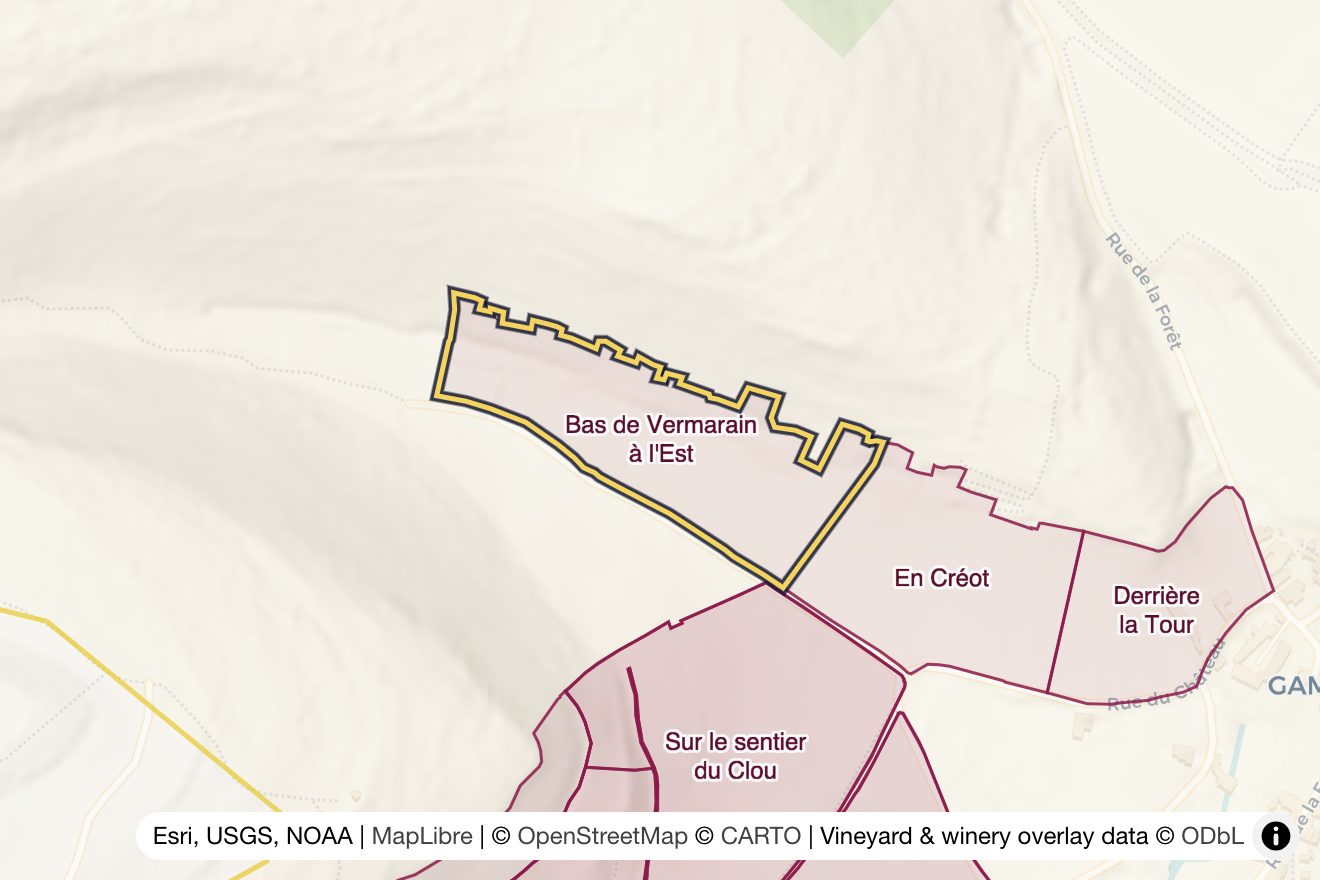
Located approximately 15 kilometers southwest of Beaune, Saint-Aubin sits at the confluence of two valleys, with Bas de Vermarain à l'Est positioned along a combe in the direction of La Rochepot while maintaining the elevation necessary for proper drainage and temperature moderation. The vineyard's location places it in direct geological and climatic continuity with some of Burgundy's most celebrated terroirs, while maintaining its own distinct characteristics that contribute to its individual expression.
The climat sits among the Vermarain lieux-dits; the neighbouring Bas de Vermarain à l'Ouest and En Vermarain à l'Est are village-level, not Premier Cru. The "Bas" designation indicates its position on the lower portion of the slope, distinguishing it from higher-elevation sites while placing it in the zone where soil depth and composition create ideal conditions for both Pinot Noir and Chardonnay cultivation.
Size
Bas de Vermarain à l'Est encompasses approximately 3.2 hectares (7.9 acres), making it a moderately sized Premier Cru within Saint-Aubin's portfolio of classified vineyards. This size places it among the mid-range climats in the commune, larger than some of the more fragmented Premier Crus but smaller than the extensive Les Murgers des Dents de Chien. The vineyard's compact size contributes to its homogeneous character, as the entire climat shares similar geological foundations and exposure patterns that create consistency in terroir expression.
The parcellation within Bas de Vermarain à l'Est reflects typical Burgundian complexity, with multiple owners holding plots of varying sizes throughout the climat. This fragmentation, while creating logistical challenges, also provides opportunities for different viticultural approaches and stylistic interpretations within the same terroir, contributing to the diversity of expressions that emerge from this single climat.
Terroir & Geology
The geological foundation of Bas de Vermarain à l'Est consists primarily of Jurassic limestone formations characteristic of the Côte de Beaune's premier viticultural sites. The bedrock belongs to the Bathonian stage, featuring hard limestone overlaid with varying depths of clay-limestone soils that provide both excellent drainage and sufficient water retention for vine health during dry periods.
The soil profile typically extends 60-80 centimeters in depth, with the upper horizons containing 25-35% clay content mixed with limestone fragments and fossil debris. This composition creates an ideal environment for root development, allowing vines to penetrate deeply enough to access consistent moisture while preventing waterlogging during periods of heavy rainfall. The presence of iron oxide deposits within the clay component contributes distinctive mineral characteristics to wines produced from this site.
The vineyard's eastern aspect provides optimal sun exposure from morning through early afternoon, with the slope gradient ranging from 8-12% across different sections of the climat. This moderate slope ensures proper drainage while preventing excessive erosion, maintaining soil integrity over decades of cultivation. The elevation ranges from approximately 280-320 meters above sea level, placing it in the ideal zone for grape ripening in Burgundy's continental climate.
Geological surveys have revealed the presence of fossilized marine deposits throughout the soil profile, contributing to the complex mineral matrix that influences wine character. The limestone content varies from 40-60% depending on specific parcels within the climat, with higher concentrations typically found in the upper portions of the slope where bedrock lies closer to the surface.
Climate & Microclimate
Bas de Vermarain à l'Est benefits from Saint-Aubin's favorable mesoclimate, which combines continental influences with moderating effects from the valley systems that characterize this portion of the Côte de Beaune. The eastern exposure ensures optimal morning sun exposure while providing some protection from the harsh afternoon heat during summer months, creating ideal conditions for gradual grape ripening.
The climat experiences slightly cooler temperatures than sites at lower elevations, with the 280-320 meter elevation range providing natural temperature moderation that extends the growing season and promotes gradual phenolic development in both Pinot Noir and Chardonnay. This cooling effect becomes particularly beneficial during hot vintage years, helping maintain natural acidity levels that define high-quality Burgundy.
Drainage patterns within the vineyard create distinct microclimatic zones, with better-drained upper sections experiencing slightly warmer conditions than lower areas where clay content increases moisture retention. These variations contribute to the complexity of wines produced from different parcels within the climat, as each microzone contributes unique characteristics to the final blend.
Air circulation patterns benefit from the valley configuration surrounding Saint-Aubin, with regular air movement helping prevent fungal diseases while moderating temperature extremes. The site's exposure to prevailing winds from the west and northwest provides natural ventilation that reduces humidity levels around grape clusters during critical ripening periods.
Viticulture
Bas de Vermarain à l'Est is planted predominantly with Chardonnay, though small sections contain Pinot Noir, reflecting the climat's versatility for both varieties. The Chardonnay plantings dominate approximately 75% of the vineyard area, with most vines ranging from 25-45 years old, providing the optimal balance between vigor and concentration that defines Premier Cru quality.
Planting density typically ranges from 9,000-10,500 vines per hectare, following traditional Burgundian practices that ensure appropriate competition between vines while maintaining manageable yields. Most producers employ Guyot pruning systems, adapted to local conditions with careful attention to bud selection and cane positioning to optimize sun exposure and air circulation.
Viticultural practices within the climat emphasize sustainable approaches, with many producers implementing organic or biodynamic methods. Soil management focuses on maintaining the delicate balance between the clay and limestone components, with careful cultivation timing to prevent compaction while preserving soil structure. Cover crops are increasingly common, particularly leguminous plants that contribute nitrogen naturally while improving soil biology.
Yield management represents a critical aspect of quality production, with Premier Cru regulations setting base yields at 55 hectoliters per hectare for white wine and 48 hectoliters per hectare for red. Most quality-focused producers target yields 10-20% below these maximums, achieving greater concentration and terroir expression through careful cluster thinning and canopy management.
The site-specific challenges include managing the varying clay content across different parcels, which affects water retention and requires adapted cultivation techniques. The eastern exposure, while generally beneficial, can create rapid temperature changes during spring frost periods, necessitating careful monitoring and occasionally protective measures.
Wine Character & Style
Wines from Bas de Vermarain à l'Est exhibit distinctive characteristics that reflect both the site's geological composition and its favorable microclimate. Chardonnay from this climat typically displays remarkable mineral precision, with primary flavors centered on citrus fruits, particularly lemon and grapefruit, complemented by subtle stone fruit notes that develop with proper ripeness.
The mineral backbone represents the wine's most distinguishing feature, expressing the limestone-clay terroir through pronounced chalky textures and a distinctive saline finish that recalls the ancient marine origins of the soil. These mineral characteristics provide structure and longevity, creating wines that improve significantly with proper cellaring.
Aromatic complexity develops through multiple layers, beginning with fresh citrus and white flowers in youth, progressing to more complex notes of honey, hazelnuts, and subtle spice with age. The clay component contributes richness and weight to the mid-palate, while the limestone foundation maintains freshness and precision through the finish.
Textural qualities distinguish Bas de Vermarain à l'Est from many other Saint-Aubin Premier Crus, offering greater density and concentration than sites with higher limestone percentages while maintaining the elegance and finesse expected from this commune. The wine typically displays medium to medium-plus body with excellent natural acidity that provides both immediate appeal and aging potential.
When Pinot Noir is produced from this climat, it exhibits distinctive characteristics shaped by the same terroir influences. The wines show bright red fruit character with notable mineral undertones, displaying the elegance and precision associated with Saint-Aubin while offering greater depth and complexity than village-level sites.
Comparison to Surrounding Crus
Bas de Vermarain à l'Est occupies a unique position within Saint-Aubin's Premier Cru hierarchy, offering characteristics that distinguish it from neighboring climats while sharing certain fundamental qualities derived from the commune's overall terroir expression. Compared to Les Murgers des Dents de Chien, Saint-Aubin's most celebrated Premier Cru, Bas de Vermarain à l'Est typically produces wines with greater immediate accessibility while maintaining excellent aging potential.
The contrast with En Remilly, another prominent Saint-Aubin Premier Cru, reveals differences in soil composition and exposure. En Remilly's higher elevation and different geological profile create wines with more pronounced acidity and mineral austerity, while Bas de Vermarain à l'Est offers greater richness and textural complexity from its clay-limestone balance.
Saint-Aubin contains no Grand Cru vineyards, but Bas de Vermarain à l's proximity to the Chassagne-Montrachet appellation provides interesting comparative context. While lacking the ultimate prestige of neighboring Grand Crus like Montrachet or Bâtard-Montrachet, wines from Bas de Vermarain à l'Est often display similar mineral precision and aging potential at a more accessible level.
Notable Producers
Several distinguished producers craft wines from Bas de Vermarain à l'Est, each bringing different approaches that highlight various aspects of the climat's potential. Domaine Sylvain Langoureau bottles a Bas de Vermarain à l'Est. Lamy's approach emphasizes minimal intervention winemaking that allows the terroir's natural characteristics to express themselves clearly.
Their approach combines traditional techniques with modern precision, creating wines that balance immediate appeal with long-term aging potential. The Colin family's multi-generational experience with this specific climat provides deep understanding of its seasonal variations and optimal harvest timing.
Prudhon's sustainable viticultural practices and careful cellar work produce wines that emphasize the mineral aspects of the terroir while maintaining the richness that defines this site.
Several smaller producers also work parcels within Bas de Vermarain à l'Est, including Domaine Sylvain Langoureau, each contributing to the diversity of expressions available from this climat. These producers often employ more experimental approaches, exploring different harvest timing, fermentation techniques, and aging regimens that reveal additional facets of the terroir's potential.
The stylistic variations among producers reflect different philosophical approaches to expressing terroir, from those who emphasize pure mineral expression through minimal intervention to others who seek to highlight the site's capacity for richness and complexity through more intensive winemaking techniques.
Historical Background & Classification
The Vermarain sector, including Bas de Vermarain à l'Est, has maintained viticultural significance for centuries, with documentation of grape growing in this area dating to medieval monastic records. The climat's name derives from local dialectal terms, with "Vermarain" possibly relating to topographical features that distinguished this site from surrounding areas.
The formal classification of Bas de Vermarain à l'Est as Premier Cru rests on the list of Saint-Aubin climats entitled to the Premier Cru mention, first drawn up in 1943 and later revised, which followed the recognition of the commune's appellation in 1937. This classification recognized the site's consistent ability to produce wines of superior quality compared to village-level vineyards, based on decades of empirical evidence regarding wine quality and aging potential.
Historical records from the 19th and early 20th centuries indicate that wines from this climat commanded premium prices compared to other Saint-Aubin sites, suggesting recognition of its quality potential even before formal classification. The phylloxera crisis of the late 19th century affected all Burgundy vineyards, but replanting in Bas de Vermarain à l'Est occurred relatively quickly, indicating confidence in the site's viticultural value.
Throughout the 20th century, Bas de Vermarain à l'Est maintained its reputation as one of Saint-Aubin's more reliable Premier Cru sites, producing consistent quality across varying vintage conditions. The recent decades have seen increased recognition of Saint-Aubin's overall potential, with Bas de Vermarain à l'Est benefiting from renewed attention to the commune's terroir diversity.
Aging Potential & Quality Level
Wines from Bas de Vermarain à l'Est demonstrate excellent aging potential, with properly made examples from good vintages developing complexity over 8-15 years for Chardonnay and 6-12 years for Pinot Noir. The climate's mineral structure provides the foundation for long-term development, while the clay component contributes richness that supports extended cellaring.
Quality consistency represents one of the climat's most valuable characteristics, with the terroir providing sufficient depth and complexity to produce good wines even in challenging vintages. The eastern exposure and moderate elevation create natural buffers against extreme weather conditions, contributing to reliable ripening patterns across different seasonal variations.
The evolution trajectory typically follows predictable patterns, with young wines displaying primary fruit characteristics and mineral precision, developing secondary complexity through the middle aging period, and achieving full tertiary development after 8-10 years. Peak drinking windows vary by vintage and producer style, but most wines reach optimal development between years 5-12 after harvest.
Vintage variation affects development timing and ultimate quality levels, with warmer years producing wines ready for consumption earlier but potentially shorter-lived, while cooler vintages create wines requiring longer development time but offering greater longevity. The climat's terroir characteristics help moderate these variations, providing more consistent development patterns than sites with less geological complexity.
The quality level places Bas de Vermarain à l'Est firmly within the Premier Cru category's middle to upper tier, producing wines that justify their classification while remaining accessible compared to Burgundy's most prestigious sites. This positioning makes wines from this climat valuable for both immediate consumption and cellar development, offering the complexity expected from Premier Cru classification while maintaining reasonable availability and pricing relative to Burgundy's hierarchy.