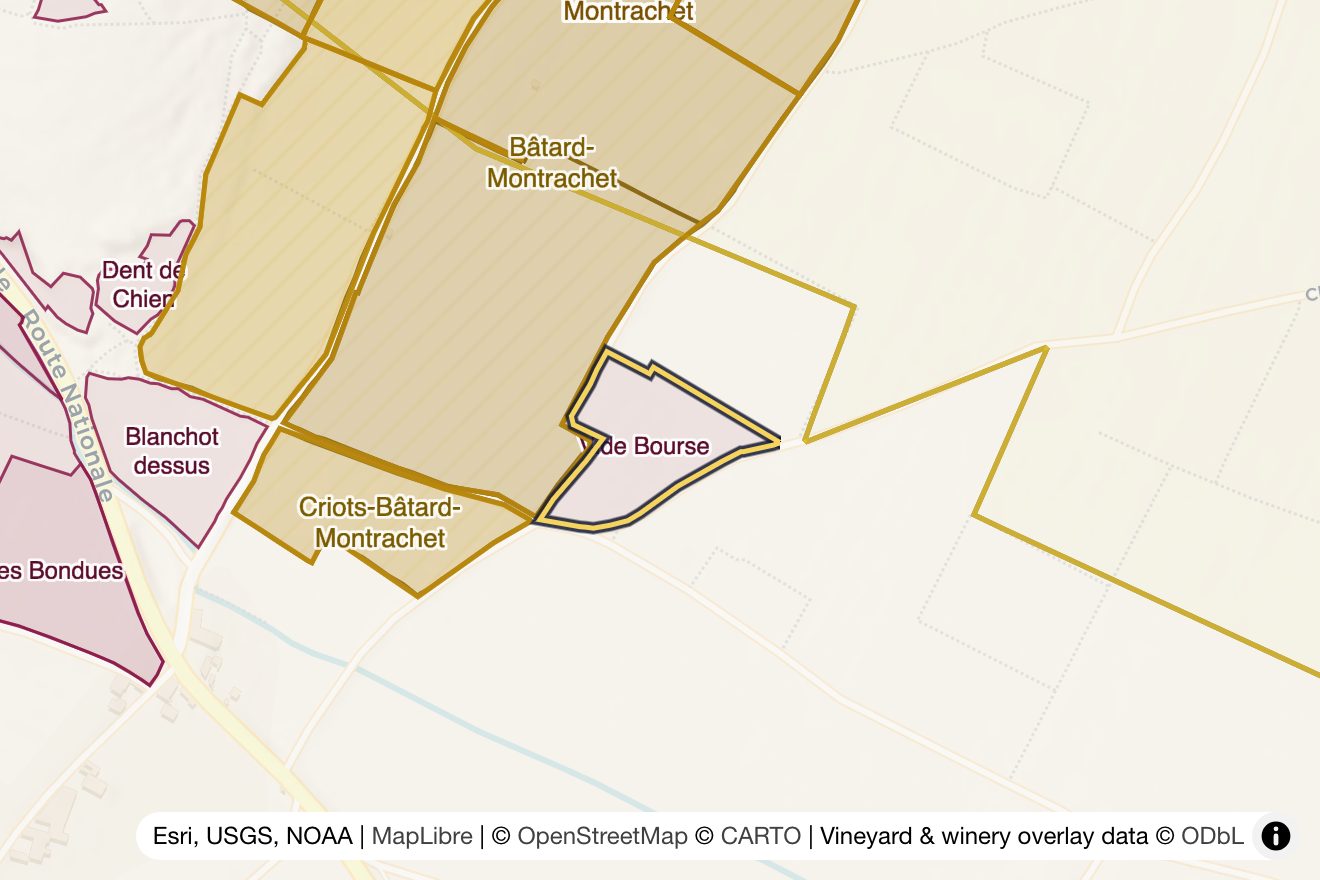
Overview & Location
The climat's position within Chassagne-Montrachet is particularly noteworthy, as it lies at the northern edge of the commune, next to the Bâtard-Montrachet Grand Cru beside the old Chemin de Couches road. This geographical positioning places Vide Bourse within the broader context of the Côte de Beaune's limestone escarpment, where the interplay between geological diversity and microclimatic variation creates some of Burgundy's most expressive terroirs.
Chassagne-Montrachet itself occupies a unique position within the Côte de Beaune, serving as the southern bookend to the region's most celebrated white wine communes, following the legendary sequence of Meursault, Puligny-Montrachet, and finally Chassagne-Montrachet. The village's dual personality (producing both exceptional Chardonnay and distinguished Pinot Noir) reflects the geological complexity that makes Vide Bourse particularly intriguing as a Premier Cru capable of expressing both varieties with remarkable finesse.
Size
Vide Bourse encompasses approximately 3.8 hectares (9.4 acres), making it a moderately-sized Premier Cru climat within the Chassagne-Montrachet appellation. This size places it within the typical range for Burgundy's Premier Cru vineyards, large enough to encompass meaningful geological variation while remaining small enough to maintain terroir coherence and individual character expression.
The climat's relatively compact size reflects the precision of Burgundy's historical vineyard delineation, where centuries of viticultural observation led to the identification of specific terroir units based on soil composition, drainage patterns, and microclimatic characteristics. Within these 3.8 hectares, the vineyard encompasses subtle variations in slope, aspect, and soil depth that contribute to the complexity and nuanced expression found in wines from this site.
Terroir & Geology
The geological foundation of Vide Bourse reflects the classic Jurassic limestone formations that define the Côte de Beaune's terroir excellence. The vineyard sits upon a complex matrix of Middle Jurassic limestone, specifically Bathonian and Bajocian formations that provide both the mineral backbone and drainage characteristics essential for premium viticulture in this region.
The topsoil composition varies across the climat, with the upper sections featuring a shallow layer of brown limestone-derived soil over hard limestone bedrock, while the lower portions display deeper accumulations of clay-limestone mixture with increased clay content. This variation creates distinct mesoterroirs within the single climat, with the clay content generally increasing as elevation decreases, providing different water retention and mineral availability characteristics throughout the vineyard.
The soil is a very well-drained clay-limestone with a high proportion of small pebbles, with the limestone bedrock providing natural drainage while preventing excessive water stress during dry periods. The presence of iron-rich deposits and fossil fragments throughout the soil profile adds complexity to the mineral matrix available to the vines, contributing to the wine's characteristic mineral expression.
Vide Bourse faces primarily east-southeast, capturing optimal morning sunlight exposure while benefiting from some afternoon protection during the hottest parts of summer days. The slope gradient ranges from 8-12%, providing natural drainage while preventing erosion, with the vineyard positioned low on the slope, just below Bâtard-Montrachet. This elevation places the climat in the optimal zone for both Chardonnay and Pinot Noir cultivation, high enough to benefit from cooler temperatures and extended ripening periods while remaining protected from excessive altitude-related stress.
Climate & Microclimate
The climatic conditions at Vide Bourse reflect the continental characteristics typical of the Côte de Beaune, with significant diurnal temperature variation during the growing season that promotes aromatic development and acidity retention. The east-southeast exposure ensures optimal light interception during morning hours while providing some protection from the most intense afternoon heat, creating conditions conducive to gradual, even ripening.
The vineyard's position within the hillside creates specific mesoclimatic effects that distinguish it from surrounding sites. Cold air drainage flows naturally down the slope, preventing frost accumulation during vulnerable spring periods while maintaining beneficial cool conditions during summer nights. This natural ventilation also reduces humidity levels around the vine canopy, decreasing disease pressure and promoting healthy fruit development.
Wind patterns play a crucial role in the site's microclimate, with prevailing winds from the west and northwest helping to moderate temperatures and maintain air circulation throughout the growing season. The limestone bedrock beneath the vineyard acts as a thermal regulator, absorbing heat during the day and releasing it gradually during cooler evening hours, extending the effective growing period and promoting phenolic development in both red and white varieties.
Precipitation patterns interact with the vineyard's drainage characteristics to create optimal water stress conditions, with the limestone providing sufficient water retention to support vine health while preventing waterlogging that could compromise fruit concentration and quality. The site's moderate elevation and easterly exposure also create favorable conditions for morning dew formation, providing supplemental moisture during dry periods while burning off quickly enough to prevent disease issues.
Viticulture
Vide Bourse is planted to Chardonnay and is known for its white wines.
Vine age across the climat varies significantly, with some parcels containing vines approaching 50-60 years of age, while others feature more recent plantings from the 1990s and 2000s. The older vine sections, particularly those planted in the 1960s and 1970s, often produce the most concentrated and complex expressions, benefiting from deep root systems that access the limestone bedrock's mineral resources and water reserves.
Planting density typically ranges from 10,000-12,000 vines per hectare, following traditional Burgundian practices that promote root competition and limit individual vine vigor. This high density, combined with the site's natural drainage characteristics, encourages the development of deep root systems essential for accessing the limestone's mineral complexity and maintaining consistent water supply during stress periods.
Viticultural practices within Vide Bourse generally follow sustainable or organic principles, with many growers adopting minimal intervention approaches that respect the site's natural characteristics. Canopy management focuses on achieving optimal fruit exposure while maintaining sufficient leaf area for photosynthesis, with green harvesting commonly practiced to limit yields and concentrate flavors.
Site-specific challenges include managing vine vigor on the deeper soils in lower elevations, where increased clay content and water retention can promote excessive vegetative growth if not carefully controlled. Conversely, the shallow soils over limestone in upper sections require attention to water stress management during dry vintages, though the limestone bedrock typically provides adequate water reserves for most growing seasons.
Wine Character & Style
Wines from Vide Bourse display distinctive characteristics that reflect both the site's geological complexity and its favorable mesoclimate. Chardonnay from this climat typically exhibits a mineral-driven profile with remarkable precision and length, combining the richness expected from Chassagne-Montrachet with an elegant restraint that distinguishes premier cru expression from village-level wines.
The aromatic profile of Vide Bourse Chardonnay often features citrus notes of lemon and grapefruit zest, complemented by white stone fruit characteristics including white peach and nectarine. Mineral expressions range from wet stone and limestone dust to more complex flint and chalk notes, particularly in wines from the upper elevation sections where limestone influence is most direct. Oak integration varies by producer, but the site's inherent mineral structure provides an excellent foundation for judicious barrel aging.
On the palate, Chardonnay from Vide Bourse demonstrates remarkable textural complexity, with a characteristic mineral tension that balances richness with precision. The limestone terroir contributes to a distinctive chalky texture and persistent mineral finish, while the site's favorable ripening conditions ensure adequate fruit concentration to support extended aging. Acidity levels typically remain vibrant due to the cooling effects of limestone and favorable diurnal temperature variation.
Pinot Noir from Vide Bourse exhibits the elegant, mineral-driven style characteristic of eastern-exposed sites in Chassagne-Montrachet. The color is typically medium to medium-plus intensity, with aromatic profiles emphasizing red fruit characteristics including cherry, raspberry, and strawberry, often accompanied by floral notes and subtle spice elements. The limestone influence contributes to distinctive mineral undertones that add complexity and distinguish the wines from purely fruit-driven expressions.
Structurally, Pinot Noir from this climat displays refined tannins and bright acidity, with the limestone terroir contributing to a characteristic mineral backbone that provides aging structure without overwhelming the fruit expression. The wines typically show excellent balance between power and elegance, with sufficient concentration for medium to long-term aging while maintaining the accessibility that makes Chassagne-Montrachet Pinot Noir particularly appealing.
Comparison to Surrounding Crus
Within the Chassagne-Montrachet Premier Cru hierarchy, Vide Bourse occupies a distinctive position that sets it apart from neighboring climats through its particular combination of elevation, aspect, and soil characteristics. Compared to Clos Saint-Jean, located to the southwest, Vide Bourse typically produces wines with greater mineral precision and less overt richness, reflecting its slightly higher elevation and more direct limestone influence.
The contrast with La Romanée, another prestigious Premier Cru, reveals Vide Bourse's more restrained character and mineral focus. While La Romanée often displays more immediate fruit richness and broader texture, Vide Bourse emphasizes precision and limestone-driven minerality, requiring additional time to reveal its full complexity. This difference reflects both geological variations and distinct mesoclimatic influences between the sites.
Compared to Les Ruchottes, Vide Bourse generally shows greater structural complexity and aging potential, particularly in Chardonnay expressions. The deeper soils and more protected exposure of Vide Bourse create conditions for more gradual phenolic development and enhanced mineral extraction, resulting in wines with greater long-term potential.
Chassagne-Montrachet shares the Montrachet and Bâtard-Montrachet Grand Crus with Puligny-Montrachet and holds Criots-Bâtard-Montrachet entirely within its boundaries; Vide Bourse, which lies next to Bâtard-Montrachet, can be meaningfully compared to them. Though lacking the ultimate concentration and complexity of these legendary sites, Vide Bourse demonstrates similar mineral precision and limestone expression, particularly in its most successful vintages, representing exceptional value within Burgundy's quality hierarchy.
Notable Producers
Several distinguished domaines maintain holdings in Vide Bourse, each bringing distinct approaches to expressing the climat's terroir potential. Domaine Marc Colin et Fils, Domaine Fernand et Laurent Pillot, Domaine Joseph Colin and Thomas Morey are among the growers who bottle a Vide Bourse Chardonnay.
Domaine Bernard Moreau et Fils works holdings distributed across different elevation zones within the climat, enabling them to blend parcels with varying characteristics or produce separate cuvées that highlight specific terroir expressions. Their approach often emphasizes the contrast between upper and lower elevation fruit, creating wines of notable complexity.
Albert Bichot, a négociant house, also bottles a Vide Bourse, contributing to the diversity of stylistic interpretations available from this climat. Each producer's approach to viticulture and winemaking creates subtle variations in expression while maintaining the fundamental character signatures that define this premier cru site.
Historical Background & Classification
The history of Vide Bourse as a recognized vineyard site extends back several centuries, with monastic communities such as the Abbey of Maizières holding vineyards in Chassagne-Montrachet during the medieval period. The climat name itself, translating roughly to "empty purse," likely reflects historical economic associations or possibly describes topographical characteristics that influenced early agricultural use.
Vide Bourse was classified as a Premier Cru rather late, after most of Chassagne-Montrachet's other premiers crus. This classification reflected centuries of empirical observation by local vignerons who had identified the site's particular characteristics and consistent quality potential.
During the 18th and 19th centuries, Vide Bourse gained increasing recognition among Burgundy merchants and négociants, who valued its consistent quality and distinctive character. The climat survived the phylloxera crisis of the late 19th century through replanting efforts that maintained its viticultural continuity while introducing improved rootstock selections adapted to local soil conditions.
The modern era has seen increased recognition of Vide Bourse's quality potential, particularly as contemporary winemaking techniques have enhanced the ability to express subtle terroir differences. The climat's reputation has grown alongside broader appreciation for Chassagne-Montrachet's white wine potential, establishing it as one of the commune's more sought-after Premier Cru sites.
Aging Potential & Quality Level
Wines from Vide Bourse demonstrate impressive aging potential that reflects both the site's geological characteristics and favorable growing conditions. Chardonnay from this climat typically reaches optimal drinking maturity between 8-12 years after vintage, though exceptional examples can continue developing complexity for 15-20 years or more. The limestone-derived mineral structure provides the backbone necessary for extended aging while maintaining freshness and preventing premature oxidation.
The evolution trajectory of Vide Bourse Chardonnay follows a classic Burgundian pattern, with initial fruit and oak integration giving way to more complex mineral and secondary characteristics after 5-7 years. Tertiary development introduces honeyed notes, deeper mineral complexity, and enhanced textural integration, while maintaining the fundamental precision that characterizes the site.
Pinot Noir from Vide Bourse typically shows optimal development between 6-10 years, with the limestone influence contributing to structural integrity that supports medium to long-term aging. The wines generally maintain their fruit character longer than more tannic expressions, while developing complexity through subtle spice and earth integration rather than dramatic transformation.
Quality consistency across vintages is notably high, reflecting both the site's favorable drainage characteristics and the skill of producers working with these parcels. Even in challenging vintages, the limestone terroir and optimal exposure help maintain adequate ripeness and concentration, while natural acidity preservation ensures balanced expressions.
The overall quality level positions Vide Bourse among the more distinguished Premier Cru sites in Chassagne-Montrachet, particularly for Chardonnay expressions. While lacking the ultimate concentration of Grand Cru sites, the climat consistently produces wines that demonstrate clear terroir expression, aging complexity, and the mineral precision that defines premier cru quality in Burgundy's classification hierarchy. Investment-grade examples from top producers represent excellent value within Burgundy's premium wine market, offering genuine premier cru character at prices significantly below Grand Cru levels.