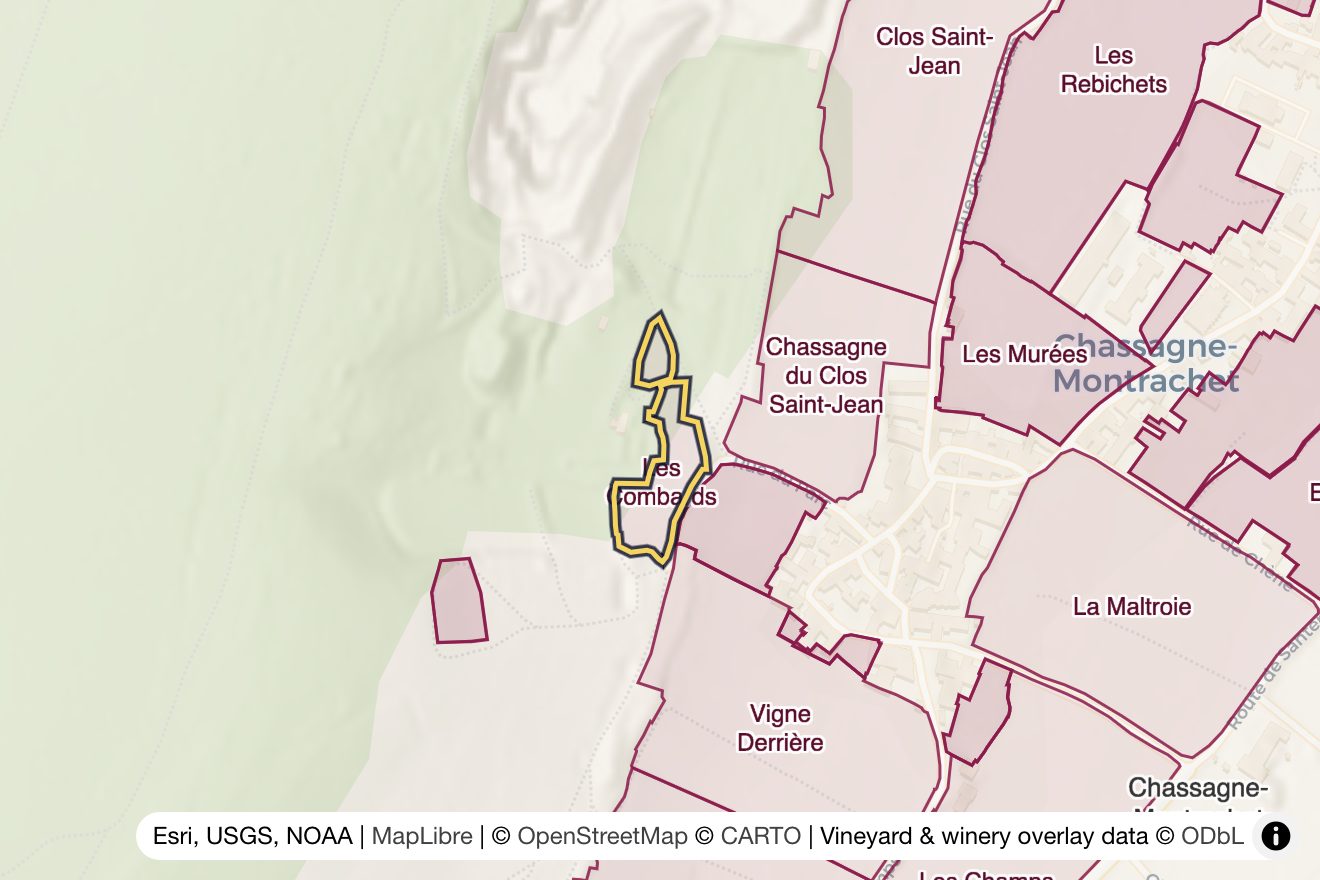
Overview & Location
The vineyard sits approximately 15 kilometers southwest of Beaune, the commercial capital of Burgundy wine, and forms part of the complex mosaic of climats that make Chassagne-Montrachet one of Burgundy's most important appellations for both red and white wines. Les Combards benefits from its position within what many consider the "golden slope" of the Côte de Beaune, where the interplay of elevation, exposition, and soil composition creates ideal conditions for both Pinot Noir and Chardonnay cultivation.
Geographically, Les Combards is situated on the eastern face of the Côte de Beaune escarpment, oriented toward the Saône River valley. This positioning places it within the broader geological formation that runs from Dijon to Santenay, a narrow band of hillsides that represents some of the world's most valuable viticultural real estate. The climat's location provides it with optimal sun exposure while maintaining the crucial elevation and slope characteristics that contribute to proper drainage and temperature moderation.
Size
Les Combards encompasses approximately 0.6 hectares (about 1.5 acres) of vineyard land, making it a very small Premier Cru climat within the Chassagne-Montrachet appellation. This relatively intimate scale is characteristic of Burgundy's climat system, where individual vineyard sites are often small enough to maintain remarkable homogeneity in their terroir characteristics while remaining large enough to support multiple growers and diverse winemaking approaches.
The vineyard's size allows for careful management and attention to detail that would be impossible in larger vineyard areas, yet provides sufficient volume to establish a consistent reputation and market presence. Like many Burgundy climats, Les Combards is divided among only a few proprietors.
Terroir & Geology
The geological foundation of Les Combards reflects the complex limestone-based terroir that defines the Côte de Beaune. The vineyard sits atop Middle Jurassic limestone formations, specifically the Bathonian and Bajocian stages, which provide the mineral backbone essential for producing wines of distinction and longevity. These limestone substrates, formed approximately 165-170 million years ago, offer excellent drainage while retaining sufficient moisture for vine nutrition during dry periods.
The soils are very stony and thin.
Les Combards exhibits a southeast to east-southeast exposure, optimizing morning sun exposure while providing some protection from the intense heat of late afternoon sun. This orientation allows Chardonnay to achieve full physiological ripeness while maintaining crucial acidity.
The vineyard sits high on the slope, among the highest-lying premier cru vines in Chassagne-Montrachet. This elevation provides sufficient altitude to benefit from cooler nighttime temperatures and enhanced diurnal temperature variation, factors crucial for maintaining grape acidity and developing complex aromatic compounds. The slope gradient varies from gentle to moderate, generally ranging from 5-15%, providing natural drainage while preventing excessive erosion.
Climate & Microclimate
Les Combards benefits from the continental climate characteristic of the Côte d'Or, modified by local topographical influences that create a distinct mesoclimate. The vineyard experiences warm, dry summers and cold winters, with spring frost risk moderated by favorable air drainage patterns.
The climat's eastern exposure captures optimal morning sunlight, crucial for photosynthesis initiation and dew evaporation, while the slight protection from westerly winds helps moderate temperature extremes. This orientation also provides some shelter from the prevailing winds that sweep across the Saône plain, creating a more stable growing environment than vineyards with full western exposure.
Annual precipitation typically ranges from 650-750 millimeters, with most rainfall occurring during winter months and spring. The vineyard's well-draining limestone soils prevent waterlogging during wet periods while the clay component provides sufficient water reserves during drought conditions. This natural water management system reduces vintage variation compared to sites with less optimal drainage or water retention characteristics.
The mesoclimate of Les Combards is further influenced by its position within a natural amphitheater formed by the hillside contours, which creates air circulation patterns that help prevent fungal diseases while moderating temperature extremes. Cool air drainage at night maintains crucial acidity levels in the grapes, while thermal retention during the day ensures adequate heat accumulation for ripening.
Sitting high and surrounded by woodland, Les Combards is a little cooler than the main part of Caillerets, and its grapes are generally picked later. This temperature moderation proves particularly beneficial during hot vintages, helping maintain the elegance and balance for which Chassagne-Montrachet is renowned.
Viticulture
Les Combards is planted exclusively to Chardonnay, reflecting Chassagne-Montrachet's reputation as one of Burgundy's premier white wine communes. The Chardonnay vines benefit from the limestone-rich soils and favorable exposition to produce wines of remarkable complexity and aging potential.
Vine ages in Les Combards vary considerably among different proprietors, with some parcels containing vines over 60 years old while others feature younger plantings from recent decades. The older vines, planted at wider spacings typical of earlier eras, often produce the most concentrated and complex wines, with root systems that penetrate deep into the limestone bedrock. Younger plantings, established at higher densities of 10,000-12,000 vines per hectare, follow modern Burgundian viticultural practices aimed at optimizing quality through vine competition and reduced per-vine yields.
Viticultural practices in Les Combards vary by producer. Canopy management focuses on achieving optimal leaf-to-fruit ratios while ensuring adequate sun exposure for the grape clusters. Pruning follows traditional Burgundian methods, typically employing the Guyot simple system for optimal spur placement and vine longevity.
Harvest timing in Les Combards typically occurs during the third or fourth week of September, though climate change has shifted harvest dates earlier in recent decades. Producers carefully monitor both sugar accumulation and phenolic ripeness, with the best parcels often harvested in multiple passes to ensure optimal maturity for each vine or section of the vineyard.
Site-specific challenges in Les Combards include managing vine vigor in deeper soil areas, where excessive growth can dilute wine quality, and ensuring adequate ripeness in cooler sections of the vineyard during challenging vintages. Erosion control requires careful attention due to the sloped terrain, with many producers employing cover crops and organic matter incorporation to maintain soil structure.
Wine Character & Style
Chardonnay from Les Combards exhibits distinctive characteristics that reflect the climat's unique terroir combination of stony limestone soils, favorable exposition, and high elevation. These wines typically display remarkable mineral intensity, with pronounced limestone-derived chalky notes that provide a signature backbone throughout the wine's evolution. The aromatic profile often features citrus fruits, particularly lemon and lime, complemented by white flowers, acacia, and subtle spice notes.
The palate structure of Les Combards Chardonnay demonstrates exceptional balance between richness and freshness, with the limestone terroir contributing vibrant acidity that supports generous fruit flavors without creating excessive weight. Oak integration, when employed, tends to be seamless, with the wine's natural minerality providing a framework that absorbs and integrates barrel flavors harmoniously.
Textural characteristics include a distinctive mineral tension that creates mouth-watering properties while maintaining sufficient body and concentration to support extended aging. The wines often exhibit a saline quality that reflects the ancient marine origins of the limestone soils, combined with a subtle petroleum or wet stone character that develops with bottle age.
The wines maintain vibrant acidity that provides freshness and food compatibility while supporting the development of tertiary aromatics during cellaring.
Chardonnay from Les Combards shows certain terroir-driven characteristics, including pronounced mineral expression, excellent acidity structure, and the ability to express vintage variation while maintaining site-specific identity. The wines demonstrate remarkable transparency to winemaking techniques, responding well to both traditional and modern approaches while always expressing their limestone terroir origins.
Comparison to Surrounding Crus
Within the Chassagne-Montrachet appellation, Les Combards occupies a distinctive position among the commune's Premier Crus, each offering unique expressions of the village's diverse terroir. Compared to Morgeot, arguably Chassagne's most famous Premier Cru, Les Combards produces wines with greater mineral intensity and more pronounced limestone character, though perhaps with slightly less immediate richness and power.
The wines from Les Combards typically show more elegance and finesse compared to those from Clos Saint-Jean, which tends to produce more robust and structured wines due to its different soil composition and exposition. Conversely, Les Combards generally offers more concentration and depth than wines from Les Chenevottes.
When compared to La Romanée, another well-regarded Premier Cru in Chassagne, Les Combards wines often display more overt minerality and limestone expression, while La Romanée tends toward greater fruit intensity and earlier approachability. The textural differences between these sites reflect their distinct geological foundations and microclimate variations.
Les Combards' position relative to the Grand Cru vineyards of neighboring Puligny-Montrachet reveals interesting quality relationships. While not achieving the ultimate complexity and aging potential of Le Montrachet or Chevalier-Montrachet, the best examples from Les Combards can rival wines from Bâtard-Montrachet in certain vintages, particularly in terms of mineral expression and structural integrity.
Notable Producers
Several distinguished domaines produce wines from Les Combards, each bringing unique winemaking philosophies and approaches to this exceptional terroir. Domaine Jean-Noël Gagnard represents one of the most respected names associated with this climat, producing a white wine that exemplifies the site's potential for elegance and mineral expression. The Gagnard family's long association with Les Combards has resulted in deep understanding of the vineyard's characteristics and optimal viticultural practices.
Domaine Coffinet-Duvernay, which shares the climat with Jean-Noël Gagnard, contributes to the climat's reputation through its interpretation of Les Combards' terroir. Each producer's parcel location within the vineyard influences their wine's specific characteristics.
The diversity of winemaking approaches among Les Combards producers creates an interesting range of stylistic interpretations while maintaining the fundamental terroir characteristics that define wines from this climat. Some producers favor more traditional approaches with extended lees aging and minimal sulfur use, while others employ more modern techniques including controlled fermentation temperatures and precise oak regimens.
Historical Background & Classification
The history of Les Combards as a recognized vineyard site extends back several centuries, with documentation of viticulture in this location dating to the medieval period. The name "Combards" likely derives from local geographical features or historical land ownership patterns, though the exact etymology remains subject to scholarly debate.
The vineyard's classification as Premier Cru was officially established under the Chassagne-Montrachet appellation rules, though its reputation for producing superior wines was well established long before legal recognition. Historical records from the 18th and 19th centuries reference Les Combards as producing wines of notable quality that commanded premium prices in regional markets.
During the phylloxera crisis of the late 19th century, Les Combards, like most Burgundian vineyards, required complete replanting on American rootstock. This replanting period allowed for some rationalization of grape varieties and improvement of viticultural practices, though the fundamental character of the site remained unchanged.
The modern era of Les Combards began in the post-World War II period when improvements in winemaking technology and increased international interest in Burgundy wines brought greater attention to individual climats. The vineyard's reputation has continued to grow, with wine critics and collectors increasingly recognizing the distinctive qualities that Les Combards brings to the Chassagne-Montrachet appellation.
Recent decades have seen increased focus on terroir expression and sustainable viticultural practices across Burgundy. This evolution reflects broader trends in Burgundy toward environmental stewardship and terroir transparency.
Aging Potential & Quality Level
Les Combards produces white wines which can develop magnificently over 15-25 years or more in favorable vintages. The limestone-derived mineral backbone provides structural support for extended cellaring, while the natural acidity helps preserve freshness and prevent oxidation during long-term storage.
Chardonnay from Les Combards typically shows optimal drinking windows beginning 5-8 years after vintage, when initial oak influence has integrated and tertiary aromatics begin developing. Peak drinking periods often occur between 10-20 years of age, when the wines achieve perfect balance between fruit, mineral, and developed characteristics.
The evolution pattern of Les Combards Chardonnay follows classic Burgundian development, with young wines showing primary fruit and floral characteristics gradually giving way to honey, hazelnut, and complex mineral notes. Aged examples often develop distinctive petroleum and truffle characteristics that reflect the limestone terroir's influence.
Quality consistency in Les Combards remains high across different vintages, with the climat's favorable mesoclimate and well-draining soils helping moderate vintage variation. Even in challenging years, producers often achieve respectable quality levels, while exceptional vintages can produce wines that rival the commune's most celebrated bottlings.
The investment potential of Les Combards wines reflects their position as Premier Cru Burgundy from a respected appellation, with prices generally remaining more accessible than Grand Cru bottlings while offering comparable aging potential and complexity. This positioning makes Les Combards particularly attractive to collectors seeking exceptional terroir expression without Grand Cru pricing.
Les Combards stands as a testament to the remarkable diversity and quality potential within Chassagne-Montrachet's Premier Cru vineyards, producing wines that authentically express their limestone terroir while offering exceptional value within Burgundy's complex hierarchy of climats.