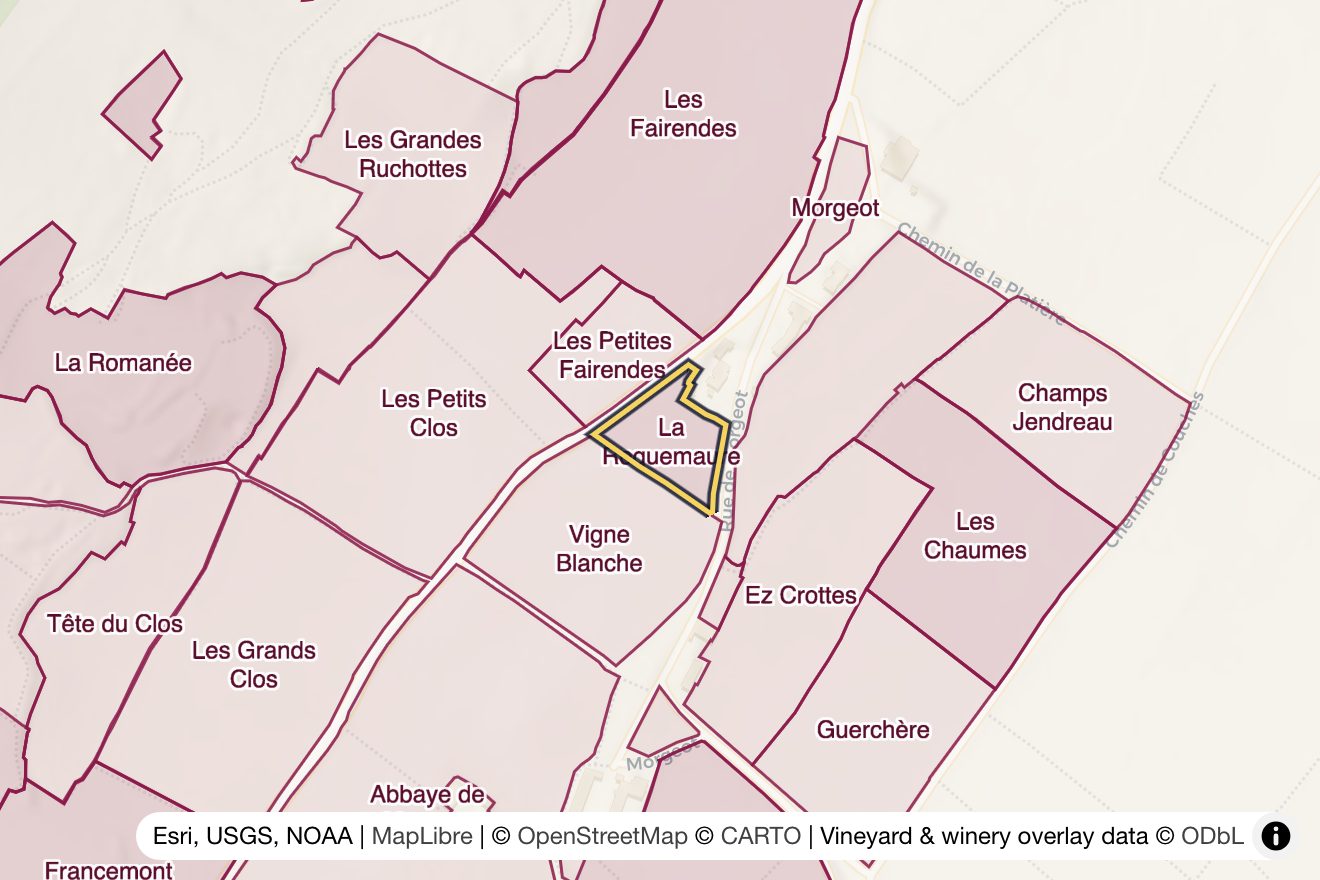
Overview & Location
The climat sits within the broader Chassagne-Montrachet appellation, which spans approximately 350 hectares and represents the southernmost major white wine commune of the Côte de Beaune. La Roquemaure's position places it south of the village center, benefiting from the optimal exposure and geological conditions that characterize this section of the Côte d'Or's limestone escarpment.
Within the context of the Côte de Beaune, La Roquemaure occupies a transitional zone where the geological and climatic characteristics begin to shift toward those found in the Côte Chalonnaise to the south. This positioning contributes to its distinctive terroir expression, setting it apart from Premier Cru sites located further north in neighboring Puligny-Montrachet or Meursault.
Size
La Roquemaure encompasses a very small area, making it one of the smaller Premier Cru climats within Chassagne-Montrachet. This modest size is typical of many Burgundian climats, where historical boundaries and natural terroir divisions have created a patchwork of small, precisely defined vineyard sites.
The compact nature of La Roquemaure means that variations in soil composition, drainage, and microclimate remain relatively consistent across the entire climat, contributing to a cohesive terroir expression. However, subtle differences in elevation and slope gradient within this small climat can still produce noticeable variations in grape ripening and wine character, particularly between parcels located at different points along the slope.
Terroir & Geology
La Roquemaure's terroir foundation rests upon the Jurassic limestone formations characteristic of the Côte de Beaune, with marls prominent in this part of the commune. The soil consists of white marl mixed with stones and gravelly limestone clay, creating the ideal balance of drainage and water retention essential for premium viticulture.
The topsoil layer typically measures 30-60 centimeters in depth, composed of limestone-rich earth with clay content ranging from 15-25%, depending on the specific parcel location. This clay percentage provides sufficient water retention during dry periods while preventing waterlogging during heavy rainfall, thanks to the excellent drainage provided by the underlying limestone bedrock.
The vineyard's aspect faces predominantly southeast, capturing optimal morning sunlight while benefiting from some protection during the hottest afternoon hours. This orientation proves particularly advantageous for Chardonnay cultivation, allowing for gradual ripening while maintaining the acidity levels crucial for age-worthy white Burgundy.
La Roquemaure sits at elevations ranging from 250 to 280 meters above sea level, positioning it in the middle elevation band of Chassagne-Montrachet's Premier Cru sites. The slope gradient averages 8-12%, providing natural drainage while preventing soil erosion. The limestone bedrock beneath lies relatively close to the surface, typically within 1-2 meters, contributing to the mineral-driven character that distinguishes Premier Cru sites from village-level vineyards located on deeper soils in the plains below.
The geological foundation includes significant deposits of fossilized marine organisms, particularly oyster shells, which impart distinctive mineral characteristics to wines produced from this site. These fossilized remains contribute calcium carbonate to the soil, influencing both vine metabolism and the eventual wine's mineral profile.
Climate & Microclimate
La Roquemaure benefits from the continental climate typical of the Côte d'Or, characterized by cold winters, warm summers, and well-defined seasonal transitions. However, its specific position within Chassagne-Montrachet creates distinctive microclimatic conditions that influence grape development and wine character.
The southeast-facing aspect ensures optimal sun exposure during crucial morning hours while providing some natural protection from excessive afternoon heat. This orientation creates a microclimate that promotes steady, even ripening, particularly important for Chardonnay, the only variety planted in La Roquemaure.
The elevation range of 250-280 meters places La Roquemaure in a zone where cool air drainage occurs naturally during nighttime hours, helping maintain crucial diurnal temperature variation. This temperature differential between day and night preserves acidity while allowing flavor compounds to develop fully, contributing to the complexity and aging potential characteristic of Premier Cru wines.
Wind patterns play a significant role in La Roquemaure's microclimate. The vineyard's position allows for good air circulation, reducing disease pressure from humidity while moderating extreme temperatures. The limestone soils contribute to temperature regulation, absorbing heat during the day and releasing it gradually during cooler evening hours.
Compared to Premier Cru sites located higher on the slope, La Roquemaure experiences slightly warmer conditions, promoting fuller ripeness while still maintaining the freshness and mineral precision expected from Chassagne-Montrachet. The microclimate proves particularly favorable during challenging vintages, where the accumulated warmth and excellent drainage help achieve optimal ripeness even in cooler years.
Viticulture
Chardonnay represents the dominant grape variety in La Roquemaure, and is the only variety planted.
Vine age across La Roquemaure varies considerably, with some parcels containing vines planted in the 1950s and 1960s, while more recent replantings have introduced younger vines. The average vine age approximates 30-35 years, providing an optimal balance between established root systems and vigorous production. Older vines, particularly those exceeding 40 years, contribute to the depth and complexity that distinguishes the finest examples from this climat.
Planting density typically ranges from 10,000 to 12,500 vines per hectare, following traditional Burgundian practices that promote competition between vines and encourage deep root penetration into the limestone subsoil. This density, combined with the natural vigor control provided by the limestone-clay soils, helps achieve optimal grape concentration and flavor development.
Viticultural practices in La Roquemaure emphasize sustainable and traditional methods. Pruning follows the Guyot system predominantly, though some parcels utilize gobelet training for older vines.
Canopy management proves crucial in La Roquemaure, with careful attention to leaf removal and shoot positioning to optimize sun exposure while preventing overexposure. The southeast aspect requires particular attention to afternoon shading of grape clusters, protecting them from excessive heat while maintaining adequate photosynthesis.
Harvest timing in La Roquemaure typically occurs during the second or third week of September for Chardonnay, depending on vintage conditions. The terroir's ability to maintain acidity while achieving full phenolic ripeness allows for flexible harvest decisions, enabling producers to optimize their stylistic preferences.
Site-specific challenges include managing vigor in younger vines planted in the deeper soils, preventing excessive crop loads that could dilute concentration, and timing harvest to balance ripeness with acidity retention. The limestone-clay soils can become compact in wet conditions, requiring careful cultivation to maintain soil structure and root health.
Wine Character & Style
Wines from La Roquemaure exhibit a distinctive character that reflects the climat's unique terroir conditions. Chardonnays typically display a mineral-driven profile with notable limestone-derived precision, balanced by the richness and texture that clay components contribute to the soil composition.
The aromatic profile of La Roquemaure Chardonnays often presents citrus notes of lemon and grapefruit, complemented by white flowers, particularly hawthorn and acacia. With age, these wines develop more complex aromatics including honey, toasted nuts, and subtle spice notes. The mineral backbone remains prominent throughout the wine's evolution, providing structure and defining the terroir expression.
On the palate, La Roquemaure whites demonstrate medium to full body with excellent acidity balance. The texture combines richness with precision, avoiding the heaviness that can characterize some Chassagne-Montrachet sites while maintaining sufficient weight and concentration to merit Premier Cru status. The finish typically shows impressive length with persistent mineral notes and subtle limestone-derived salinity.
The small plantings of Pinot Noir in La Roquemaure produce wines with distinctive character, showing more structure and mineral influence than might be expected from Chassagne-Montrachet reds. These wines display red fruit character with notable earth and mineral components, medium body, and aging potential that can surprise those familiar primarily with the commune's white wine reputation.
Color intensity in La Roquemaure Chardonnays remains moderate, typically showing pale gold with greenish reflections in youth, deepening to golden yellow with age. The wines maintain clarity and brightness throughout their development, reflecting the excellent natural acidity preservation that the terroir provides.
Textural elements include a distinctive chalky minerality that appears mid-palate, contributing to the wine's complexity and food-pairing versatility. The integration of oak, when employed, tends to be seamless, with the terroir's natural structure providing sufficient backbone to support barrel aging without overpowering the site's inherent character.
Comparison to Surrounding Crus
La Roquemaure's wines demonstrate notable differences when compared to other Premier Cru sites within Chassagne-Montrachet. Relative to Morgeot, the commune's largest and most well-known Premier Cru, La Roquemaure typically shows more restraint and mineral precision, with less overt richness but greater elegance and aging potential.
Compared to Caillerets, another prestigious Premier Cru, La Roquemaure exhibits similar mineral intensity but with different aromatic profiles. While Caillerets often shows more tropical fruit characteristics, La Roquemaure maintains a more citrus-driven profile with greater limestone influence apparent throughout the wine's development.
The contrast with Chenevottes, located on similar elevation but with different soil composition, highlights La Roquemaure's distinctive clay-limestone balance. Chenevottes typically produces more immediately accessible wines, while La Roquemaure requires additional aging to reveal its full complexity and character.
When compared to neighboring village-level Chassagne-Montrachet wines, La Roquemaure demonstrates the additional complexity, structure, and aging potential that justifies Premier Cru classification. The mineral intensity and textural precision clearly distinguish these wines from those produced on the deeper soils of the village appellation.
In the broader context of Côte de Beaune Premier Cru sites, La Roquemaure shows characteristics that bridge the gap between the more powerful style typical of southern Chassagne-Montrachet and the more elegant expression found in northern Premier Cru sites. This positioning creates wines with both immediate appeal and long-term development potential.
Notable Producers
Domaine Fleurot-Larose bottles it as a monopole, Clos de la Roquemaure.
Historical Background & Classification
La Roquemaure's viticultural history extends back to medieval times, when monastic communities first recognized the site's potential for premium wine production.
This nomenclature reflects the geological characteristics that define the site's terroir and distinguish it from surrounding areas.
During the 18th and 19th centuries, La Roquemaure gained recognition among Burgundy merchants and négociants who valued its consistent quality and distinctive character. However, like many smaller climats, it remained relatively obscure compared to the most famous Premier Cru sites in neighboring communes.
La Roquemaure is classified Premier Cru within the Chassagne-Montrachet AOC, created in 1937. This classification recognized the site's superior terroir characteristics and consistent ability to produce wines of Premier Cru quality. The boundaries established at that time have remained essentially unchanged, reflecting the natural terroir divisions that define the climat.
Throughout the 20th century, La Roquemaure's reputation grew steadily among knowledgeable Burgundy enthusiasts who appreciated its distinctive character and aging potential. The climate's small size meant production remained limited, contributing to its relative obscurity in international markets while maintaining strong appreciation among regional connoisseurs.
Recent decades have brought increased recognition to La Roquemaure as wine writers and critics have explored lesser-known Premier Cru sites within established communes. This attention has highlighted the climat's unique terroir expression and potential for producing wines that rival more famous sites within Chassagne-Montrachet.
Aging Potential & Quality Level
La Roquemaure produces wines with exceptional aging potential, particularly the Chardonnay that makes up all of the production. The combination of natural acidity preservation, mineral structure, and terroir complexity creates wines capable of development over 15-20 years or more in optimal storage conditions.
Young wines from La Roquemaure often show somewhat reserved character, requiring 3-5 years of cellaring to begin revealing their full complexity. During this initial development period, the mineral components integrate with fruit characteristics while oak influence, where present, becomes more seamlessly incorporated.
The peak drinking window for La Roquemaure typically occurs between 8-15 years after vintage for most examples, though exceptional vintages and traditional winemaking approaches can extend this timeline considerably. During peak maturity, these wines display the full range of terroir expression, with developed aromatics, integrated textures, and the distinctive mineral finish that characterizes the site.
Quality consistency in La Roquemaure has improved markedly over recent decades as producers have gained better understanding of the terroir's requirements and optimal viticultural practices. While vintage variation remains significant, as expected in Burgundy, the basic terroir character and structure remain recognizable across different years and producers.
The climat's elevation and aspect provide natural protection against some vintage challenges, though extremely wet or cool years can still impact quality significantly. Conversely, very warm vintages tend to produce wines that maintain better balance than might be expected, thanks to the natural acidity preservation and cooling influence of the limestone soils.
Exceptional vintages from La Roquemaure demonstrate aging potential extending beyond 20 years, developing complex tertiary aromatics while maintaining structural integrity and terroir expression. These wines serve as benchmarks for understanding the climat's full potential and justify its Premier Cru classification through their combination of complexity, longevity, and distinctive character.
The overall quality level in La Roquemaure continues to evolve as producers refine their understanding of this terroir's specific requirements and optimal expression methods, ensuring that this distinguished climat maintains its position among Chassagne-Montrachet's most respected Premier Cru sites.