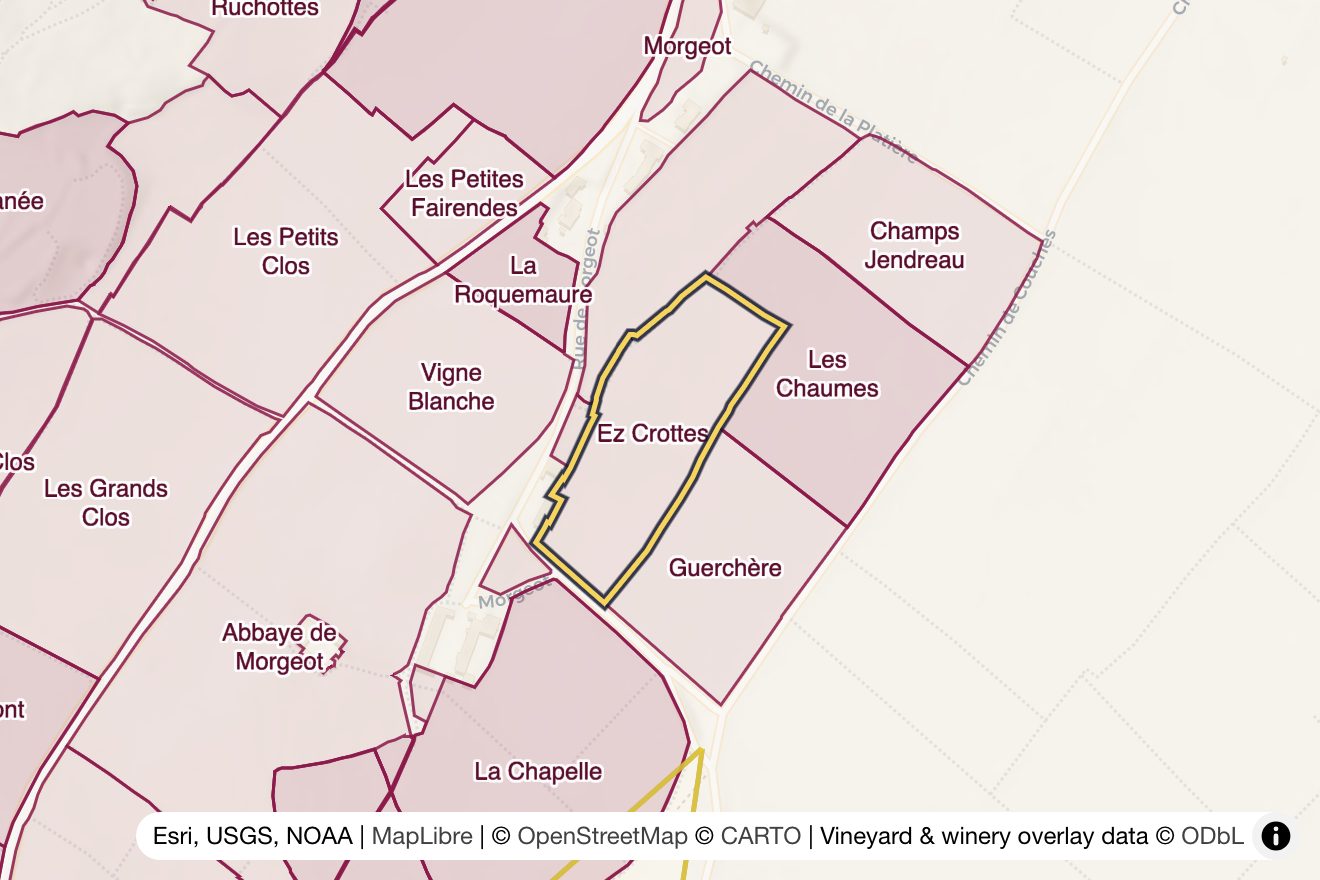
Overview & Location
Located at the southern end of the Côte de Beaune, Ez Crottes sits within the broader geographical context of the Côte d'Or's golden slope, where the intersection of geology, climate, and centuries of viticultural refinement have created some of the world's most coveted wines. The vineyard lies in the southern part of the appellation, within the Morgeot premier cru.
The climat's name, "Ez Crottes," derives from local Burgundian dialect, with "Ez" meaning "at" or "near" and "Crottes" referring to small hollows or depressions in the landscape. This nomenclature reflects the vineyard's undulating topography, characterized by gentle undulations that create distinct microclimates within the broader site. These natural variations in elevation and exposure contribute significantly to the complexity and character of wines produced from Ez Crottes.
Within Chassagne-Montrachet's Premier Cru hierarchy, Ez Crottes lies in the southern part of the appellation, within the Morgeot premier cru. The vineyard borders several other notable Premier Crus, creating a tapestry of terroir expressions that demonstrate the remarkable precision of Burgundy's classification system. This positioning allows for fascinating comparative tastings that highlight the subtle but significant differences that mere meters of vineyard location can produce.
Size
Ez Crottes encompasses approximately 1.8 hectares (4.4 acres), making it one of the smaller Premier Cru vineyards within Chassagne-Montrachet. This modest size is characteristic of Burgundy's fragmented vineyard landscape, where centuries of inheritance laws and land divisions have created a complex mosaic of small parcels, each with distinct characteristics.
The vineyard's compact size contributes to its relative obscurity compared to larger, more famous Premier Crus, but also ensures that production remains limited and exclusive. With typical Burgundian planting densities and yields, Ez Crottes produces approximately 800-1,000 cases of wine annually, depending on vintage conditions and producer practices.
This small scale allows for meticulous attention to detail in both viticulture and winemaking, as producers can monitor and respond to the specific needs of individual vine rows or even sections within rows. The intimate size also means that the entire vineyard can be harvested in a single day under optimal conditions, ensuring uniform ripeness and quality across all fruit destined for Ez Crottes bottlings.
Terroir & Geology
The geological foundation of Ez Crottes exemplifies the complex sedimentary history of the Côte de Beaune, with soils derived primarily from Jurassic limestone formations dating back approximately 150-200 million years. The vineyard sits atop a base of Bathonian and Bajocian limestone, characteristic of the middle Jurassic period, which provides excellent drainage while maintaining sufficient water retention for sustained vine growth throughout the growing season.
The topsoil composition varies subtly across the vineyard, with the upper sections featuring a thin layer of reddish-brown clay mixed with limestone fragments and fossilized marine debris. This soil type, known locally as "terre rouge," contains higher iron oxide content, contributing to the mineral complexity found in wines from these parcels. Moving down the slope, the soil transitions to deeper deposits of limestone-rich clay with increased stone content, providing different water retention characteristics and root penetration patterns.
Soil depth ranges from 30 to 80 centimeters across the vineyard, with the shallowest soils found on the steepest sections of the upper slope. This variation in depth creates natural variations in vine vigor and fruit concentration, with vines planted on shallower soils typically producing more concentrated, mineral-driven fruit, while those on deeper soils contribute volume and textural richness to the final blend.
The vineyard's slope ranges from 8 to 15 degrees, providing excellent drainage while remaining gentle enough for mechanized viticulture where desired. This moderate gradient ensures that cold air drainage occurs naturally during the growing season while preventing excessive erosion during heavy rainfall events.
Ez Crottes faces primarily east-southeast, capturing the beneficial morning sun that helps drive photosynthesis and sugar accumulation while avoiding the potentially harmful effects of excessive afternoon heat during warm vintages. This exposition, combined with the vineyard's elevation between 250 and 280 meters above sea level, creates an optimal balance of warmth and cooling influences.
The underlying geological structure includes several small faults and fractures in the limestone bedrock, creating natural drainage channels that prevent waterlogging while allowing vine roots to penetrate deeply into the mineral-rich substrate. These geological features contribute to the distinct mineral signature found in Ez Crottes wines, particularly the characteristic limestone-derived salinity and tension that defines high-quality Chassagne-Montrachet.
Climate & Microclimate
Ez Crottes benefits from Chassagne-Montrachet's favorable mesoclimate, which combines continental influences from the interior of France with moderating effects from distant maritime influences. The vineyard's position on the eastern slopes of the Côte de Beaune provides protection from prevailing westerly winds while capturing optimal solar exposure during crucial ripening periods.
The site experiences a semi-continental climate characterized by cold winters, warm summers, and moderate precipitation distributed throughout the year. Average annual rainfall ranges from 650 to 750 millimeters, with spring and autumn typically receiving the highest precipitation. This distribution pattern supports healthy vine development during the growing season while providing sufficient winter moisture for deep soil water reserves.
Temperature patterns within Ez Crottes create distinct microclimatic zones based on elevation and exposure. Upper sections of the vineyard experience greater diurnal temperature variation, with cooler nighttime temperatures that help preserve acidity and aromatic complexity in the developing fruit. Lower sections benefit from slightly warmer overnight temperatures that can aid in phenolic development and tannin polymerization, particularly important for Pinot Noir production.
The vineyard's east-southeast exposition ensures optimal morning sun exposure, which helps dry dew and prevent fungal diseases while initiating photosynthetic activity early in the day. During summer months, the site receives direct sunlight from sunrise until approximately 2:00 PM, after which the western ridge provides beneficial afternoon shade that prevents excessive heat stress during the hottest part of the day.
Air circulation patterns within Ez Crottes are influenced by the surrounding topography, with natural thermal currents moving up the slope during daytime heating and descending during nighttime cooling. This natural ventilation helps regulate humidity levels and reduces disease pressure, particularly important given Burgundy's occasionally challenging weather conditions.
The vineyard's microclimate differs subtly from surrounding Premier Crus due to its specific elevation and exposition. Compared to higher-elevation sites, Ez Crottes experiences slightly earlier budbreak and harvest timing, while its eastern exposition provides different light quality and intensity compared to more southerly-facing neighbors.
Viticulture
Ez Crottes is planted primarily to Chardonnay, with small sections dedicated to Pinot Noir, reflecting Chassagne-Montrachet's reputation for both varietals. The Chardonnay plantings dominate the vineyard, occupying approximately 75% of the total surface area, while Pinot Noir accounts for the remaining 25%, primarily in the vineyard's upper sections where the combination of elevation, exposition, and soil depth creates optimal conditions for red grape production.
Vine age varies significantly across the vineyard, with the oldest plantings dating to the 1960s and recent replantings establishing new sections with contemporary clonal selections and rootstock combinations. This age diversity contributes to the complexity of Ez Crottes wines, as older vines typically produce fruit with greater concentration and mineral expression, while younger plantings contribute fresh fruit character and structural backbone.
Planting density ranges from 10,000 to 12,000 vines per hectare, consistent with modern Burgundian practices that balance vine competition with mechanization requirements. The specific density varies based on soil depth and slope characteristics, with higher densities employed in areas of deeper, more fertile soils to increase competition and reduce individual vine vigor.
Rootstock selection reflects the vineyard's limestone-rich soils, with SO4 and 3309C being the most commonly employed rootstocks for Chardonnay plantings. These selections provide good adaptation to calcareous soils while maintaining reasonable vigor control. Pinot Noir sections utilize 161-49C and 3309C rootstocks, chosen for their ability to moderate vigor while providing adequate drought tolerance in the vineyard's well-draining upper slopes.
Training systems employ the Guyot method predominantly, with either single or double Guyot configurations depending on vine vigor and desired production levels. Spur pruning (Cordon de Royat) is employed in some sections, particularly for older Pinot Noir plantings where this method helps control vigor and concentrate fruit production.
Viticultural practices emphasize sustainable approaches, with most producers implementing integrated pest management strategies that minimize chemical inputs while maintaining vine health. Cover crops are commonly employed between vine rows, particularly during autumn and winter months, to prevent erosion, improve soil structure, and enhance biodiversity within the vineyard ecosystem.
Canopy management practices focus on optimizing light exposure and air circulation while preventing excessive yield. Leaf removal is typically performed selectively, removing foliage from the morning sun side while maintaining afternoon shade protection. Green harvesting may be employed in high-yielding vintages to ensure optimal fruit concentration and quality.
Site-specific viticultural challenges include managing vine vigor on the deeper soils of the lower slopes, where excessive vegetative growth can delay ripening and reduce fruit quality. Conversely, the shallow soils of upper sections require careful water management during dry periods to prevent excessive stress that could halt ripening or reduce yields to uneconomical levels.
Wine Character & Style
Wines from Ez Crottes exhibit the refined elegance and mineral complexity characteristic of high-quality Chassagne-Montrachet, while displaying unique characteristics that distinguish them from neighboring Premier Crus. The Chardonnay wines demonstrate exceptional balance between richness and precision, offering immediate accessibility while possessing the structural foundation for extended aging.
The aromatic profile of Ez Crottes Chardonnay typically presents white stone fruits, particularly white peach and pear, complemented by citrus notes of lemon zest and grapefruit. Mineral expressions include wet limestone, chalk dust, and subtle saline notes that reflect the vineyard's geological foundation. With bottle age, these wines develop more complex tertiary aromas including honey, brioche, and subtle nutty characteristics from lees contact and malolactic fermentation.
On the palate, Ez Crottes Chardonnay demonstrates medium to full body with elegant texture that balances richness with freshness. The wine's structure is built around vibrant acidity that provides lift and longevity, while the mineral backbone creates tension and precision throughout the palate. Flavors mirror the aromatic profile, with stone fruits and citrus complemented by subtle oak influences when present.
The textural qualities of Ez Crottes Chardonnay are particularly noteworthy, displaying a combination of richness and elegance that avoids both excessive weight and austere thinness. This balance reflects the vineyard's terroir characteristics, where limestone soils provide mineral structure while clay content contributes to textural depth and complexity.
Pinot Noir from Ez Crottes exhibits the refined character expected from quality Chassagne-Montrachet reds, though production is limited due to the smaller planted area. These wines typically display red berry fruits, particularly cherry and raspberry, with subtle earth and mineral undertones. The tannic structure is generally elegant rather than powerful, with silky textures that reflect both the terroir characteristics and careful winemaking approaches.
The distinctive characteristics that set Ez Crottes apart include its particular expression of limestone minerality, which manifests as a subtle salinity and tension that runs throughout the wine. The balance between fruit expression and mineral character tends to favor integration rather than dominance of either component, creating wines that are both immediately appealing and capable of long-term development.
Vintage variation in Ez Crottes wines reflects both the site's specific characteristics and broader Burgundian weather patterns. Warm vintages tend to emphasize the richness and tropical fruit aspects while maintaining the mineral backbone, while cooler years showcase the site's ability to maintain freshness and precision even in challenging conditions.
Comparison to Surrounding Crus
Ez Crottes occupies a distinctive position within Chassagne-Montrachet's Premier Cru hierarchy, offering characteristics that both complement and contrast with neighboring vineyards. Compared to the more powerful and structured wines from Les Caillerets, Ez Crottes displays greater elegance and immediate accessibility, with less obvious power but perhaps more subtle complexity.
Ez Crottes is one of the lieux-dits within the Morgeot premier cru, and wines from it are often bottled as Morgeot.
Compared to Les Baudines, another neighboring Premier Cru, Ez Crottes wines typically show more limestone-driven minerality and less obvious richness. Les Baudines benefits from deeper soils and slightly different exposition, creating wines with more body and power, while Ez Crottes emphasizes finesse and complexity over sheer concentration.
Ez Crottes offers earlier drinking pleasure while maintaining excellent aging potential.
When compared to the village's Grand Cru sites, particularly Montrachet itself, Ez Crottes naturally shows less intensity and complexity but demonstrates many of the same fundamental characteristics that make Chassagne-Montrachet exceptional. The mineral precision, balance, and aging potential are all present, though at a more approachable scale.
Within the broader context of Chassagne-Montrachet's red wine production, Ez Crottes Pinot Noir tends to be more elegant and mineral-driven compared to the more structured examples from Clos Saint-Jean or the power of La Boudriotte. This reflects both the specific terroir characteristics and the relatively small production that allows for careful selection and handling.
Notable Producers
Several distinguished producers craft wines from Ez Crottes, each bringing their individual winemaking philosophy and techniques to express the vineyard's unique character. The fragmented ownership typical of Burgundy means that multiple producers work parcels within the vineyard, creating interesting stylistic variations while maintaining the fundamental terroir characteristics.
Négociant bottlings may combine fruit from several parcels or blend with other Premier Crus to create consistent house styles. These larger operations often employ different approaches than domain producers, focusing on consistency and broader market appeal.
The stylistic variations among producers reflect different philosophical approaches to expressing Ez Crottes' terroir. Some emphasize mineral precision through restrained oak use and early bottling, while others seek to develop textural complexity through extended lees contact and careful oxygen management during élevage.
Historical Background & Classification
Ez Crottes' history as a recognized vineyard site extends back several centuries, though like many Burgundian climats, its precise historical documentation varies in completeness. The vineyard appears in historical records from the 18th century, when it was already recognized as producing wines of superior quality compared to village-level sites.
The climat is a premier cru of the Chassagne-Montrachet appellation, created in 1937. This classification recognized the vineyard's consistent ability to produce wines of superior quality and character, based on both historical reputation and systematic evaluation of terroir characteristics.
This recognition was based on centuries of empirical observation of wine quality and consistency, combined with the site's favorable growing conditions and distinctive terroir expression.
The vineyard's ownership history reflects the typical Burgundian pattern of gradual fragmentation through inheritance and sale. Originally part of larger estates owned by religious institutions and nobility, the site was divided during the French Revolution and subsequent periods of social and economic change.
During the 19th century, Ez Crottes gained recognition among wine merchants and collectors for producing wines of particular elegance and aging potential. This reputation helped establish premium pricing that encouraged quality-focused viticulture and winemaking practices.
The classification system's establishment formalized Ez Crottes' position within Burgundy's hierarchy, ensuring that wines from the vineyard would be subject to stricter regulations regarding yields, grape varieties, and production methods. These regulations help maintain the quality standards that justified the Premier Cru designation.
Historical climate records suggest that Ez Crottes has consistently performed well across different weather patterns, demonstrating the site's fundamental suitability for high-quality wine production. This consistency was crucial in establishing and maintaining its Premier Cru status over decades of varying vintage conditions.
Aging Potential & Quality Level
Ez Crottes produces wines with excellent aging potential that reflects both the vineyard's terroir characteristics and the quality-focused approaches of its producers. Chardonnay wines from the site typically reach initial drinking maturity 3-5 years after harvest, but continue developing complexity for 10-15 years under proper storage conditions.
The aging trajectory of Ez Crottes Chardonnay follows a typical pattern for high-quality white Burgundy, with primary fruit characteristics gradually integrating with secondary and tertiary development. During the first 2-3 years, the wines display fresh fruit and mineral characteristics with any oak influences well-integrated but still apparent.
Between years 5-8, Ez Crottes Chardonnay typically enters its first optimal drinking window, with fruit and mineral characteristics achieving excellent balance while developing subtle complexity from bottle age. The wine's acidity structure provides excellent support during this period, maintaining freshness while allowing textural development.
Extended aging beyond 10 years reveals the vineyard's true character, as the limestone-derived minerality becomes more prominent while fruit characteristics evolve toward more complex, tertiary expressions. Well-stored examples can continue developing for 15-20 years, though peak drinking periods vary by vintage and producer style.
Quality consistency in Ez Crottes wines is generally excellent, reflecting both the site's favorable terroir characteristics and the careful approaches of producers working the vineyard. Vintage variation exists but rarely results in poor wines, with challenging years producing wines of somewhat different character rather than reduced quality.
The vineyard's ability to maintain quality across different weather patterns demonstrates its fundamental suitability for premium wine production. Hot vintages produce richer, more tropical-influenced styles while maintaining mineral backbone, while cooler years emphasize precision and longevity potential.
Pinot Noir from Ez Crottes, while produced in smaller quantities, also demonstrates excellent aging potential with optimal drinking periods typically occurring 5-12 years after vintage. These wines benefit from bottle age to fully integrate their tannin structure and develop tertiary complexity.
Investment potential for Ez Crottes wines reflects their position within Burgundy's Premier Cru hierarchy, offering excellent value compared to more famous sites while maintaining the quality characteristics that drive long-term appreciation. The limited production ensures reasonable scarcity that supports pricing stability over time.