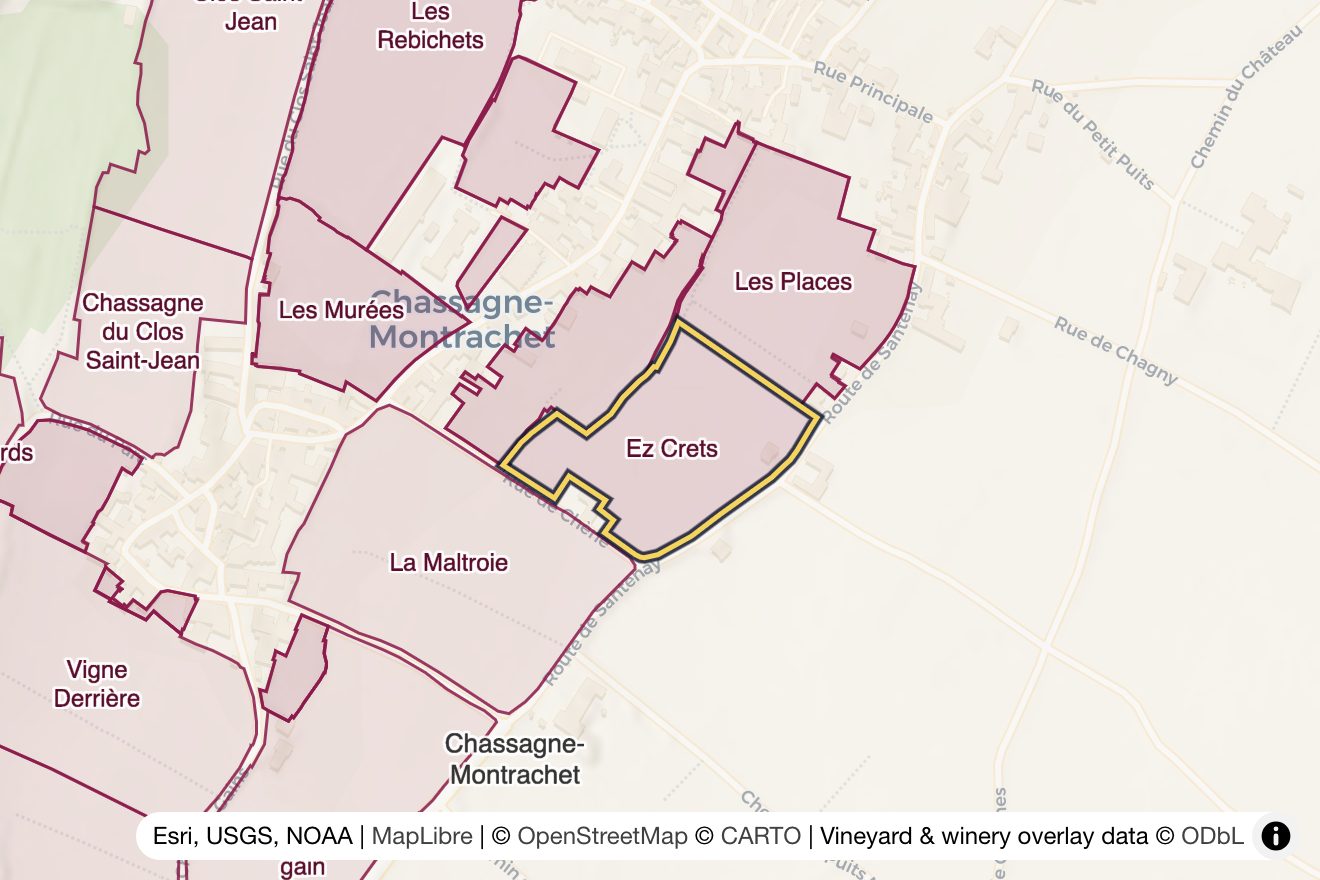
Overview & Location
The vineyard sits on the lower to mid slope of the Côte de Beaune escarpment, benefiting from the optimal exposition and geological conditions that have made Chassagne-Montrachet synonymous with exceptional white Burgundy production. Ez Crets is a named place within the La Maltroie premier cru, alongside La Maltroie proper and Les Places, and lies close to other premier cru vineyards, forming part of the prestigious band of Premier Cru sites that stretches across Chassagne-Montrachet's most favorable terroir.
Within the context of the Côte de Beaune's geographical framework, Ez Crets occupies the transitional zone where the limestone-rich soils of the Côte begin their gradual shift toward the more varied geological composition found in the southern reaches of the escarpment. This positioning grants Ez Crets access to the mineral complexity that defines great Chassagne-Montrachet wines while maintaining the elegance and finesse characteristic of the Côte de Beaune's finest expressions.
Size
The Ez Crets Premier Cru encompasses only a few hectares, making it a relatively compact climat even by Burgundy's standards of intimate vineyard parcellization. This modest size reflects the precision with which Burgundian terroir has been delineated over centuries, with Ez Crets representing a distinct geological and climatic entity worthy of individual Premier Cru recognition.
The vineyard's limited size contributes to the exclusivity and rarity of Ez Crets wines in the marketplace, with total annual production rarely exceeding 1,200 cases across all producers who hold parcels within the climat. This scarcity, combined with the vineyard's reputation for quality, ensures that Ez Crets wines command significant attention from collectors and connoisseurs of fine Burgundy.
Terroir & Geology
The geological foundation of Ez Crets reveals the complex interplay of limestone formations that characterize the finest sites in Chassagne-Montrachet. The vineyard rests on Jurassic limestone with alternating clay-limestone marl beds that provide the mineral backbone essential for producing wines of distinction and longevity.
The topsoil composition varies across the climat, with depths ranging from 30 to 60 centimeters over the underlying limestone bedrock. The soil profile exhibits a predominant limestone-clay matrix, with clay content typically ranging between 15-25%, providing sufficient water retention for vine health while ensuring adequate drainage to prevent waterlogging during periods of excessive rainfall.
The limestone component consists primarily of hard limestone with significant fossil content, contributing essential mineral elements and pH buffering capacity that influences both vine nutrition and wine character. Scattered throughout the soil profile are fragments of hard limestone and occasional iron-rich deposits that add complexity to the mineral composition.
Ez Crets benefits from a gentle to moderate slope orientation facing predominantly east to southeast, capturing optimal morning and midday sun exposure while receiving some protection from the harsh afternoon sun during the hottest summer periods. The vineyard lies at roughly 240 to 255 meters above sea level, positioning it within the ideal altitude band for quality wine production in the Côte de Beaune.
The slope gradient averages between 8-12%, providing natural drainage while preventing excessive erosion. This inclination also facilitates air circulation, reducing the risk of frost damage and promoting healthy canopy management. The southeastern exposure ensures excellent sun exposure throughout the growing season while maintaining the freshness and acidity that distinguishes great Chassagne-Montrachet whites.
Climate & Microclimate
Ez Crets experiences the semi-continental climate characteristic of the Côte de Beaune, with distinct seasonal variations that provide the thermal amplitude necessary for producing complex, age-worthy wines. The vineyard's specific microclimate benefits from its position on the mid-slope, where cold air drainage prevents frost accumulation while warm air circulation during the day promotes optimal ripening conditions.
The southeastern exposure creates a mesoclimate that captures early morning sunlight, allowing for gentle warming of the vineyard throughout the day. This orientation proves particularly beneficial during the crucial ripening period, when consistent but not excessive heat promotes the development of physiological maturity while preserving the natural acidity that defines great Chassagne-Montrachet.
Rainfall patterns in Ez Crets follow the regional norm, with annual precipitation averaging 700-800mm, distributed relatively evenly throughout the year. The vineyard's drainage characteristics and slope orientation help manage water stress during dry periods while preventing excessive moisture retention during wet seasons.
Wind patterns play a crucial role in Ez Crets' microclimate, with prevailing westerly winds providing air circulation that reduces humidity and disease pressure. The vineyard's position offers some protection from harsh northerly winds while remaining open to beneficial air movement that promotes healthy vine development.
Compared to surrounding sites, Ez Crets enjoys a slightly warmer microclimate than vineyards positioned higher on the slope, while maintaining greater freshness than lower-elevation sites. This positioning creates an optimal balance between ripeness potential and acidity retention, contributing to the distinctive character of Ez Crets wines.
Viticulture
Ez Crets is planted predominantly to Chardonnay, reflecting both historical tradition and the vineyard's particular suitability for producing exceptional white wines. The varietal selection aligns with Chassagne-Montrachet's reputation as one of Burgundy's premier white wine communes, where Chardonnay reaches its most refined expression.
Vine age across the climat varies among different parcels and producers, with many blocks featuring mature vines ranging from 30 to 60 years old. Some sections contain even older vines, including plantings that date back 70-80 years, contributing to the depth and complexity that characterizes the finest Ez Crets expressions. These older vines, with their deep root systems and naturally restricted yields, produce grapes of exceptional concentration and mineral expression.
Planting density in Ez Crets follows traditional Burgundian practices, typically ranging from 10,000 to 12,000 vines per hectare. This high density encourages competition among vines, promoting deep root development and limiting individual vine vigor to concentrate energy into grape production rather than excessive vegetative growth.
Viticultural practices in Ez Crets emphasize sustainable and traditional approaches, with many producers implementing organic or biodynamic principles. Canopy management focuses on achieving optimal sun exposure and air circulation while preventing excessive vigor that could compromise fruit quality. Pruning follows the Guyot system, with careful attention to bud load management to control yields and ensure physiological ripeness.
Harvest timing proves critical in Ez Crets, with producers carefully monitoring sugar accumulation, acid retention, and phenolic maturity to determine optimal picking dates. The vineyard's microclimate typically allows for harvest in mid to late September, though vintage variation can shift timing by several weeks in either direction.
Site-specific challenges in Ez Crets include managing the limestone-rich soils that can become compacted under certain conditions, requiring careful cultivation practices to maintain soil structure. The vineyard's exposure to morning sun necessitates vigilant monitoring for early-season frost risk, though the slope orientation generally provides adequate protection.
Wine Character & Style
Ez Crets Premier Cru produces Chardonnay wines of exceptional elegance and mineral complexity, expressing the distinctive terroir characteristics that distinguish this climat within the broader Chassagne-Montrachet appellation. These wines exhibit a remarkable balance between power and finesse, combining substantial body with refined texture and persistent length.
The aromatic profile of Ez Crets wines typically reveals layers of complexity that evolve with time in both glass and bottle. Young expressions often display precise citrus notes, particularly lemon zest and lime, accompanied by white floral elements including acacia and hawthorn. As the wines develop, stone fruit characteristics emerge, with white peach and pear complemented by subtle tropical hints of pineapple and mango in warmer vintages.
The mineral signature of Ez Crets proves particularly distinctive, expressing the limestone-rich terroir through notes of chalk, wet stone, and crushed oyster shell. This minerality provides both aromatic complexity and palate structure, creating a backbone that supports the wine's fruit expression while contributing to its aging potential.
On the palate, Ez Crets wines demonstrate remarkable textural sophistication, with a silky, almost creamy mouthfeel that reflects both terroir characteristics and careful winemaking. The wine's structure reveals well-integrated acidity that provides freshness and vitality without excessive sharpness, supporting the mineral and fruit elements while contributing to long-term aging potential.
The finish of quality Ez Crets expressions extends with remarkable persistence, often revealing additional mineral nuances and subtle spice notes that weren't immediately apparent on the initial palate impression. This length and complexity distinguish Ez Crets from many other Premier Cru sites and contribute to its reputation among serious Burgundy enthusiasts.
Oak integration in Ez Crets wines varies among producers but generally emphasizes restraint and balance, with the best examples showing seamless integration of wood elements that enhance rather than dominate the terroir expression. The wine's natural richness and texture can support judicious oak usage, which often contributes subtle vanilla, spice, and toasty characteristics without overwhelming the inherent fruit and mineral qualities.
Comparison to Surrounding Crus
Within the constellation of Chassagne-Montrachet Premier Crus, Ez Crets occupies a distinctive position that sets it apart from neighboring climats through both geological differences and resulting wine character. Compared to the more famous Morgeot Premier Cru, Ez Crets typically produces wines with greater mineral precision and slightly more restrained fruit expression, reflecting differences in soil composition and microclimate.
The nearby Caillerets Premier Cru, generally produces wines with more immediate fruit appeal and slightly softer structure, while Ez Crets maintains greater mineral backbone and aging potential. This difference reflects Ez Crets' higher proportion of limestone in the soil profile and its specific mesoclimatic conditions.
Compared to Chassagne-Montrachet's portion of the Batard-Montrachet Grand Cru, Ez Crets wines show similar mineral intensity but typically with less opulent fruit expression and slightly more restrained power. While Batard-Montrachet represents the ultimate expression of Chassagne terroir, Ez Crets offers many of the same fundamental characteristics in a more accessible and earlier-developing format.
The Les Ruchottes Premier Cru, located on similar mid-slope terrain, produces wines that share Ez Crets' mineral emphasis but often with slightly more austere character in youth. Ez Crets generally shows greater approachability in its early years while maintaining comparable aging potential, making it particularly appealing to consumers who appreciate both immediate pleasure and long-term development potential.
Against the backdrop of Puligny-Montrachet Premier Crus across the commune border, Ez Crets wines demonstrate the slightly more robust character typical of Chassagne, with greater body and mineral intensity compared to the more elegant and refined style associated with Puligny's finest sites.
Notable Producers
The limited size of Ez Crets means that only a select group of producers hold parcels within this Premier Cru climat, each bringing their individual winemaking philosophy to express the site's unique characteristics.
The négociant house of Louis Latour sources fruit from Ez Crets through long-term contracts with local growers, producing a more commercially available expression that still maintains the essential character of the climat. Their approach typically involves careful selection and gentle handling to preserve the wine's inherent elegance and mineral signature.
Several smaller estate producers hold modest parcels within Ez Crets, contributing to the diversity of styles available from this climat. These producers often emphasize low yields and extended aging to maximize the expression of their limited holdings, creating wines of exceptional concentration and character.
The stylistic variations among Ez Crets producers reflect different approaches to oak usage, fermentation temperature, and aging duration, though all share the common goal of expressing the unique terroir characteristics that distinguish this Premier Cru site.
Historical Background & Classification
The history of Ez Crets as a recognized vineyard site extends back several centuries, .
The climat's name derives from local patois, with "Ez" representing an old contraction meaning "in the" or "at the," while "Crets" refers to a ridge or elevated terrain feature. This nomenclature reflects the vineyard's position on a slight ridge within the broader slope structure of the Chassagne-Montrachet hillside.
During the 18th and 19th centuries, Ez Crets gained recognition among négociant houses in Beaune and beyond, with records showing regular purchases of wine from the site for blending into premium cuvées. This commercial recognition helped establish the reputation that would eventually support Premier Cru classification.
Ez Crets was classed as Premier Cru within the Chassagne-Montrachet appellation, established in 1937. The classification committee recognized Ez Crets' consistent quality production and distinctive terroir characteristics as meriting Premier Cru status, cementing its position within the hierarchy of Chassagne-Montrachet vineyards.
Throughout the 20th century, Ez Crets maintained its reputation for producing wines of exceptional quality, with several vintages gaining particular recognition from wine critics and collectors. The site's ability to produce outstanding wines across diverse vintage conditions contributed to its growing reputation among serious Burgundy enthusiasts.
Aging Potential & Quality Level
Ez Crets Premier Cru demonstrates exceptional aging potential, with well-made examples capable of developing for 15-20 years or more under proper storage conditions. The wine's combination of natural acidity, mineral structure, and fruit concentration provides the foundation necessary for long-term cellaring and gradual evolution.
In their youth (1-3 years), Ez Crets wines typically display vibrant fruit character with pronounced mineral undertones, though they may show some integration challenges as various elements settle into harmony. During this period, the wines often benefit from decanting to fully express their potential.
The early maturity phase (4-8 years) reveals Ez Crets at perhaps its most approachable, with fruit and mineral elements achieving balance while maintaining freshness and vitality. Many consumers find this period optimal for appreciation, as the wines show both complexity and accessibility.
Extended aging (10-20+ years) allows Ez Crets wines to develop tertiary characteristics including honey, nuts, and dried fruit notes, while the mineral backbone becomes more pronounced and integrated. The finest examples can continue developing for decades, revealing new layers of complexity with extended cellaring.
Quality consistency in Ez Crets has proven remarkably high across different vintages and producers, reflecting both the inherent characteristics of the terroir and the careful attention paid by vignerons working with this prestigious site. Even in challenging vintages, Ez Crets typically produces wines that maintain the essential character and aging potential that distinguish Premier Cru quality.
The investment potential of Ez Crets wines has grown significantly in recent years, as collectors and investors recognize both the quality and relative scarcity of this climat within the broader Burgundy market. This appreciation reflects growing understanding of the site's unique characteristics and its position within the hierarchy of great Chassagne-Montrachet vineyards.