History
Jesus Velasquez and Patricia Greer bought their ridgetop in the 1990s, drawn to Cazadero by its remoteness, and planted vines at the end of the decade: producer accounts date the planting anywhere from 1997 to 1999. The variety ran against the neighborhood. Fort Ross-Seaview was staking its identity on Pinot Noir, and the couple, fearing Pinot Noir would prove a fad, wanted a variety that would stand up over time. He has farmed organically from the beginning, with little or no irrigation, and still works the vines himself. For years the site had no name, known to buyers simply as Jesus and Patricia's vineyard. John Lockwood of Enfield Wine Co., who founded his label in 2010 while at Failla, began bottling the site in the early 2010s; the winery's flagship Cabernet from the site was featured in Decanter's June 2016 roundup of six Sonoma Coast producers to watch. The ranch also supports the family's other trade, small-batch preserves and teas sold under the same name.
The Site
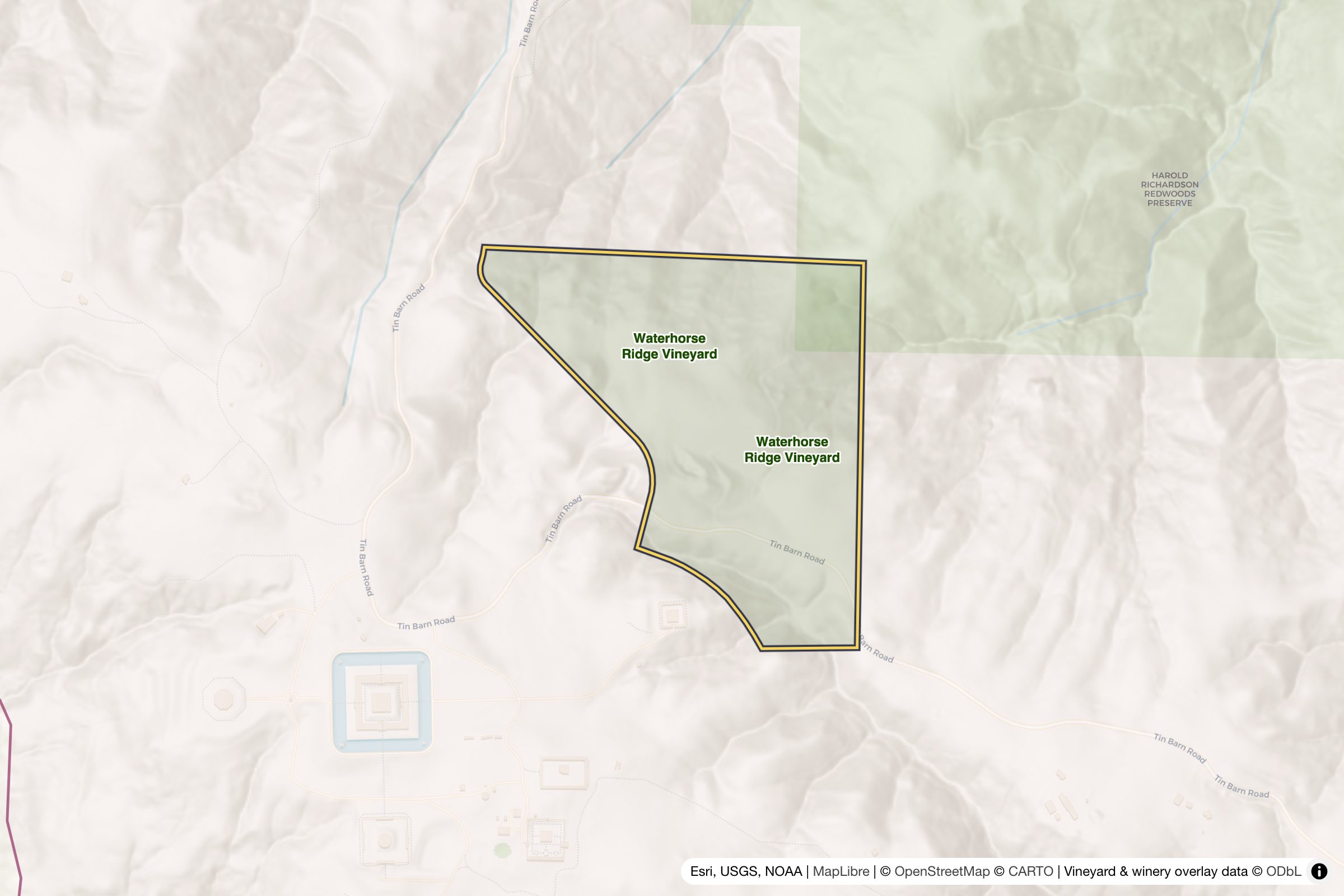
The vines sit on Stewart Ridge above Cazadero, in Sonoma County, at about 1,700 feet and roughly five to seven miles from the Pacific. The elevation lifts the rows above much of the summer fog, so days run warmer here than in the Pinot vineyards on the surrounding ridges, Marcassin and Hirsch among them, while ocean air holds the nights down. The soil is rocky, fast-draining loam weathered from uplifted ocean-floor sediments and basalts, and the vines went in on drought-resistant rootstock. Farming is dry in most vintages, with limited irrigation only in recent drought years, no-till and organic without certification: sulfur once or twice a season, canopy work by hand, and a clover cover crop kept down by a grazing horse and a burro.
Vines and Blocks
A field blend in the old sense: mostly Cabernet Sauvignon with Merlot, Cabernet Franc and Petit Verdot interplanted through the rows, picked together and fermented together. Enfield's bottling has run around 80 percent Cabernet Sauvignon with roughly 10 percent Merlot and the Franc and Verdot filling out the rest, and a further planting of Cabernet Franc was reported underway in 2018. There are no named blocks; at two acres, the vineyard is the block.
The Wines
Enfield's Waterhorse Ridge Cabernet Sauvignon is the reference: a native-yeast co-fermentation with a modest whole-cluster fraction, a quarter of the fruit in some vintages and under a tenth in others, raised a year and a half or more in French puncheons and barriques with almost no new wood, and bottled unfined and unfiltered. Alcohols run 12.8 to 14 percent, and production sits in the low hundreds of cases. The style is the one merchants keep comparing to California Cabernet of the 1960s and 1970s: mid-weight, taut and peppery claret with saline acidity, built to be cellared. Unturned Stone bottles the same field blend under its Spider Chase label, .