History
The vineyard was put in by Santa Colina LLC, an investment vehicle fronted by the Napa vintner William Hill and funded through CalPERS, the California public employees' pension system, which paid 4.5 million dollars for the parcel. Sea Smoke Cellars bought it in August 2016, kept the existing grape contracts in place and said plainly that the fruit would not go into Sea Smoke's own wine; reporting at the time suggested the purchase was as much about controlling who crossed the neighbouring estate as about the vines. Atlas Vineyard Management has run the farming. In May 2024 Constellation Brands bought Sea Smoke outright, and Rita's Crown went with it.
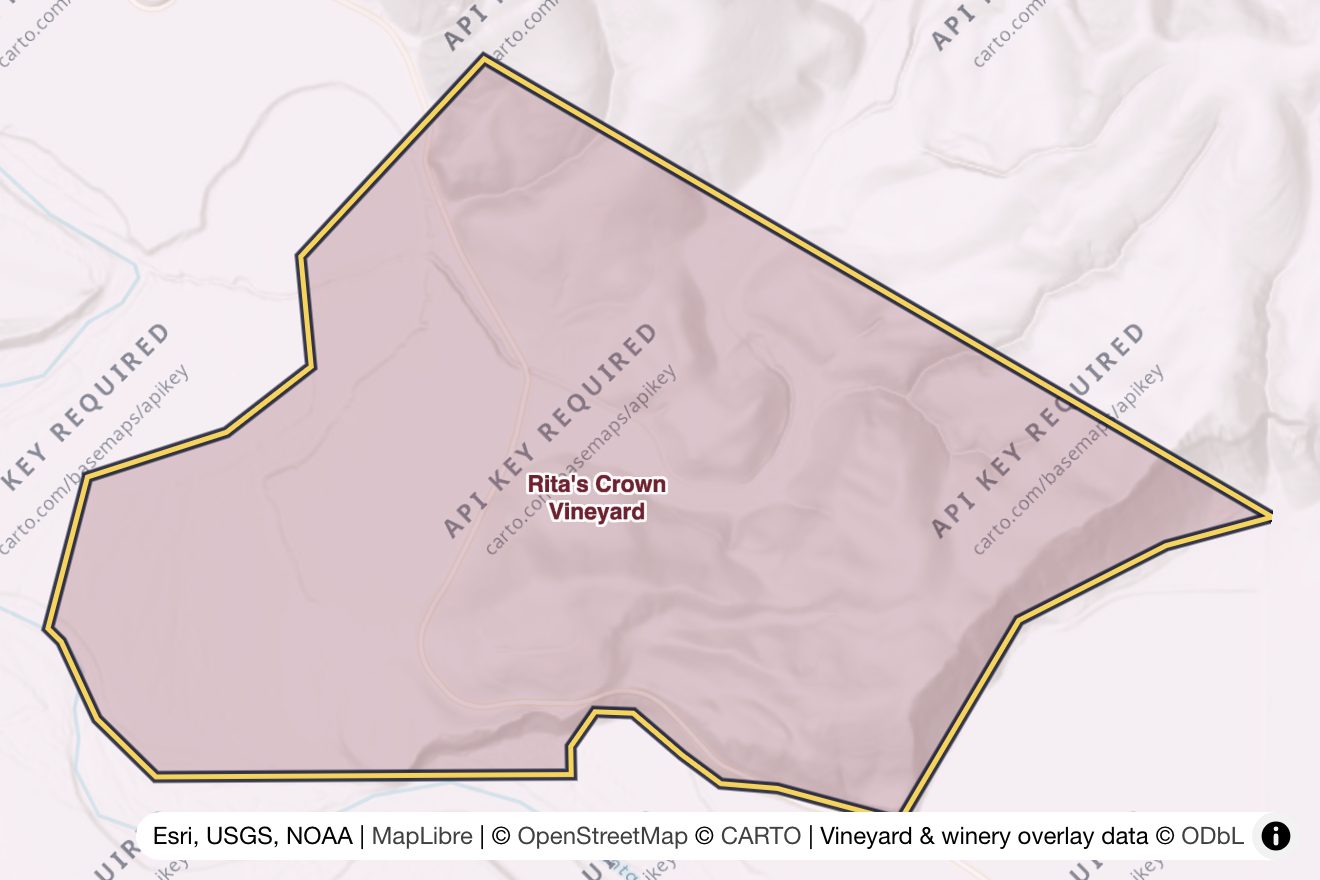
The Site
Sixty-one acres of vines sit inside a 201 acre parcel, planted at high density and climbing from about 600 to 950 feet, which makes this the highest planted site in the Sta. Rita Hills. The exposure is broadly south, looking down over the Santa Ynez River valley, with Sea Smoke's estate alongside and Mount Carmel nearby. The soils are the reason for the vineyard's reputation: shallow sandy and clay loams over ancient seashell beds and diatomaceous earth, the fossil seabed that runs through this part of the appellation. Published acreage varies, and figures as high as 84 and 256 circulate, the larger of which appears to be the combined Sea Smoke and Rita's Crown planting rather than this vineyard alone.
Vines and Blocks
Pinot Noir and Chardonnay only. The Pinot Noir blocks are known by their clone numbers rather than by names, running 115, 667, 777 and 828, and the Chardonnay is Dijon material, certainly 76 and 95 and by some accounts 96 and 124 as well. Vine density is consistently described as high, though no source publishes the spacing. There are no proper block names here, which is unusual for a site of this standing and reflects how recently it was planted.
The Wines
With no estate label, the vineyard speaks entirely through its customers. Kosta Browne bottles a Rita's Crown Pinot Noir every year, Dragonette has made a Chardonnay from it across most vintages since the site was young, and Sandhi has worked with the fruit since the first crops. Ken Brown, Byron, Lutum, Babcock, Bevan, Sweetzer and WALT have all bottled designates, and Liquid Farm folds its allocation into blends rather than bottling it alone. The style the buyers describe is consistent: high acid, citrus and saline tension, and a mineral edge they attribute to the shells underfoot.