History
Hagen managed the vineyard from 1998 through 2014 and surveyed elevations and soils across the region from 1997 onward as part of the work that produced the Sta. Rita Hills AVA in 2001, which makes this one of the few vineyards whose manager helped draw the appellation it sits in. The Clos Pepe Estate label ran from 2000 to 2014 at around 700 cases a year and has released nothing since. Rather than sell, the Pepes leased the vineyard to Hall Wines for its WALT label from the 2015 vintage on a fifteen-year term running to about 2030, and WALT has bottled a Clos Pepe Pinot Noir every year since. The family listed the 40 acre property at 9.75 million dollars in 2021; whether that sale completed, and who holds title now, is not on the public record. Hagen went on to make wine for J. Wilkes.
The Site
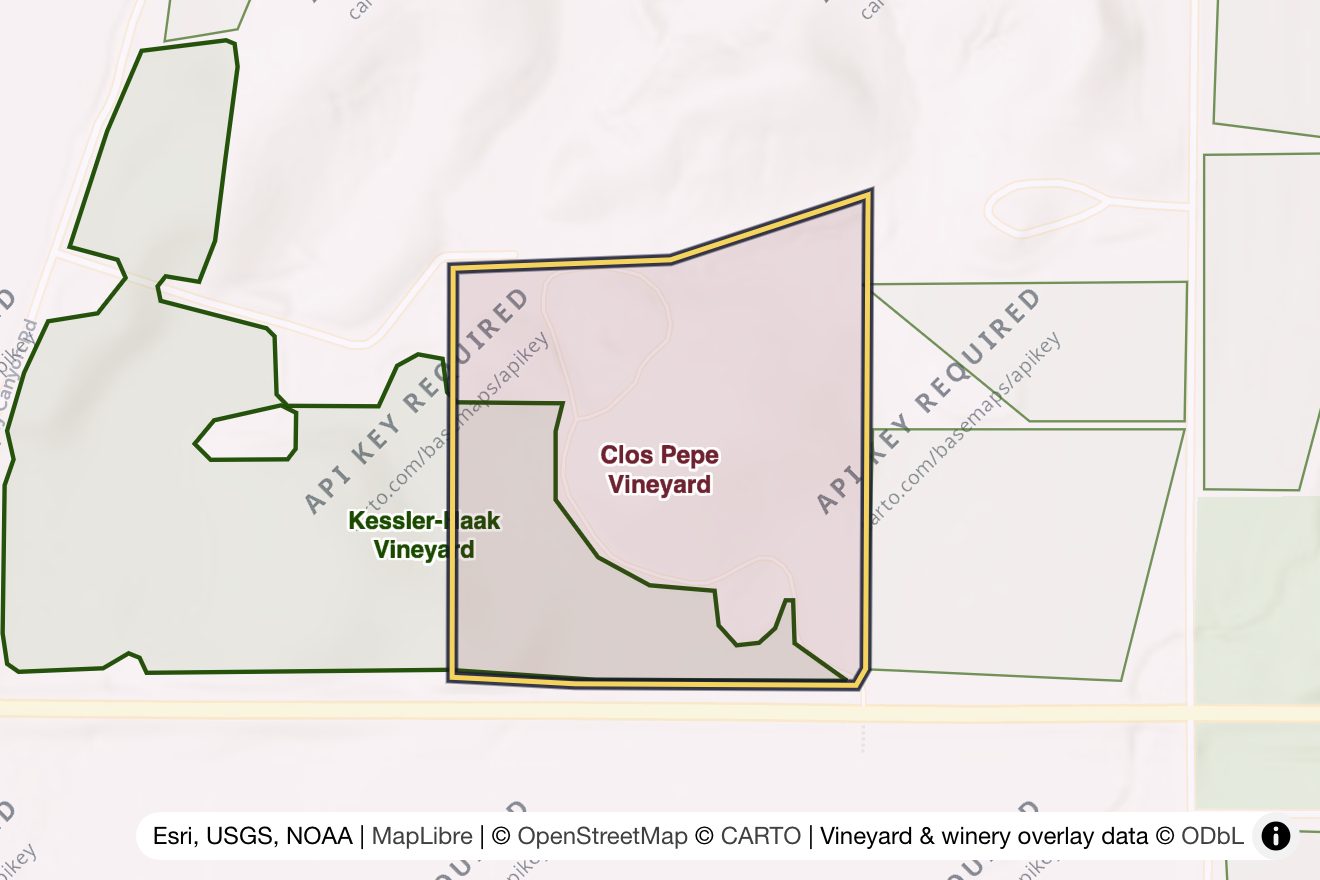
Between 25 and 29 acres of vines inside a roughly 40 acre parcel, about eight miles east of Lompoc in the middle of the appellation, with an olive orchard and the family house on the rest. The soils are sandy loam over the Miocene seabed, rich in calcareous shale and diatomaceous earth, low in vigour and given to small berries. No elevation figure for the site appears in any published source, which is a notable gap for a vineyard of this standing.
Vines and Blocks
Pinot Noir with a smaller planting of Chardonnay. The Pinot Noir is reported as roughly half Dijon 115 with the balance split between 667 and 777, and a Pommard block was added from 2008. Planting dates are given variously as 1994, matching the purchase, or across 1996 to 1998; sources do not agree. No named internal blocks are documented.
The Wines
For fifteen years the estate wines and a long list of designates carried the name: A.P. Vin and Roessler among those confirmed, with the wider Sta. Rita Hills trade buying here freely before 2014. Today the name survives commercially through one wine, WALT's Clos Pepe Pinot Noir, which has run through at least the 2024 vintage. That is an unusual afterlife for a vineyard whose founding family has left: the label is gone, the tasting room is closed, and the fruit is still famous.