History
The Bourn fortune came out of the Empire Mine in Grass Valley, the largest hard-rock mine in California; Sarah's maiden name, Chase, survives on the family label. The couple paid $15,000 for the property in 1872, a date the family and the Historic Vineyard Society both give, though Turley's copy says 1876. Their son William Bowers Bourn II built Greystone, the cooperative stone cellar north of town that now houses the Culinary Institute of America, in 1889, and their daughter Maud married William Alston Hayne, which is where the vineyard's name comes from. Phylloxera killed the first vines; Zinfandel went back in during 1902 and 1903 on resistant rootstock, and in 1953 Otty Hayne, home from college, added Petite Sirah. For over a century the family only sold grapes. Turley has bought fruit since its first vintage in 1993, and Chase Cellars, the family label founded by Andrew Simpson, debuted in 1998; Katie Hayne Simpson, great-great-granddaughter of the founders, has run it since 2012. Andy Beckstoffer bought a piece of the original property in 2010 and farms it separately as his 12-acre Bourn Vineyard.
The Site
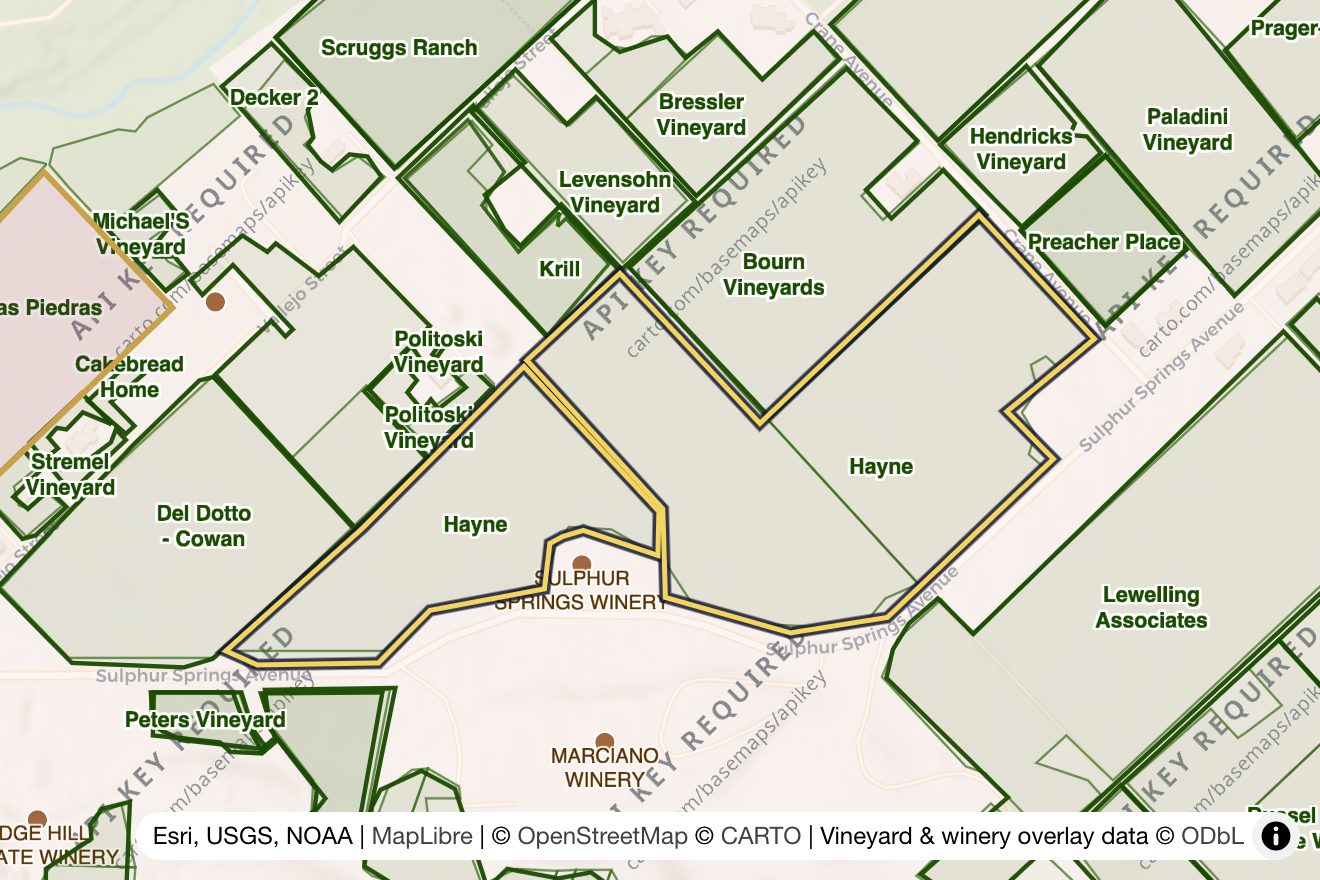
The vines sit at the foot of the Mayacamas, inside the St. Helena AVA, on an alluvial fan of gravelly Cortina-series loam, stony and fast-draining. Sulphur Canyon opens directly behind the property and pulls marine-cooled air across the rows earlier in the afternoon than the neighboring benchland receives it, the family's explanation for how a warm site holds this much acidity. Forty-five acres remain of the original 120, held as three 15-acre parcels by different members of the family.
Vines and Blocks
The 1902 and 1903 Zinfandel is head-trained, spur-pruned and dry-farmed; only establishing replants are watered, by hand. Roughly a quarter of the vineyard is younger vines propagated from the property's own budwood rather than nursery clones, and Chase picks and ferments old and young vines separately, splitting lots further by sun exposure. Interplanted Trousseau noir and Petite Syrah still ferment into Turley's Zinfandel in recent vintages, field-blend fashion. The 1953 Petite Sirah, recorded by the Historic Vineyard Society as nine rows in the property's Bourn section, is head-trained and dry-farmed like the old Zinfandel. A trellised Cabernet Sauvignon block went in across 1995 and 2002.
The Wines
Turley calls Hayne "the archetype for Zinfandel and Napa Valley" and treats it accordingly: native yeasts, 18 months in roughly 80% used barriques, mostly French, bottled unfined and unfiltered. It is among the few Zinfandels routinely cellared a decade or more; Vinous ran a complete 1993 to 2015 vertical in 2018. The Hayne Petite Syrah is powerful and inky young and typically needs years in bottle to unwind. Nickel & Nickel bottles a St. Helena Cabernet designate from the younger block, Cathy Corison also takes Cabernet, and Carlisle's short run of Hayne Zinfandel ended with the 2014. Chase's own range splits CHASE varietal bottlings, led by the Heritage Vine Zinfandel, from BOURN blends, with Russell Bevan the winemaker since 2014.