History
Rocco and Lodovina Morisoli, Italian-Swiss immigrants, began farming in Rutherford in 1902 and the family has worked the ground by hand ever since, now into its fifth generation. For most of that time they sold fruit rather than making wine, to Robert Biale, Elyse and Amici among others. Fifth-generation Chris Morisoli launched the family's own label with the 2018 vintage, with former Beaulieu winemaker Joel Aiken making it.
The Site
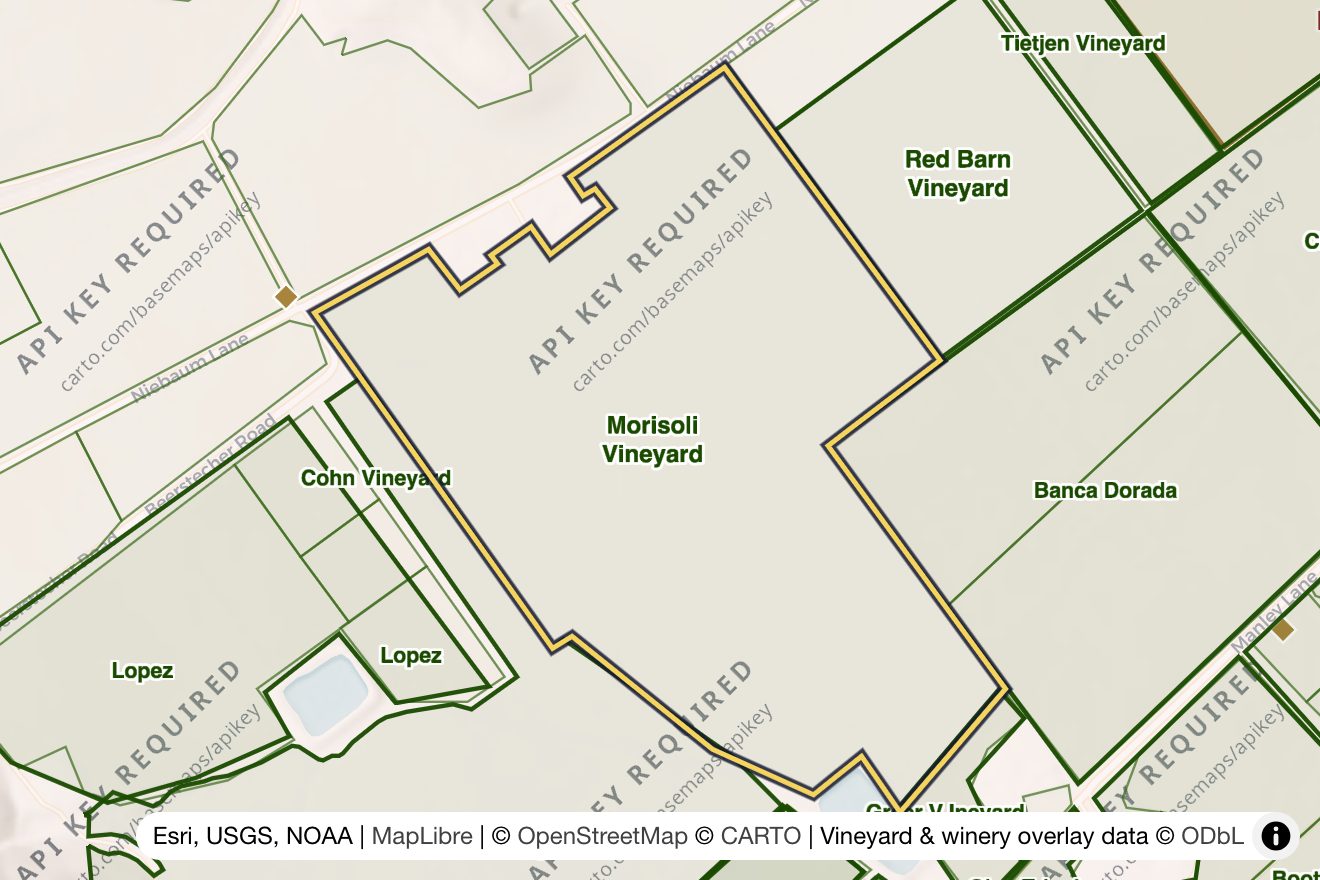
Fifty-three acres of planted vines less than a mile west of Highway 29 along Niebaum and Manley lanes in Rutherford, on a gentle fan at 150 to 200 feet at the base of Mount St. John. Inglenook lies to the north, Scarecrow to the west and Joseph Phelps to the east, with Staglin in the same neighbourhood. The soils are deeply layered gravelly Bale clay loam and Pleasanton loam, and their high subsurface gravel content is the conventional explanation for the fine cocoa-powder tannin the district calls Rutherford dust.
Vines and Blocks
Plinio's Block, an isolated acre and a half to two acres on a gravelly rise, was planted in the early 1900s and is named for Chris Morisoli's great-grandfather Plinio and is among the oldest producing ground in Rutherford. Jean-Michel Boursiquot identified its nine varieties: predominantly Zinfandel interplanted with Alicante Bouschet, Carignan, Durif, Grand Noir, Muscat Hamburg, Negrette, Syrah and Valdiguie, head-trained and dry-farmed on St. George at about two tons per acre. The remaining acreage is Cabernet Sauvignon in long bench rows, with the buying wineries' names painted on tractor disc blades welded to the end posts. The family rejects chemical weed control and turns its cover crops with a 1934 Cletrac crawler and a vintage plough.
The Wines
The Cabernet is the textural Rutherford archetype, plush through the middle and finishing on fine dusty tannin. Elyse's bottling from Plinio's Block is dark, brambly and peppery, carrying the field blend's mixed genetics rather than a varietal profile.