History
Zinfandel and Riesling went in during the 1880s, planted by Charles Nathan Pickett and Jackson G. Randall, and Cabernet Sauvignon followed in 1964 on St. George rootstock. Paul Draper made the Ridge bottling, Conn Creek made the 1974, and Joseph Phelps issued an Eisele designate from 1975 through 1991. The Eiseles sold to William Farley in 1989, and Bart and Daphne Araujo bought from Farley in 1990 and let Phelps take one last crop, so that 1991 produced both the final Phelps Eisele and the first estate wine. The Araujos replanted most of the vineyard through the 1990s, went organic in 1998 and biodynamic in 2000, and worked with Tony Soter, Mia Klein and Francoise Peschon in the cellar. Artemis Domaines, the Pinault holding that owns Chateau Latour, bought the estate in July 2013 and retired the Araujo name in 2016. Helene Mingot has made the wine since.
The Site
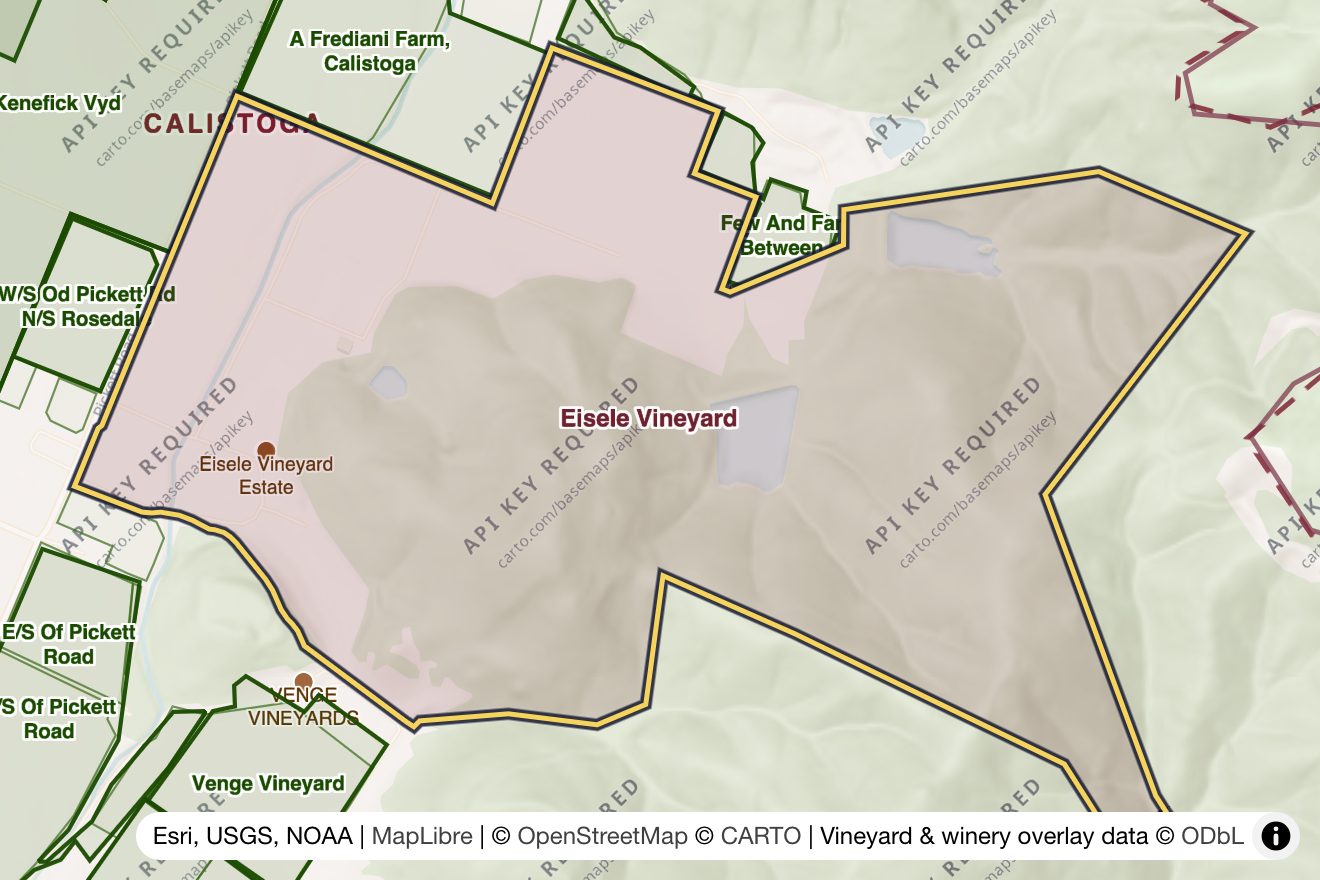
The property covers 162 acres on Pickett Road at the northeastern edge of Calistoga, 38 of them in vineyard. The ground is an alluvial fan of cobbly volcanic wash off the Palisades, shallow over rounded stone and laid down by Simmons Creek, which bisects the estate, and by a tributary from the east; at its eastern edge it turns to clay-rich volcanic hillside. The Palisades shelter the vineyard from the north, while westerly air drawn through the Chalk Hill Gap cools the afternoons. Farming is CCOF organic and Demeter biodynamic, and part of the Cabernet is dry-farmed.
Vines and Blocks
Cabernet Sauvignon takes roughly three-quarters of the plantings, with Cabernet Franc, Petit Verdot and Merlot beside it and Sauvignon Blanc on eastern parcels of deep clay and north-facing slope. The estate counts thirteen blocks and more than forty sub-blocks, renamed from numbers to landmarks, and its harvest notes make the names legible. Paloma, at the heart of the fan, ripens first; Olivos comes in late; Jardin and Piedras on the volcanic hillside close the picking; and Coyote, rested fallow for more than six years, holds the youngest vines. Average vine age stood at twenty-seven years for the 2019 Cabernet. The Syrah dates to a 1978 planting grafted over to Cabernet in 1986, though about a hundred vines refused the graft and kept bearing Syrah, bottled in 1991 and 1993; the planting was expanded afterwards and an Alban selection added in 2007. Frediani, the neighbouring ranch bought in February 2023 with 21 planted acres, is a block name as well.
The Wines
The Cabernet is built around the parcels bordering Simmons Creek, which the estate calls the heart of the vineyard. It has been a straight varietal of late, spending eighteen to twenty-one months in French barriques along with a share of Austrian oak foudre, seven percent in 2019 and forty-five in 2020. Production reached 875 cases in 2020, the smallest since the replanting, against 1,950 in 2019. Altagracia, made since 1999 from the eastern and hillside parcels, is the Bordeaux blend, and Piedras is a newer bottling drawn from the hillside alone. The Syrah runs to two or three hundred cases, part whole cluster and part amphora, while the Sauvignon Blanc is mostly Musque and spends a year on its lees in stainless steel, concrete eggs and oak.