History
Drew began in 2000 as a label without land, made in a Central Coast warehouse while Jason Drew, an Adelaide-trained enologist, worked at Babcock in the Sta. Rita Hills. The ridge-top property the couple bought in 2004 was a dry-farmed apple orchard planted in the 1960s and already farmed organically. The winery broke ground in June 2005 and crushed that autumn, but the vines waited six more years: roughly seven acres of Pinot Noir went in during 2011 with a token block of Chardonnay, and the first crop came in 2014. Early accounts call the property Drew Ranch and the first Pinot planting Blossom Tree; Faite de Mer Farm settled on it later, and the newest labels read simply Drew Estate.
The Site
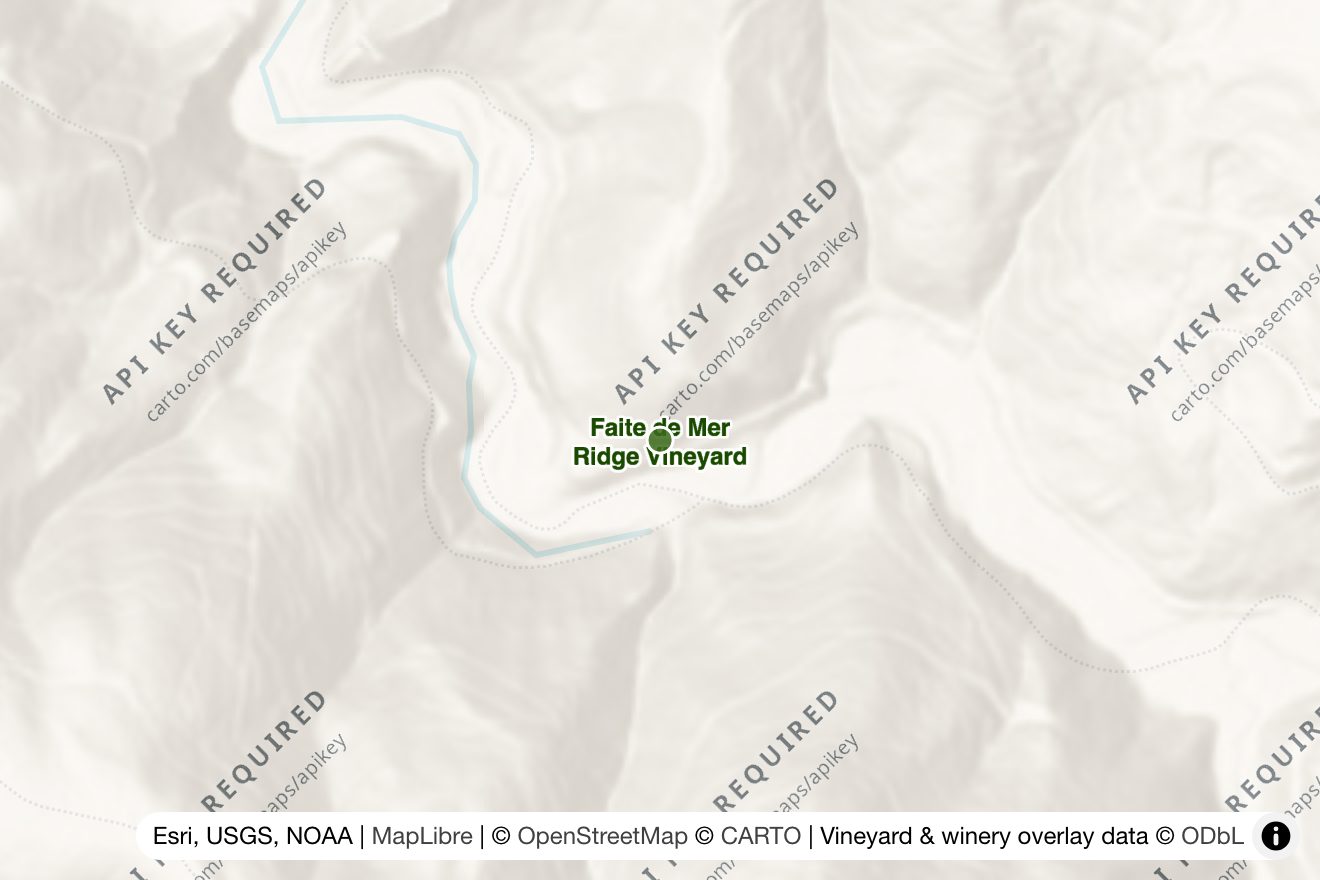
The vineyard lies on the northwestern flank of Greenwood Ridge above Elk, at 1,200 to 1,250 feet, which Drew calls the most westerly vineyard in Mendocino County. Mendocino Ridge, approved in 1997 and the only American appellation with a non-contiguous boundary, takes in land only at or above 1,200 feet, so these vines sit close to its floor. Height buys sunlight, since fog typically banks to 800 or 1,000 feet and leaves the vineyard above it, in the islands-in-the-sky pattern the appellation was drawn around. Three soil series of ocean-floor origin cross the property: Ornbaun, the darker and denser, sandstone-based with more clay, iron and shale, and the paler, sandier Zeni and Yellowhound, which carry radiolarian chert and milk quartz. The farm is certified organic and regenerative and much of it is dry-farmed, and wind at flowering, spring hail and rain at harvest are the standing risks here.
Vines and Blocks
About ten and a half acres are planted, up from the eight the winery published for years. Pinot Noir leads, in California heritage field selections, suitcase material alongside Dijon clones, so Pommard, Mount Eden, Calera, Swan and Dijon 38, 115, 667, 828 and 943 all appear across the bottlings. Chardonnay runs to roughly two and a half acres in Wente, Dijon 76 and 548. Smaller parcels went in at the end of the 2010s: an acre of Gamay, a Chenin Blanc test block and two-thirds of an acre of Syrah in four clones. No blocks carry formal names, and the divisions that matter are soil and selection.
The Wines
Drew alone bottles the site. Field Selections comes off the Ornbaun ground from the heritage and suitcase material, fermented on native yeast with a small whole-cluster fraction and raised eleven to eighteen months in French oak, twenty to thirty percent new. Radiolaria takes three blocks on the Zeni and Yellowhound soils in Dijon 943, 828 and 38, with a Chardonnay of the same name, and a lighter mid-slope parcel is bottled on its own as Mid Slope. Ocean proximity and that thin margin above the elevation floor give some of the leanest, coolest-toned wine the appellation offers, pale, red-fruited and firmly acid, carrying the savoury coastal-forest note of the ridge, which is why the couple planted here rather than inland. Ten to fourteen acres of 1960s apple trees and a truffle orchard remain, and the apples go into cider.