History
Hans and Theresia Kobler bought their Philo ranch in 1969 and planted in 1972, beginning with Pinot Noir and Gewurztraminer, with Riesling and Chardonnay added in later years, and they set the vines on phylloxera-resistant rootstock at a time when that was still treated locally as an experiment. The winery they founded, Lazy Creek, is often called the second oldest in Anderson Valley; the family sold it in 1999, and Ferrari-Carano bought the property in 2008. Norman Kobler grew up in those rows and went on to plant vineyards for other owners around the valley. In 2011 he planted this one for himself, on Kobler land rather than the old winery parcel, as a tribute to his parents and the Alsatian varieties they favored, and he named it for Vonarburg, his mother's maiden name. Arista has also bottled the fruit, and Ross Cobb's first vintage here, in 2016, was also the first wine he made from Anderson Valley under the Cobb label.
The Site
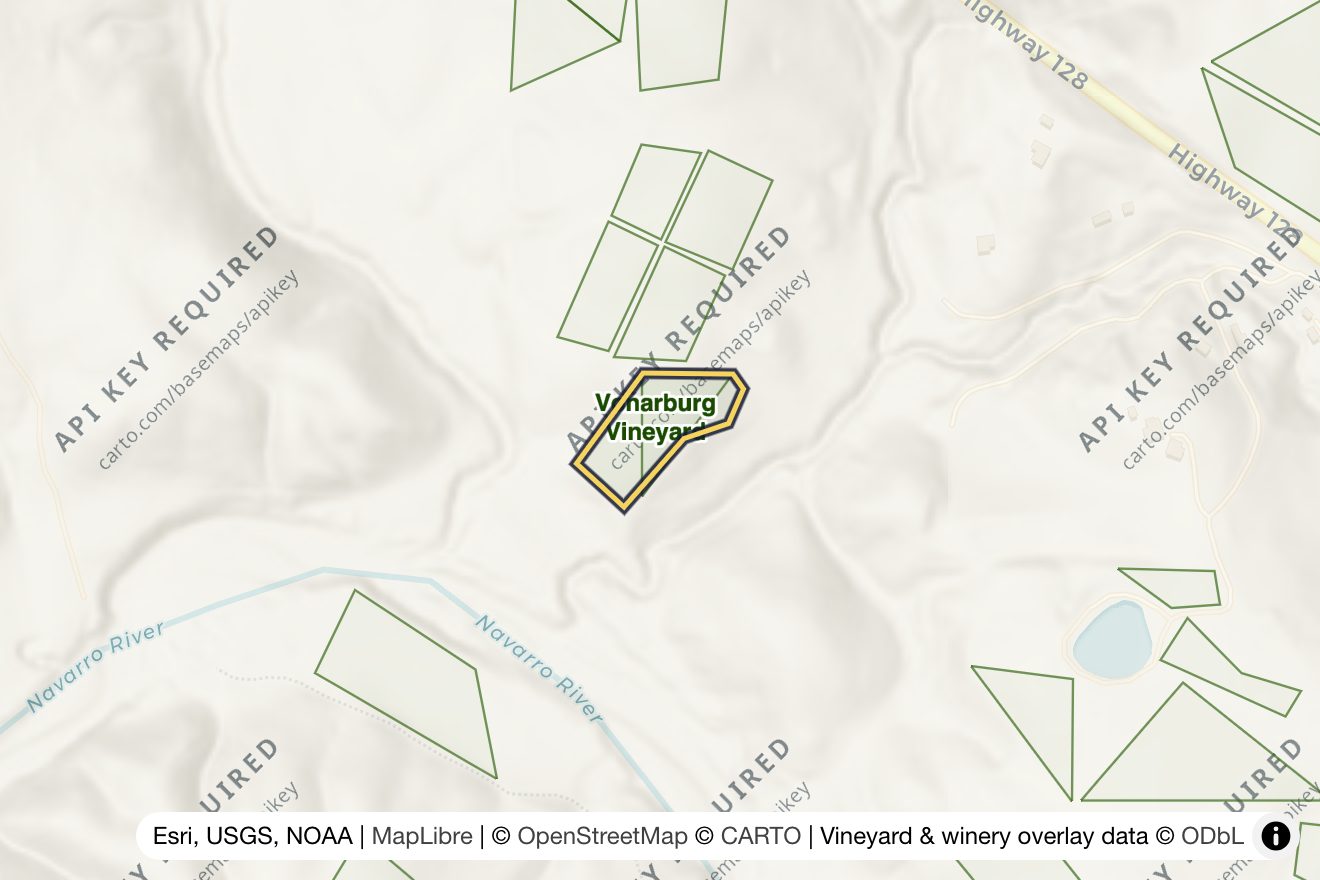
The planting sits at roughly 305 feet in the deep end, the northwestern reach of the valley where the Navarro River gap opens toward the coast and marine fog pushes furthest inland. The cold is a function of that corridor rather than of altitude, since this is low ground, and it means ripening runs slow while acidity survives the wait. The parcel is rolling hillside with very thin topsoil over fractured sandstone and slate, which drains hard and holds little, so the vines work for everything they get. The old Lazy Creek ranch lies close by, while Cobb describes the parcel as sitting alongside Roederer Estate land, with Twomey also nearby.
Vines and Blocks
The vineyard is Riesling only, in clones 17 and 23, with no block divisions worth the name on a parcel this size. Published acreage runs from Cobb's "barely two acres" to the 2.5 acres Reeve lists, and the mapped parcel measures 2.39. The 2011 planting date is worth restating, because producers and retailers keep describing the fruit as old vine: the vines are not yet twenty years old.
The Wines
Cobb, Reeve and Arista are the only three cellars to have made the wine, and they have taken one small crop in three different directions. Cobb ferments with native yeast in a mix of stainless steel and large neutral barrels, bottles the following spring, and finishes dry, at around 13 percent alcohol in 2020 and 2021. Reeve's is also fully dry, 12.9 percent in 2021, made with Ross Cobb and Katy Wilson alongside Noah Dorrance. Arista went the other way, leaving 46 grams per liter of residual sugar in its 2019 at 10.1 percent alcohol and calling the 2023 semi-dry; that 2023 was the last Riesling the winery made. The wine has appeared on lists at Michelin-starred restaurants including Atomix and SingleThread.