History
Al and Lynn Roman own the property. The vines went in during 1999, and Littorai has held a long-term lease over them rather than buying fruit by the ton. Prince of Pinot records the planted area as 1.87 acres, which is consistent with a 2022 crop of 1.24 tons to the acre and 110 cases in the cellar. Roman came comparatively late in Littorai's Anderson Valley history, since Ted Lemon had been working One Acre from 1993 and buying Savoy fruit since 1995, and published reviews of a Roman designate begin only with the 2005 vintage. The site has been farmed with organic materials since it was planted, without certification, and it converted to biodynamic method in 2008. Lemon has described putting sheep on Roman alongside the ground the winery owns.
The Site
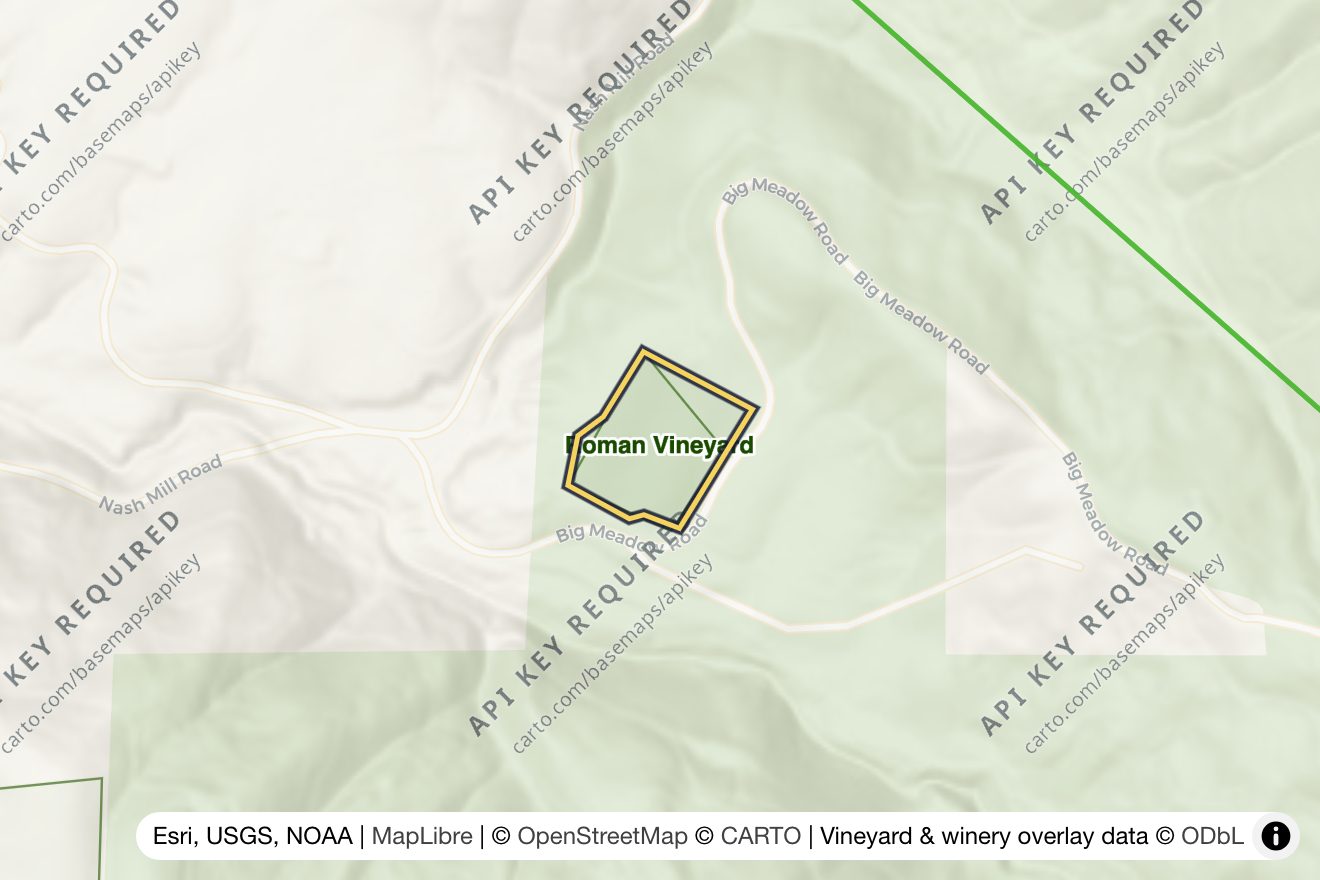
Littorai's technical notes place the vineyard 2.3 miles southeast of Navarro at 1,150 feet, on a saddle looking due south down the length of the valley, while the winery's website calls the same spot mid-valley. It is regularly placed near Boonville beside Littorai's One Acre, which is a separate hilltop at 1,600 feet and not a neighbour. The knoll breaks east and west as well as south, so exposure shifts across a very small parcel. It sits just above the fog line, which makes the cooling here a matter of wind rather than fog, with the coastal air funnelling up the valley to reach the site unbroken. The soil is Boont loam, roughly eighteen inches of sandy loam over soft sandstone, which Littorai calls typical of upland Anderson Valley and credits with stressing the vines. Yields are correspondingly small: Littorai publishes a ten-year average of 2.19 tons per acre, Prince of Pinot lists 2.48, and the cold spring of 2022 cut the crop to 1.24.
Vines and Blocks
The planting is Pinot Noir only, in Dijon 114 and 667 alongside a proprietary selection Littorai does not identify. No blocks are named, and at this size there is nothing to divide. The site runs late by any measure: in 2022 Roman reached full bloom between 20 and 25 June, a month behind Littorai's Sonoma Coast vineyards, and set the small thick-skinned shot berries whose high ratio of skin to juice concentrates the wine.
The Wines
Littorai alone bottles Roman, and scarcely at that: 110 cases in 2022, among the smallest of the winery's Anderson Valley designates. Lots that do not make the cut go into the Les Larmes Anderson Valley bottling, along with the press wine, which has been kept separate from free run since the 2001 vintage. Vinification follows the house pattern for designates, with native yeast, a whole-cluster proportion that rarely passes half, no extended maceration, and 14 to 17 months in French oak at roughly 20 to 25 percent new, much of it from Jacques Damy in Meursault. Littorai's note on the 2022 runs to citrus, leather, waxy tones, strawberry, tarragon and rosemary over wet rock and damp forest floor, and records that Roman often carries enough structure to need years of ageing, which shallow soil, constant wind and a small crop would predict.