History
The Kirschenmanns were among the German-Russian families who reached Lodi's east side by way of the Dakotas after 1897, the same migration that left the Schmiedt and Baumbach names on the ground around Victor, and a county history published in 1923 already listed a Theopold Kirschenmann among the district's successful vineyardists. The Zinfandel went in on its own roots in 1915, and Alan Kirschenmann farmed it until his death in 2004. Tegan and Olivia Passalacqua bought the twenty-acre property from Sandy Laskey, née Kirschenmann, in the spring of 2012. Passalacqua is head winemaker and vineyard manager at Turley Wine Cellars as well as the proprietor of Sandlands, and a standing agreement with Larry Turley kept the site off the Sandlands label for years, so that 2018 was the first Sandlands Zinfandel drawn entirely from his own ground.
The Site
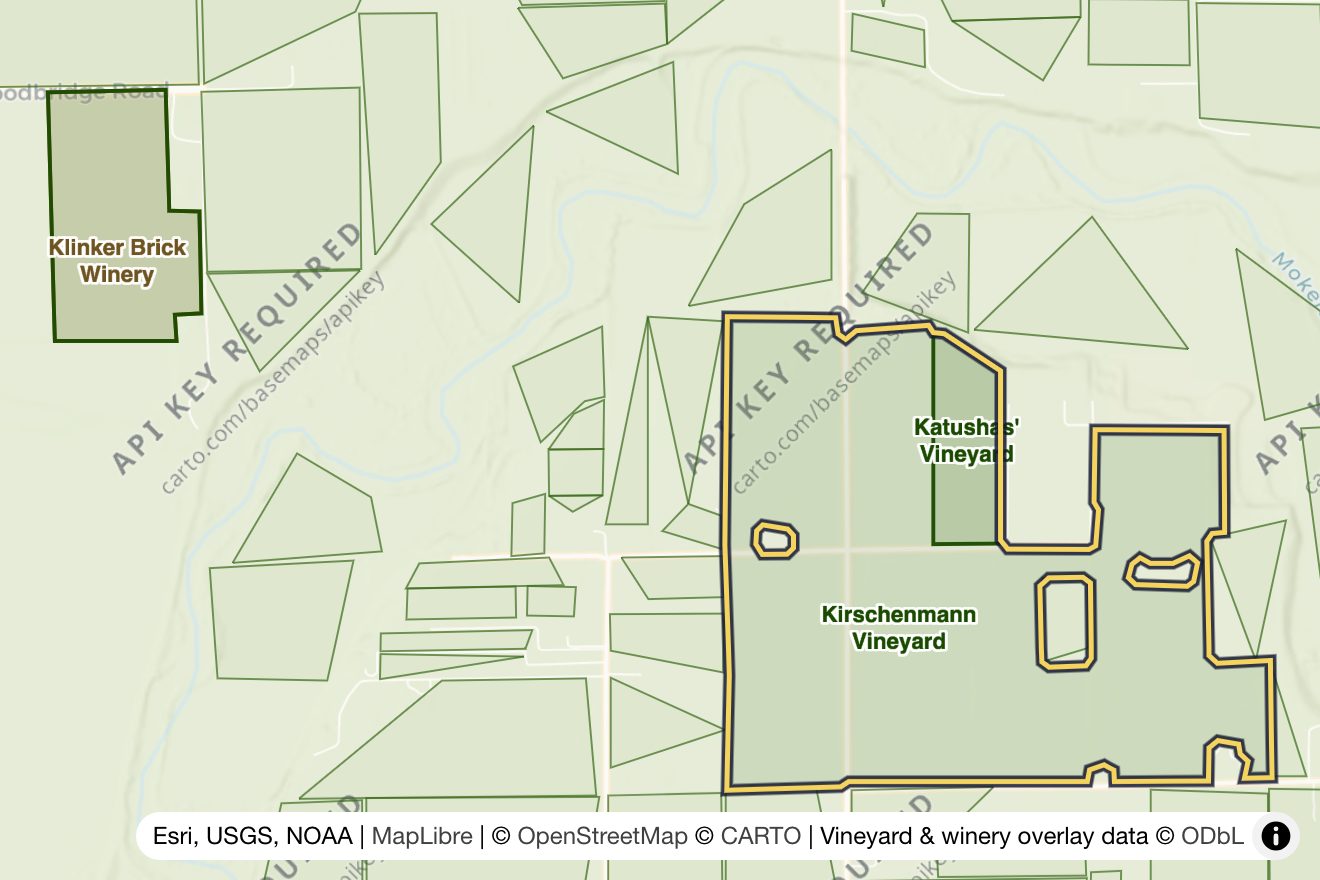
The vineyard lies just east of Bruella Road and south of Schmiedt Road, north of the hamlet of Victor in San Joaquin County, inside the Mokelumne River AVA at around 86 feet. The river strikes bedrock here and turns back on itself in a U, so water wraps the parcel on three sides and holds it a degree or two cooler than the ground around it. The soil is Tokay fine sandy loam, granitic sand carried down out of the Sierra, and sand of that depth is the reason the vines were never grafted, since phylloxera moves poorly through it. While digging a well, Passalacqua turned up a ribbon of chalky, limestone-like material about four feet down, a detail the soil classification does not carry. The old vines are dry-farmed, and the site is certified under LODI RULES.
Vines and Blocks
The 1915 planting is head-trained and own-rooted, and published accounts of its extent run from fifteen to nineteen acres inside the twenty-acre property. It was laid out as a field blend, with Carignane, Cinsault and Mondeuse Noire through the Zinfandel, and Alicante Bouschet and Grand Noir de la Calmette are recorded here as well. Passalacqua has added rather than replaced: the property already carried trellised Pinot Gris, and he has since put in an acre of grafted Cinsault and grafted Chenin Blanc, along with three rows grafted to Green Hungarian, Lignan Blanc and Grec Rouge, enough for a single barrel. No blocks are named.
The Wines
The 2012 crop, the first under the new ownership, went to five wineries: Turley, Bedrock, Carlisle, Arnot-Roberts and Newsome Harlow. Turley, Arnot-Roberts and Precedent bottle a vineyard-designated Kirschenmann now, and Bedrock has also done so, the Sandlands fruit goes into a wine labelled simply Lodi Zinfandel, and Scholium Project has also made wine here. Arnot-Roberts takes roughly a ton, two or three barrels' worth. Sandlands' Kirschenbloom rosé, 68 percent Zinfandel and 32 percent Cinsault in 2024, comes entirely from the site and puns on a family name that means cherry man in German. The house character is perfumed and silken rather than heavy, running to cherry, tea and licorice, over an acidity that complicates what Lodi is assumed to taste like.