History
Morgan Twain-Peterson MW and his Bedrock partner Chris Cottrell were at Kirschenmann, across Schmiedt Road, when they noticed a for-sale sign on the block opposite them. A driver pulled up and told them he had an offer in and meant to pull the old vines for walnuts. Bedrock offered within four days and closed three days later on the first vineyard the label owned outright, though the fruit was still contracted to Manna Vineyards for the 2014 harvest. The name records the timing, since the offer was accepted the day before Mother's Day. Katusha was Twain-Peterson's stepmother's mother, who emigrated from Ukraine, and his own mother was born Katherine, the English form of the same name. The plural possessive is the point, though the name is often written as a singular. The vineyard is registered with the Historic Vineyard Society.
The Site
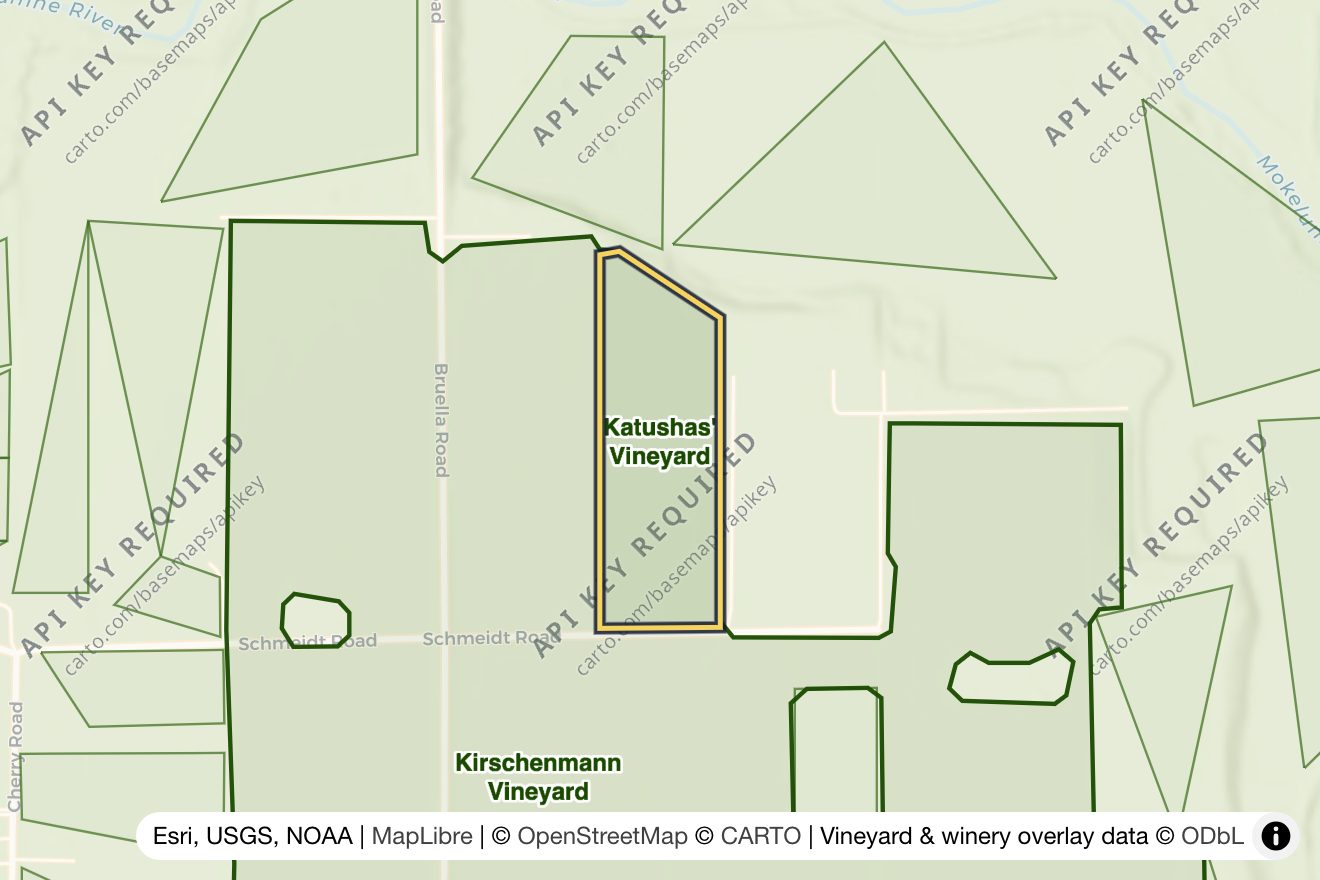
The ten acres lie just north of Victor in San Joaquin County, in the Mokelumne River AVA inside Lodi, on Tokay fine sandy loam. That series was renamed from Hanford around 1990 for the Flame Tokay it had grown for a century, and it is pulverised granite mixed with loam, as much as ninety feet deep and quick to drain. Sand is one of the few media phylloxera cannot work in, which is why the appellation still carries thousands of acres of ungrafted vines. The block sits in what growers call the Victor Triangle, an unofficial pocket on the east side of the AVA, sandier than the rest, with lower water tables and smaller berries than the loamier ground west of it. Rauser lies immediately to the west and Kirschenmann across the road, and the cooling comes from afternoon air off the Sacramento delta and the river.
Vines and Blocks
The planting is predominantly own-rooted, head-trained Zinfandel, some seven and a half acres of it at purchase, interplanted with Carignan and a few Flame Tokay vines left from the table-grape era. Published accounts give 1915, with one putting the planting between 1915 and 1920. It arrived furrow-irrigated and badly pruned, carrying eutypa, nematodes, missing vines and invasive grasses. Bedrock converted it to subsurface irrigation, pruned by hand to strip dead wood, halved the spur positions and reshaped the vines toward goblet heads on single crowns, then spread close to a hundred tons of compost and dolomitic lime against the decline in soil pH left by cheap nitrogen fertiliser. Cover crops, insectary flowers, released predatory insects and minimal tillage followed, and the Merced rye grows tall enough by late spring to dwarf the vines before it is crimped flat as a mulch. Shoot length and vigour responded within two years. No blocks are named.
The Wines
Bedrock bottles the vineyard under its own name and also draws on it for the Old Vine Zinfandel blend. The designate is Zinfandel alone, fermented on native yeast and raised around nine months, largely in neutral large-format wood, at about 14.5 percent in recent vintages. It reads red rather than black, running to raspberry and wild plum, pepper and dried herb, with a stony edge and firm acidity: the east side of the Mokelumne doing what growers say it does against the loamier ground west of the railroad tracks.