History
The land came to Gary Franscioni through his mother's side of the family, which had held it since the 1950s, and it was grazed rather than farmed until the vineyard went in from 2007, with planting continuing through 2009 as the varieties were filled out. Where Rosella's was named for his wife and Garys' for the two men who built it, Sierra Mar was named for what the site is: mountain and sea. It is the southernmost of the Franscioni vineyards and the last of them to be planted. The estate is SIP certified.
The Site
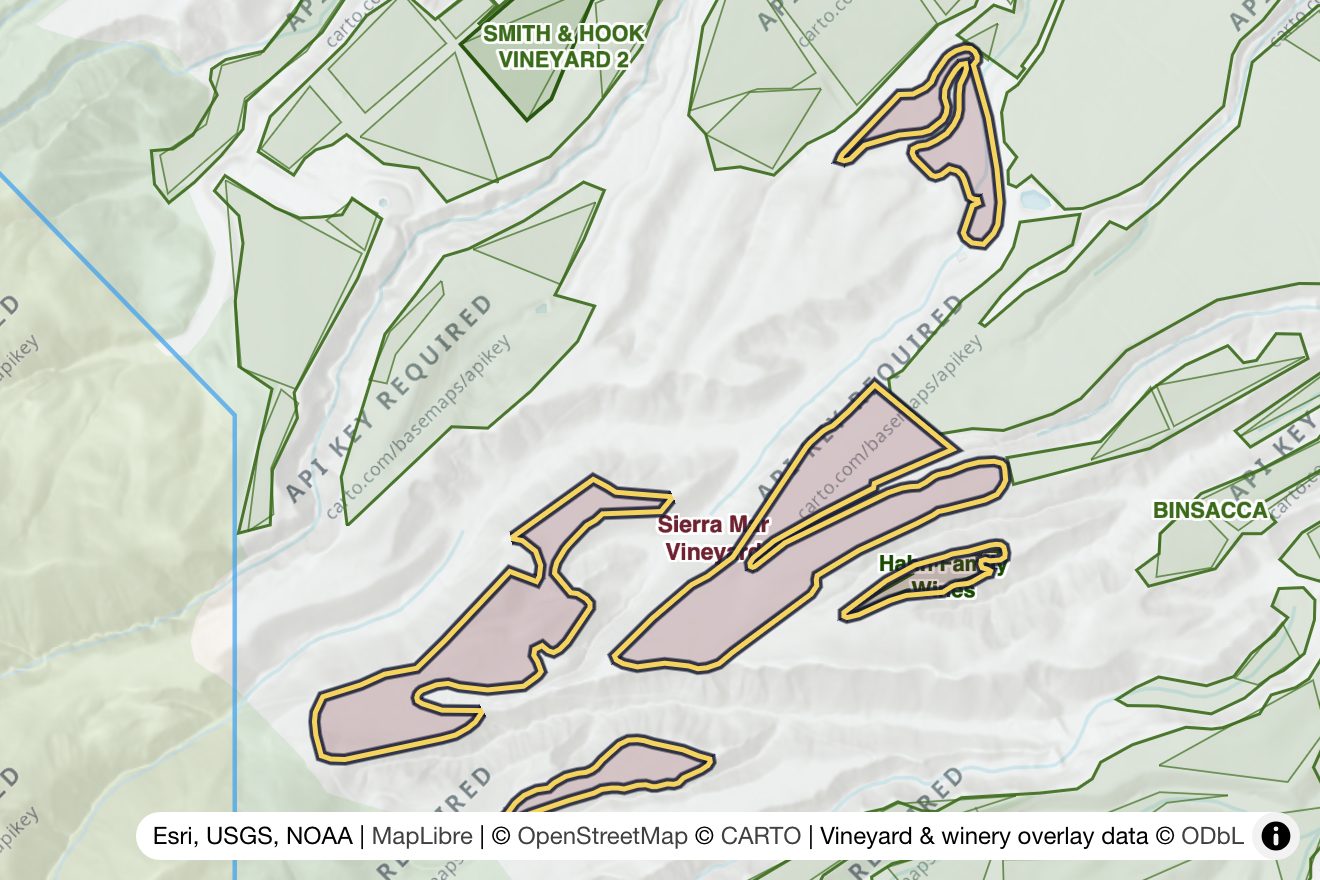
About 47 acres of vines sit between 550 and 1,170 feet, roughly three times the ceiling of the bench vineyards to the north, which top out near 400. The terrain is steep fingers of mountain broken into what ROAR counts as eight mesas, each planted separately, and the soil is thin gravelly loam over decomposed granite rather than the Arroyo Seco sandy loam of the bench. Exposures differ mesa by mesa, and published descriptions of the site's aspect contradict each other for that reason. Height puts the vineyard at or above the morning fog, which gives warmer days and colder nights than the fog-bound sites north of it, an earlier harvest and a darker fruit profile. Carlisle, which buys here and at Rosella's eight miles north, calls it the warmer of the two and still a cool site.
Vines and Blocks
Five varieties are planted to suit the range of microclimates across the mesas: Pinot Noir at roughly 35 acres, Chardonnay making up most of the rest, and small parcels of Syrah, Grenache and Viognier. The Pinot draws on the Pisoni selection alongside Calera, Swan and clones 667 and 943, with Pommard, 23, 777 and 828 appearing in individual buyers' blocks; the Chardonnay runs Hyde, Wente, Monty and Dijon 95 and 96; the Syrah and Grenache are Alban material. The mesas are farmed as distinct blocks but are not individually named in any published source.
The Wines
ROAR bottles across the range, including Grenache and Viognier that exist almost nowhere else in the appellation. Miner has made a Sierra Mar Pinot Noir since 2010, and Testarossa, Bernardus, Siduri, Carlisle, WALT and Red Stitch all take fruit. The wines are the appellation's dark end: riper and deeper than the bench sites, held together by the acidity that the altitude and the cold nights preserve.