History
The 1973 planting predates the appellation by nineteen years. The Santa Lucia Highlands AVA was established by T.D. ATF-321, published on 15 May 1992, on a petition from Barry Jackson of the Harmony Wine Company, and the 1991 date usually quoted is the proposed rule rather than the final one. McIntyre bought in after a spell at neighbouring Hahn, and co-owns Monterey Pacific, a vineyard-management company reported at 11,000 to 16,000 farmed acres depending on the account; by his own reckoning he has planted more than a fifth of the appellation and farmed close to a third of it. He helped found the Central Coast Vineyard Team's Sustainability in Practice programme, and this estate was among the first in the Highlands certified under it. The estate label began with the 2005 vintage, Byron Kosuge making the wines. McIntyre's own account credits a 1979 Pinot Noir from this fruit, bottled under the Stony Hill label, as one of the district's finest early varietal Pinots, a claim that traces no further than the estate.
The Site
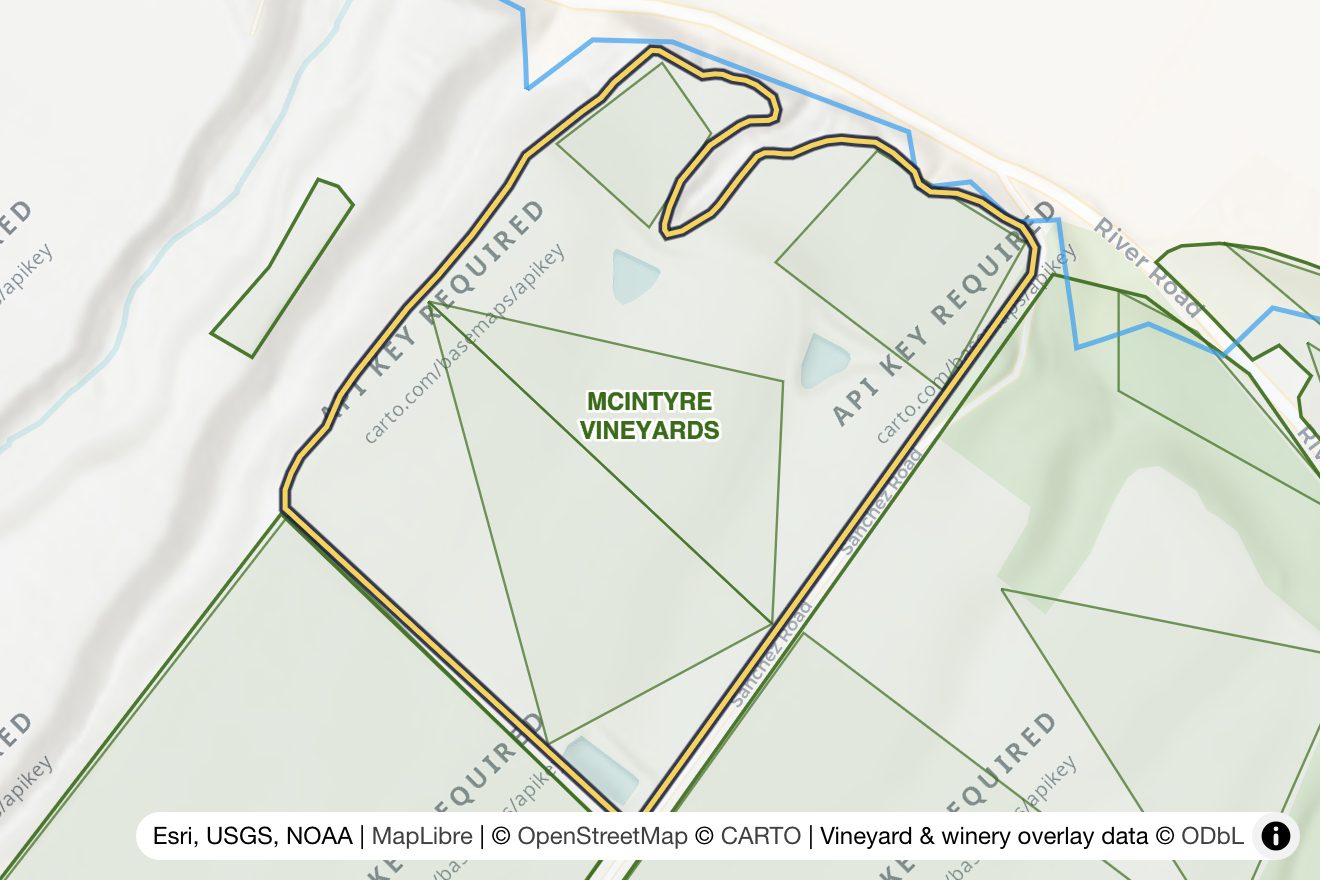
Sixty of the eighty acres are planted, in the central stretch of the appellation, on the east-facing bench that runs a dozen miles along the foot of the Santa Lucia range. The soil is Chualar loam, granitic alluvium shed off the mountains and terraced above the valley, the appellation's dominant type. No elevation figure is published for the site, but the bench here stands one to two hundred feet above the Salinas River floor rather than up in the hills, so the morning fog and the afternoon wind off Monterey Bay run straight up the valley into the vines, drawing the season out. Farming is SIP certified and moving toward regenerative practice, the rows run mostly north to south, and the crop is thinned to no more than three tons an acre.
Vines and Blocks
The sixty planted acres divide into thirty-seven of own-rooted Pinot Noir from 1973, ten of Pinot Noir in Dijon 115 and 777, and thirteen of Chardonnay in Dijon 76 and 96. The old material is described only as a heritage selection and no source identifies it further. It predates the Dijon clones that now define the appellation, and having never been grafted it sits on no rootstock at all, unusual for a California block of this age and size. One account adds Swan selection alongside the 777. The 1973 vines are trained to a lyre trellis and the later blocks to vertical shoot positioning. Blocks are numbered rather than named, and Block 3 and the old-vine parcel are the two that reach a label.
The Wines
About fifteen acres are held back for the estate label, which takes in Chardonnay, Pinot Noir in old-vine and single-block bottlings, a rosé off the 1973 vines and a méthode champenoise sparkling, L'Homme Qui Ris. Morgan has bought here since 2006 and makes both a Pinot Noir and a Chardonnay, while De Tierra, Joullian and La Rochelle have bought historically, and Sostener, a joint venture between McIntyre and the grower Michael Thomas, draws on the own-rooted fruit. Since 2019 a Winemaker Series has given a block each to Don Van Staaveren, Sabrine Rodems and Kosuge to pick and vinify as they choose.