History
The first crop came in 2007, a few barrels off three-year-old vines. Cold air pooling in the upper of the two Chardonnay sections cost the 2008 crop and pushed the first Horseshoe Chardonnay to 2009. By that vintage Horseshoe was the largest Rhys bottling, and 2009 was also the year Rhys stopped buying fruit and put the Alesia label on hiatus; Alesia returned in 2011 and became an estate-fruit appellation line in 2016; those appellation wines now carry the Rhys name. Chenin Blanc replaced a Carricante nursery block in 2018; 3.5 acres of high-density Pinot Noir followed on the rocky eastern slope by 2019.
The Site
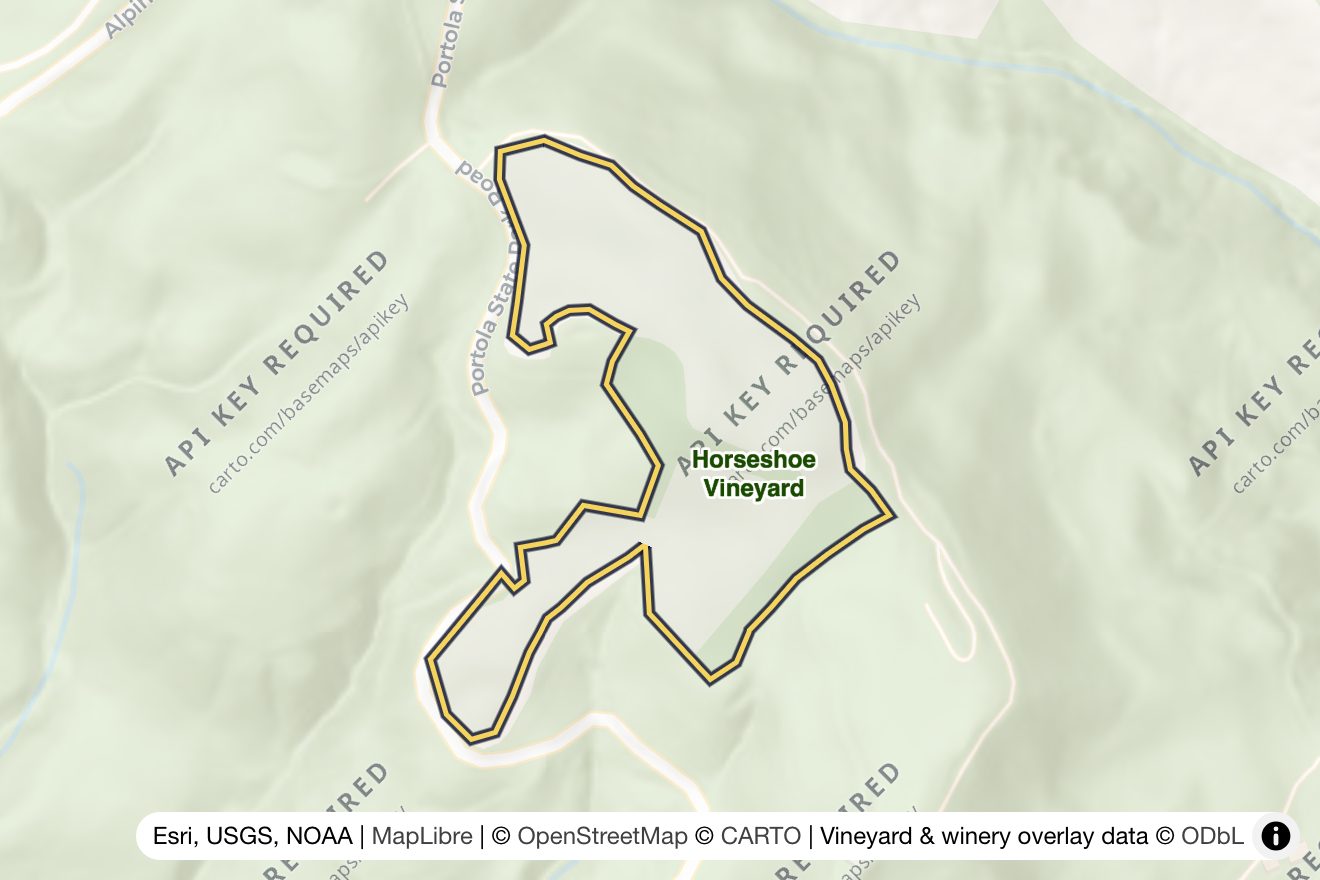
Rhys counts 21.21 acres under vine inside a 67.7 acre property; the mapped footprint traces nearer 24. Elevation runs 1,360 to 1,610 feet, aspect south and east, the Pacific ten miles west. The ground reads as two gently sloping plateaus, one near 1,400 feet and one near 1,600, joined by a steep south-facing hillside, with a ridge toward Alpine blunting the direct marine influence. The rock is rust-mottled diatomaceous Monterey shale with interbedded limestone, fractured enough for roots to work through, weathering to fine pink clay and shards of white bedrock under about twenty inches of topsoil. Farming is organic and dry, spacing six feet by four down to three by two, blocks half an acre to nine tenths.
Vines and Blocks
Pinot Noir covers 14.54 acres, Chardonnay 3.59 and Chenin Blanc half an acre, alongside 2.58 acres of Syrah. More than twenty blocks divide the upper plateau, mostly Pinot Noir on gentle east and south exposures and the backbone of the vineyard bottling, plus an acre of south-facing Syrah and a late-ripening west-facing Pinot. The steep hillside between the plateaus gives some of the best wine on the property; the lower plateau holds the principal Chardonnay and the Syrah block Rhys calls the cheeseblock. The Pinot Noir is Rhys's own massale, selected on this ground; the Chardonnay runs Wente, Old Wente, Mount Eden and Hyde heritage selections, the Syrah Alban, Chave and Noir, the Chenin clone 982. Two acres of previously unplanted hillside carry ungrafted Pinot Noir at very high density; nurseries declined to root the cuttings, so Rhys built its own sand-filled rooting boxes. Those vines cropped so lightly that a 2014 wine went unreleased and 2018 made two barrels.
The Wines
Fruit goes to the gravity-flow cave winery at Skyline: native yeast, foot punchdowns, whole clusters in a share that moves with the vintage, no fining or filtration. Rhys makes its terroir argument with Chardonnay: Alpine, same material and same farming, comes out piercing and saline where Horseshoe opens on jasmine and wet rock. Horseshoe Hillside is a barrel selection rather than a parcel, four to eight barrels drawn only in exceptional vintages from the steepest, lowest-yielding blocks; barrels that miss the single-vineyard cut feed the Santa Cruz Mountains appellation bottlings, the first of them a 2009 Pinot Noir blended with Alpine.