History
Dr. George Selleck was a wine connoisseur and a friend of Josh Jensen's father; Jensen tasted the great wines of the world at Selleck's dinners from his teens onward. Jensen took a Yale degree and an Oxford master's, then picked the 1970 harvest at Domaine de la Romanée-Conti and worked at Domaine Dujac and Château-Grillet. His Burgundian mentors insisted that serious Pinot Noir required limestone, and he spent two years hunting for it before finding Mount Harlan in 1974, a property then without paved road or electricity. The first 24 acres went in during 1975 as three named parcels in the Burgundian manner: Jensen, the largest at 14 acres, for his father; Reed for Bill Reed, the only original non-family investor; and Selleck for the mentor. The 1978 debut came to 65 cases across the trio, 15 of them Selleck. Duckhorn bought Calera in August 2017; Mike Waller, at the winery since 2007, has been sole winemaker since Jensen's death in June 2022.
The Site
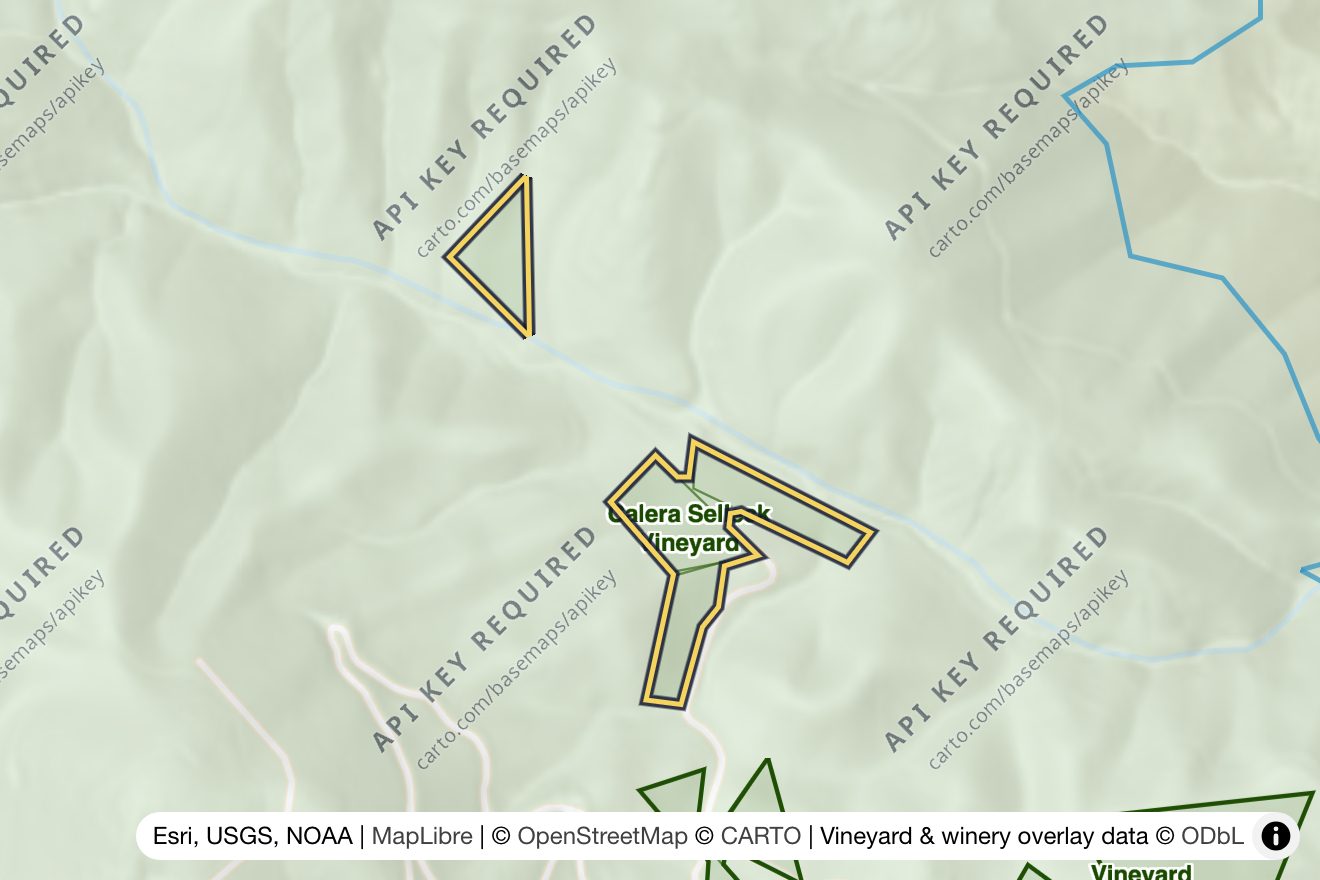
About 4.8 acres in a steep, rocky, southwest-facing pocket at roughly 2,200 feet, on shattered limestone shed from one of California's larger deposits of the pure rock; the kiln that once burned it gave the winery its name, calera being Spanish for limekiln. Mount Harlan is a 3,274-foot peak in the Gavilan range of San Benito County, about 25 miles east of Monterey Bay, close enough that marine air keeps these among the highest and coolest vineyards in California. The Mt. Harlan AVA, approved in 1990 with an 1,800-foot minimum elevation, holds exactly one winery. The estate has farmed CCOF-certified organic since 2008; yields rarely reach two tons per acre anywhere on the mountain, and Selleck ran leaner still, averaging 1.34 tons per acre from 1982 through 2010.
Vines and Blocks
Selleck has been a single small block of Pinot Noir since 1975. Those original vines are gone; as of early 2026 the replanted rootstock stood ungrafted, with budding over to Pinot Noir planned for that spring. The scion wood is the Calera selection, descended from the cuttings Jensen carried home from Burgundy: legend places their source at Romanée-Conti, a claim Jensen never confirmed, and a rival account routes the material through nearby Chalone. No new fruit is expected until the grafted vines mature, so the designate's status is transitional rather than settled.
The Wines
Before the replant, Selleck was regarded as the most brooding and mineral of the six Mount Harlan crus and the one that asked the most patience; older accounts credit its exposure with an extra dimension of richness among the designates. The winemaking passed from Jensen to Waller intact: whole-cluster fermentation on native yeasts over about two weeks, roughly 30 percent new French oak for 18 months, and bottling without racking, everything moved by gravity through the winery Jensen built into a 1950s rock-crushing plant on Cienega Road. Quantities are small, 381 cases in the 2010 vintage, and recent vintages continue to move through the winery's club while the new vines take hold. Robert Parker's verdict on the estate, "California's Romanée-Conti", rested on verticals of these crus.